Inspiration for local low carbon adventures in Europe: Travelling by train, bike, walking, kayak and other alternatives. From micro-adventures to big adventures. Most trips are focused around our hometown Brussels, but can certainly be reached or done from other locations as well.
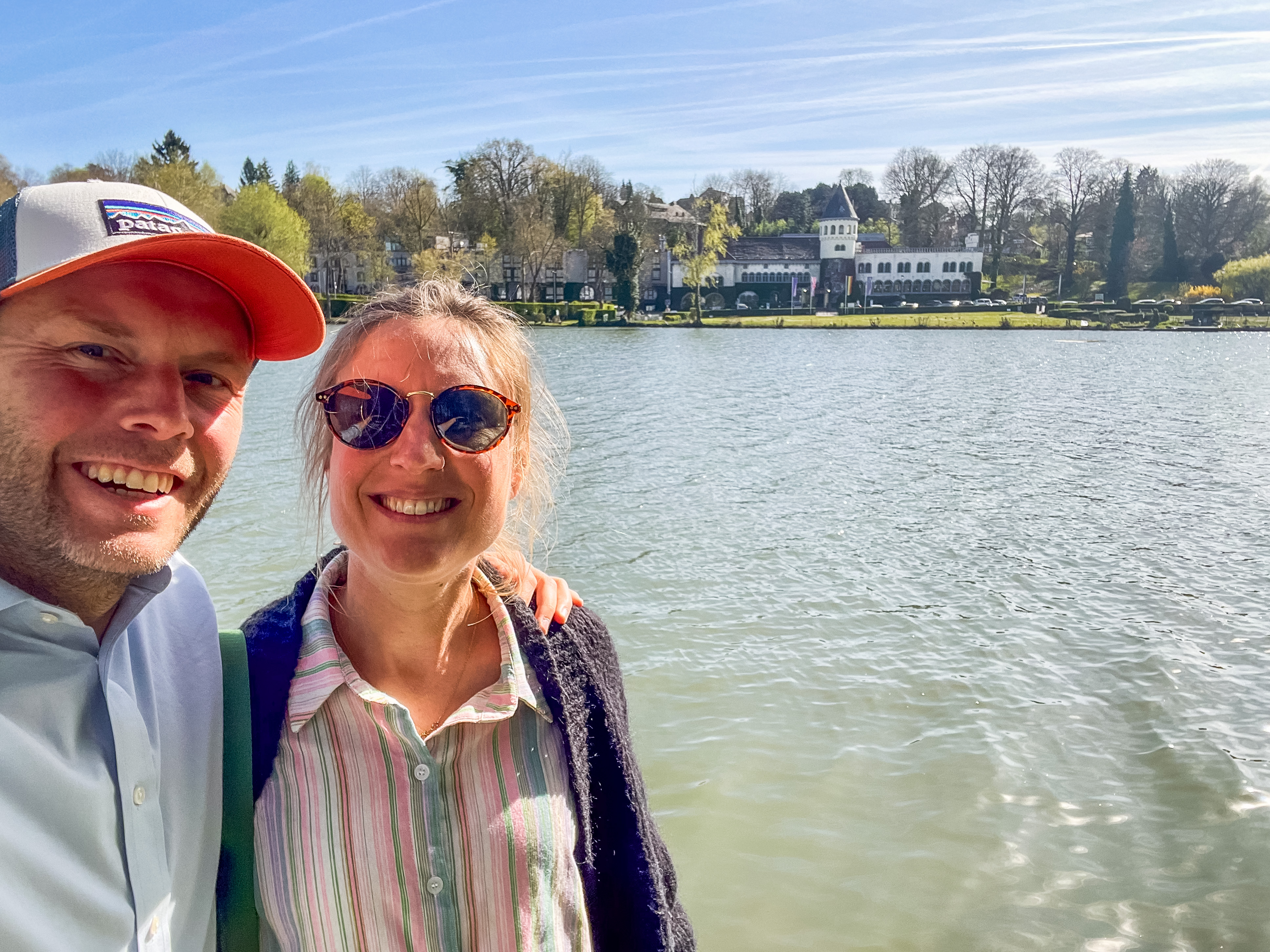
Looking for a quick family-friendly escape close to Brussels that’s both sustainable and full of adventure? For my birthday, my (very pregnant!) wife surprised me with a weekend at Lac de Genval—the perfect blend of slow travel, nature, and fun activities accessible for both big and small explorers.
Getting There the Green Way
Train: Hop on the direct train from Brussels North or Brussels Luxemburg station for a stress-free, low-carbon journey.
Bike: Feeling energetic? Cycle through the beautiful Sonian Forest for a scenic and eco-friendly route the kids will love. The trip takes between 1 and 1.5 hours from Brussels depending on where you start
What to Do at Lake Genval
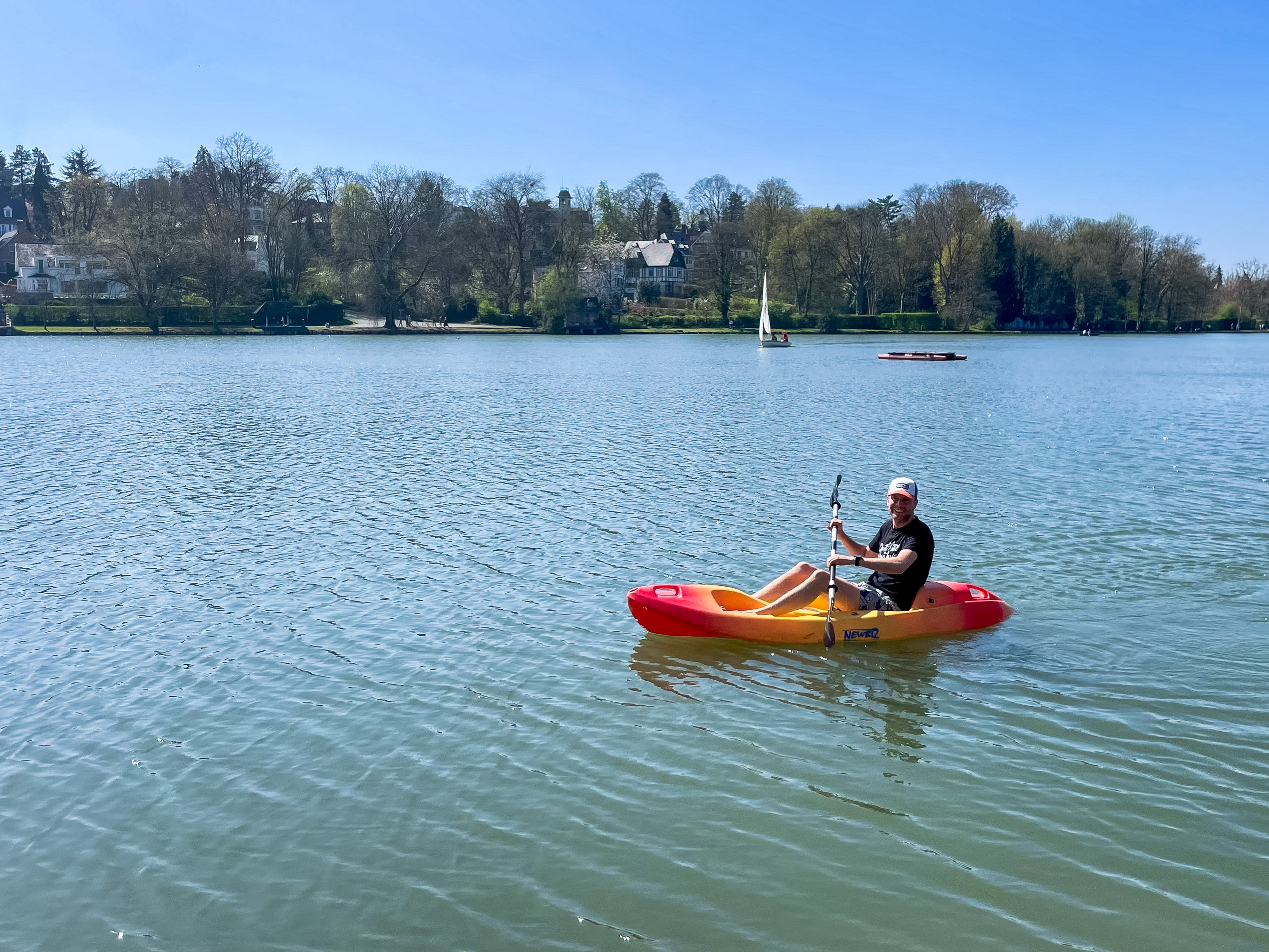
On the Water: Rent a kayak, pedalo, SUP, rowing boat, or sailing boat at the local yacht club. Or, relax on the club’s terrace in a comfy beach chair while the kids watch the action.
Run or Stroll: Go for a run or a leisurely walk around the lake—perfect for burning off some energy in nature, spotting beautiful lakeside houses and classic cars driving around during the weekends.
Picnic & Play: Pack a picnic to enjoy by the water. Bring a book or some games for the kids. (Swimming is officially forbidden, but I couldn’t resist a sneaky early morning dip!)
Wellness & Tennis: Treat yourself at the spa or tennis courts at Martin’s Château du Lac—ideal for parents needing a little recharge. The spa also has a rooftop terrace where we read our books for hours.
Where to Eat
Lakeside Terraces: Grab a table at one of the many restaurants with terraces overlooking the water—Lucy Chang is a favorite for families.
Special Occasion: For something extra special, try L’amandier (my wife’s birthday treat for me!) for a 6-course haute-cuisine lunch or dinner.
Don’t Miss: An ice cream from La Laguna, right by the lake—guaranteed to delight! The cue on summer days is worth the wait.
Where to Stay
Lakeside Cabins: Book a cozy cabin or house along the water via Airbnb for a homey, kid-friendly stay.
Boutique Comfort: L’amandier offers charming but pricy guest rooms.
Hotel: We stayed at Martin’s Château du Lac (watch for deals including spa and tennis) for a touch of luxury and plenty of space for kids to roam.
Why We Loved It
This weekend reminded us that you don’t need to travel far to create lasting memories. Slow travel—by train or bike—makes the journey part of the adventure, and Lake Genval’s mix of nature, activities, and relaxation is perfect for families with young kids (and parents-to-be!).
Want tips or help booking your own sustainable lakeside escape? Drop me a message—I’m happy to share more!
We took this trip about two years ago, in Covid times. We found a new way to enjoy a weekend getaway: a cycling journey from Brussels to De Haan with a stay at the seaside. Whether you’re planning a winter trip with a scenic grey backdrop or a sunny summer escape, this route offers a perfect blend of nature, history, and adventure. Let’s delve into our experience and how you can recreate this journey.
Setting Off: Leave early!
Our adventure began on an early Saturday morning in Brussels. I packed a picnic and set off around 7 AM. The route was approximately 140 kilometers, guiding us through some of Belgium’s most scenic towns and cities. You can check out the detailed route here: NodeMapp Cycling Route. This system of fietsknooppunten is the best way to plan any cycling trip in Flanders.
Since Tine was pregnant then, she chose to go by train and join me for the last part of the cycling trip.
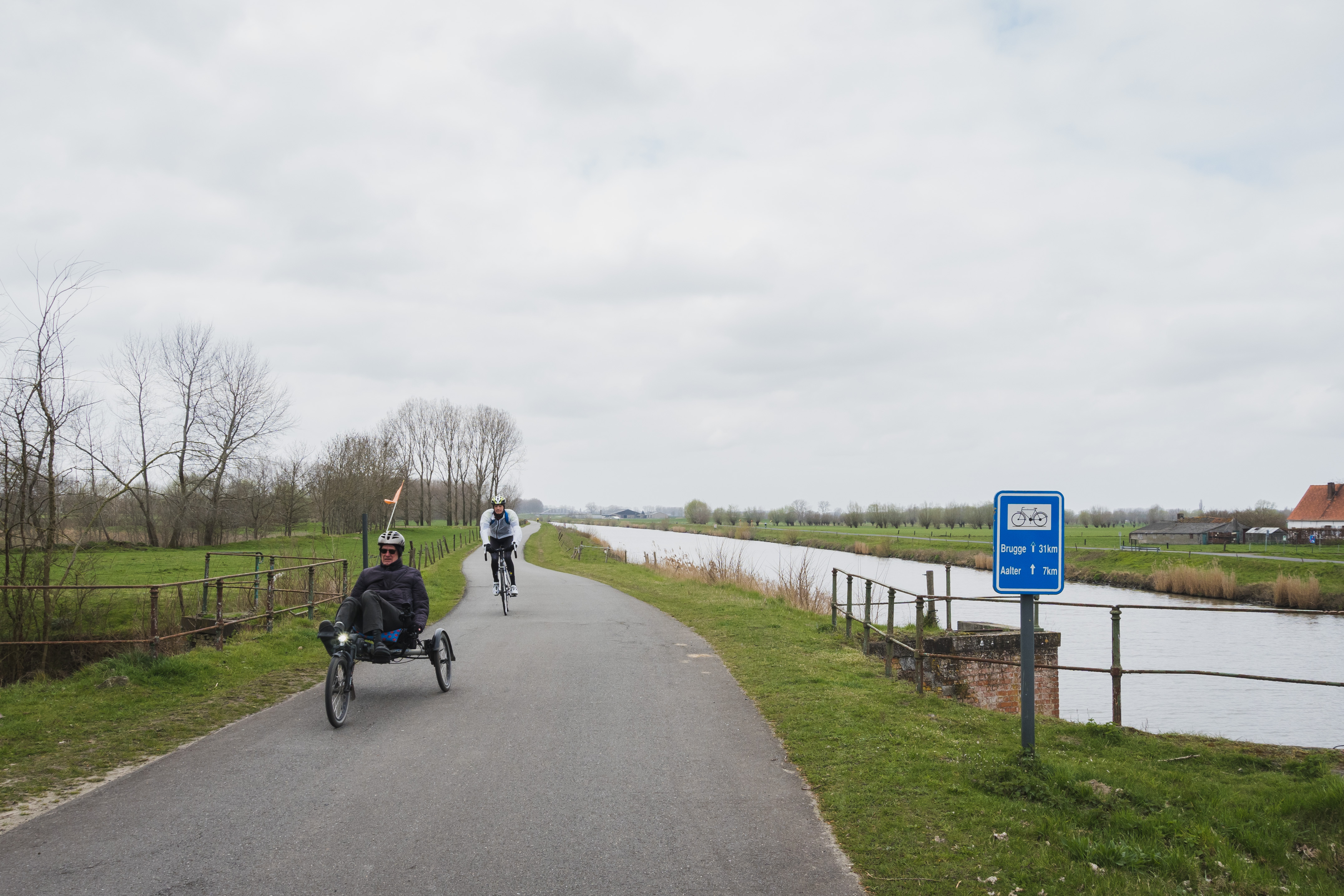
Cycling long distances can seem daunting, but planning becomes easy when following canals and rivers. These natural guides make navigation straightforward, turning the ride into a sequence of picturesque views avoid having to look at your phone or gps too often.
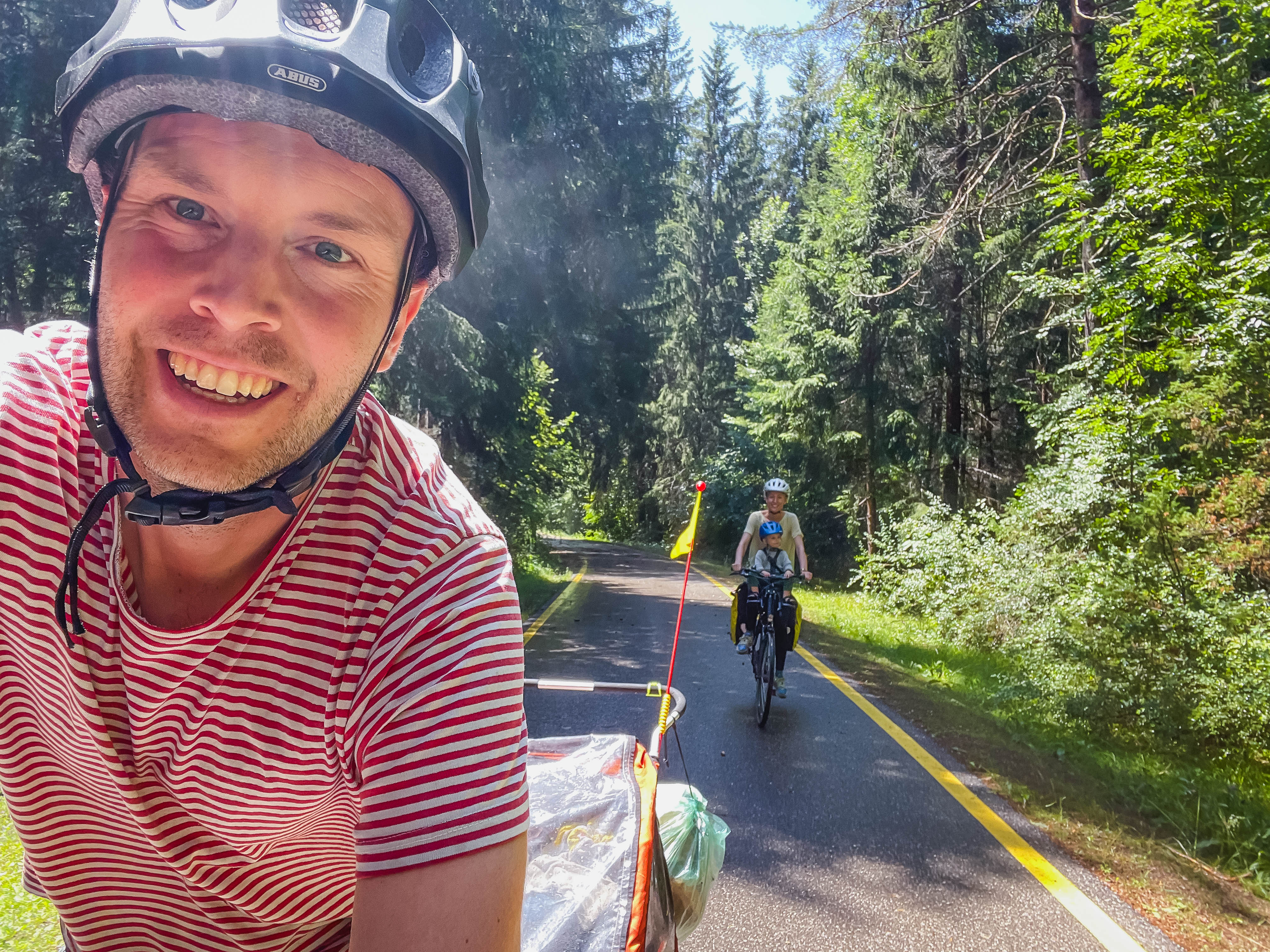
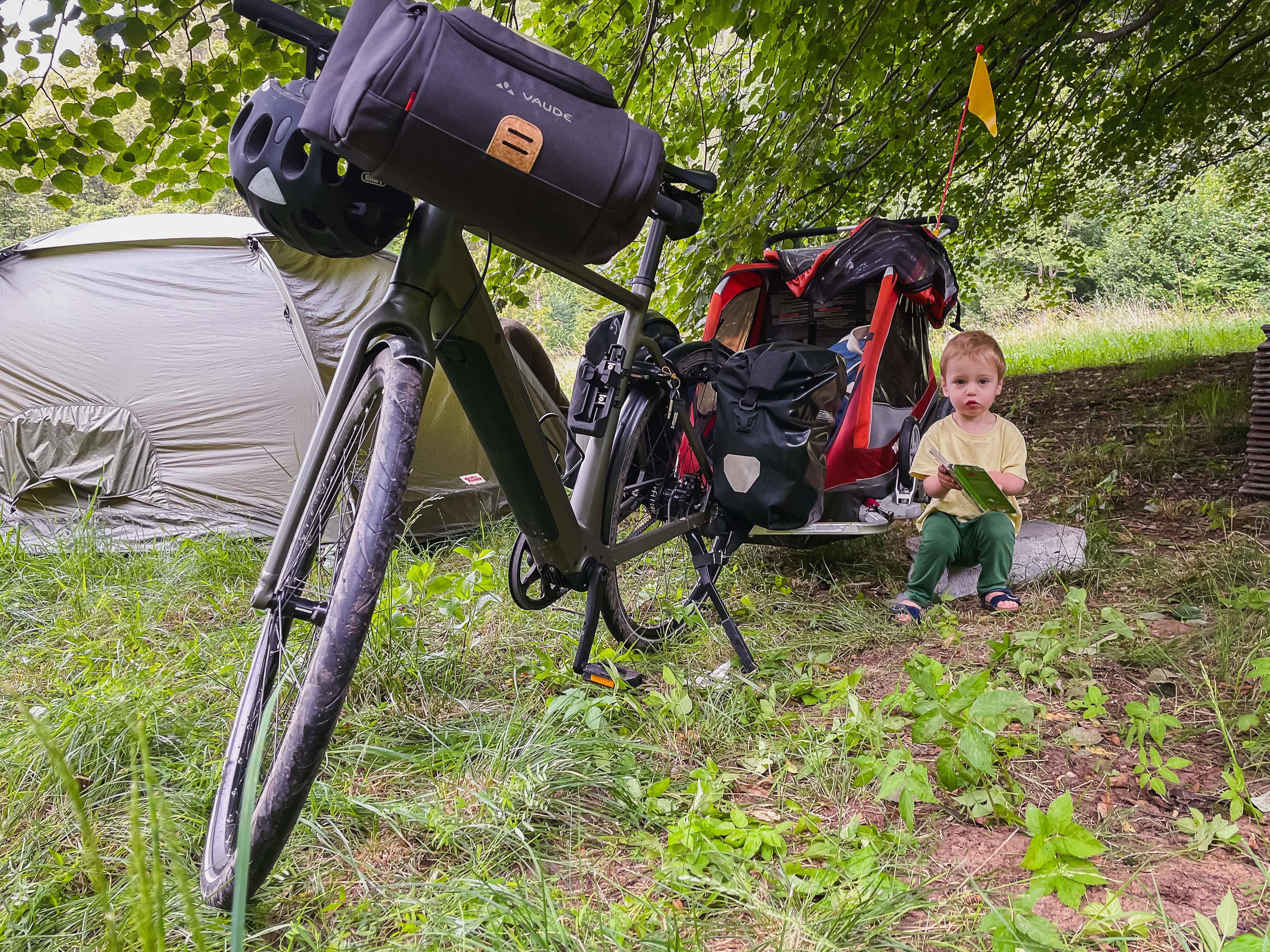
If you’re traveling with kids, consider using an electric bike with a bicycle cart. For those who prefer a more relaxed pace, split the trip into two days with an overnight stay in or before Ghent. This approach allows you to break up the journey, enjoy the ride, and fully appreciate your surroundings.
The Journey: From Brussels to De Haan
I maintained a slow but steady pace, with my touring bike, averaging about 20 kilometers per hour this takes 7 hours without brakes. This allowed me to enjoy the sights along the route without feeling rushed. The journey took us through Ghent, a city known for its vibrant culture and historic buildings, and Bruges, often called the “Venice of the North” for its beautiful canals and medieval architecture.
In Bruges, Tine joined me for the final leg of the trip to De Haan. This part of the journey combined scenic countryside with coastal views.
The Seaside: De Haan
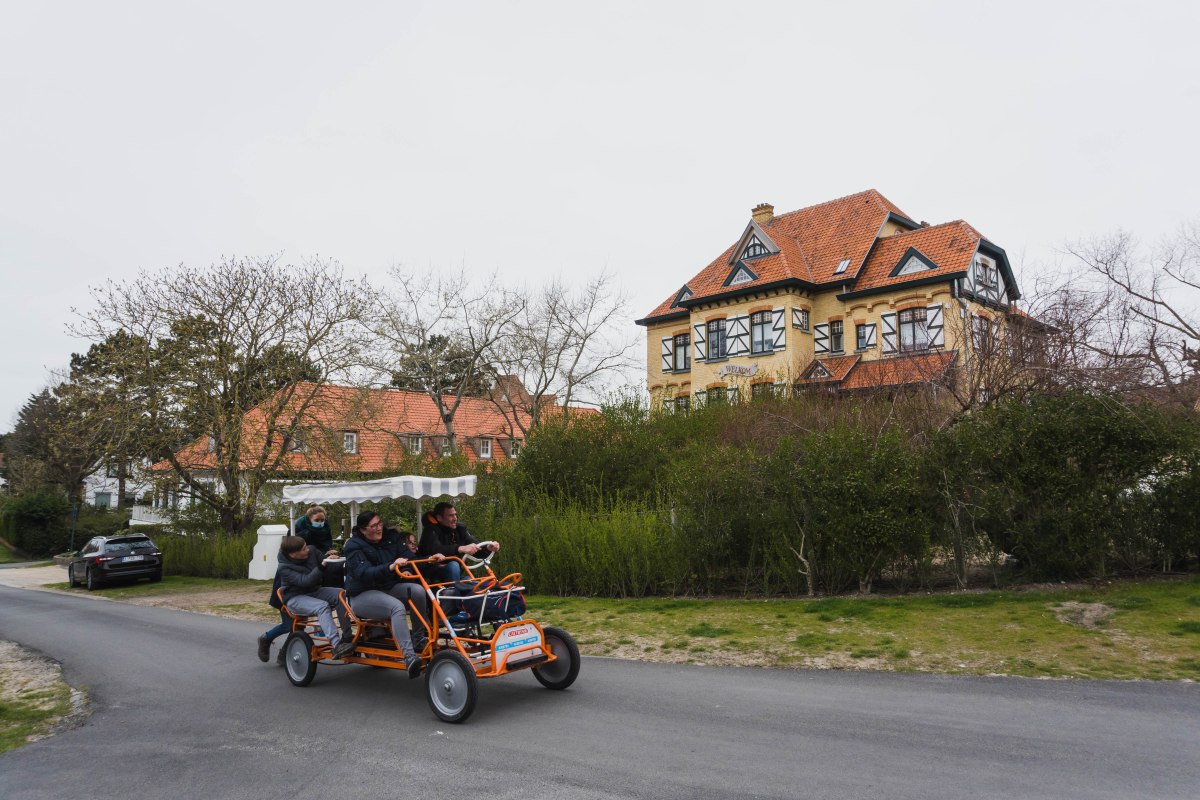
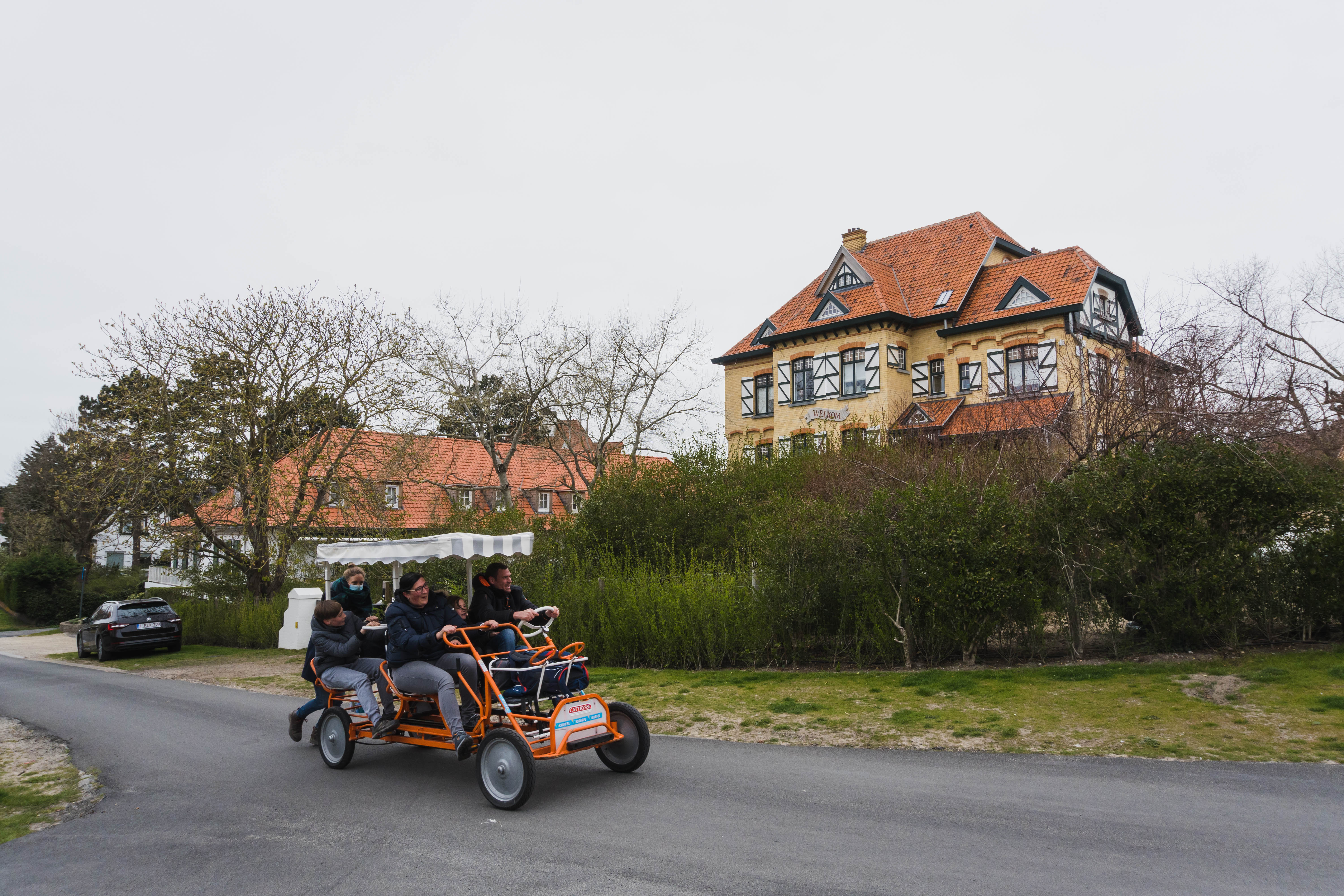
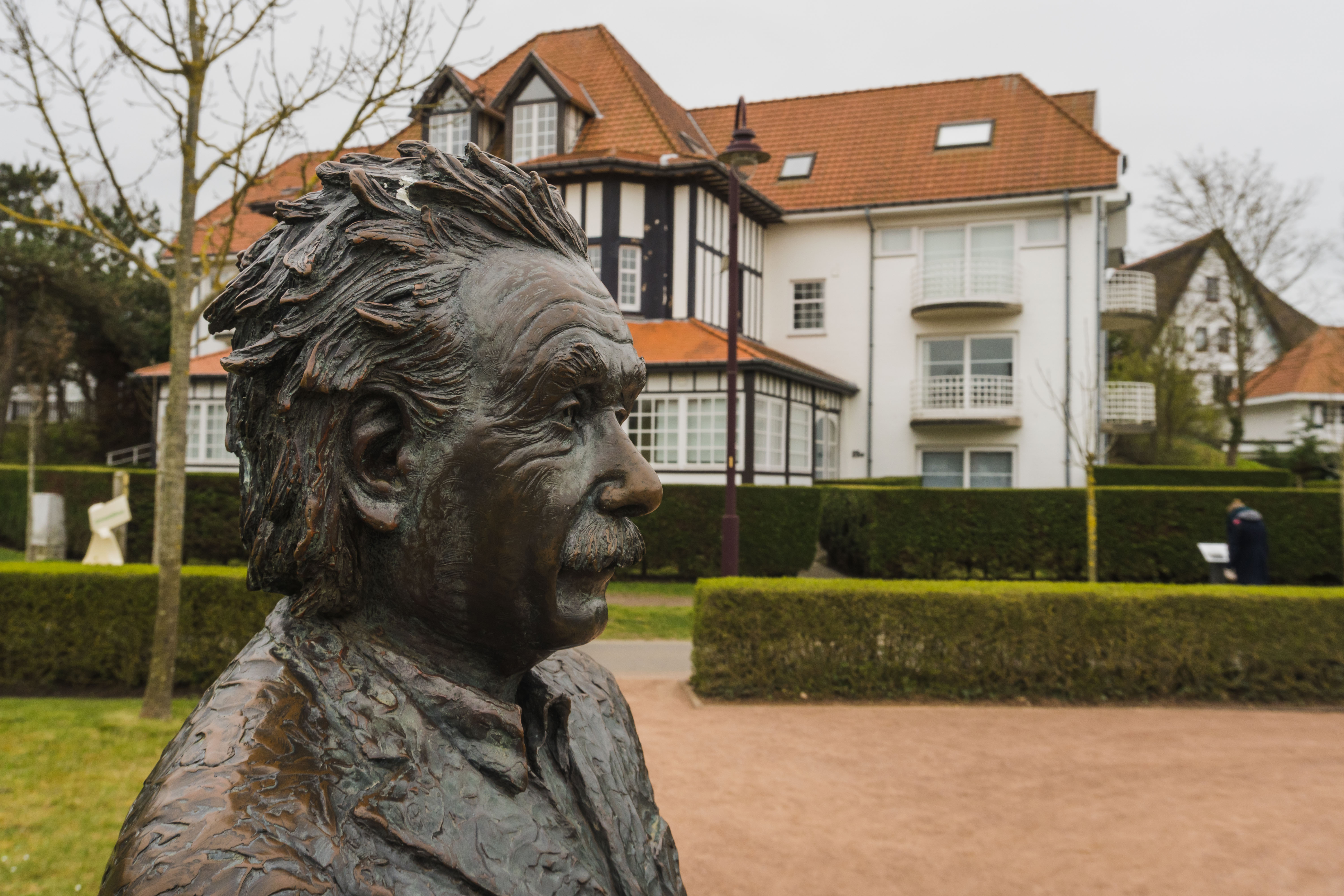
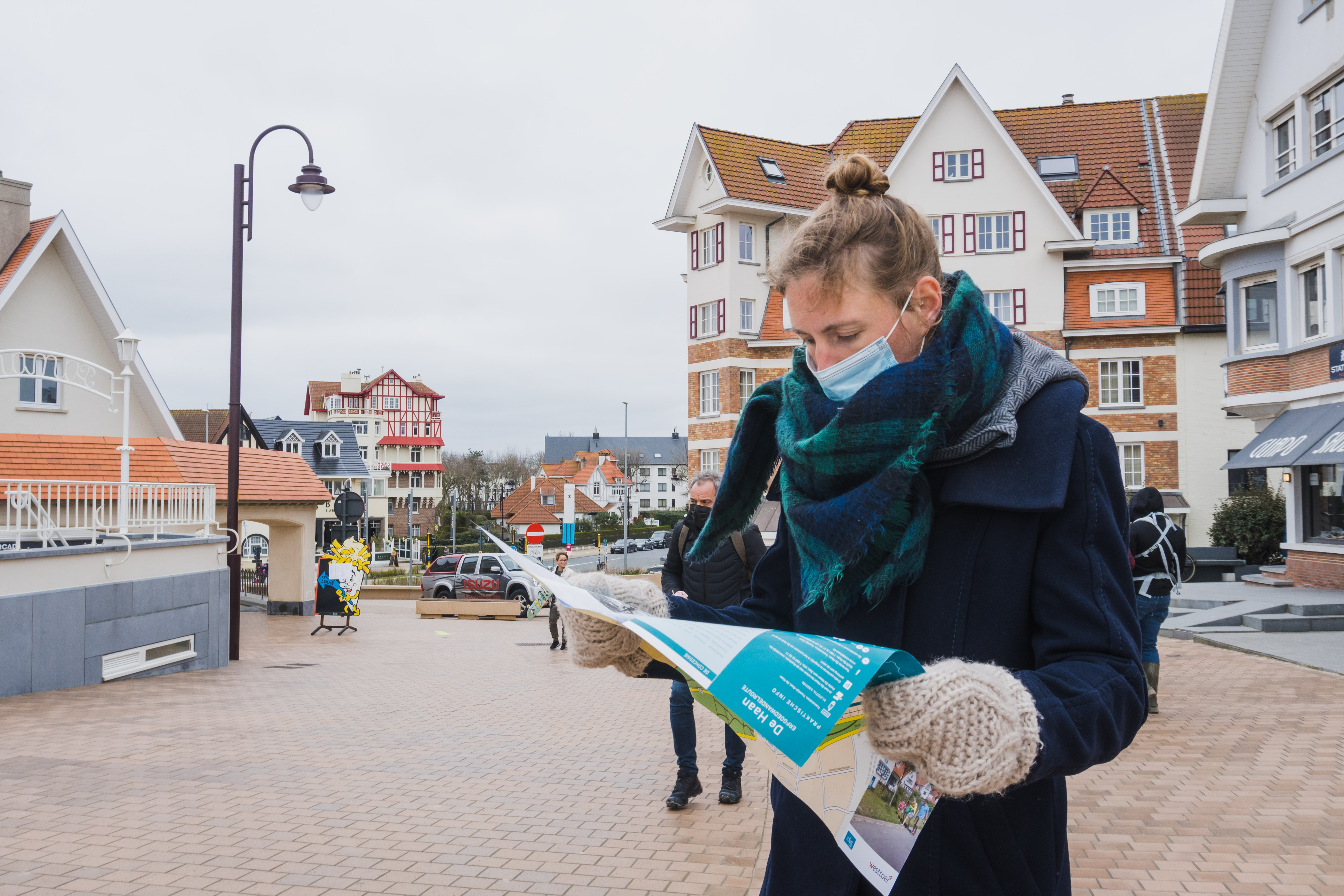
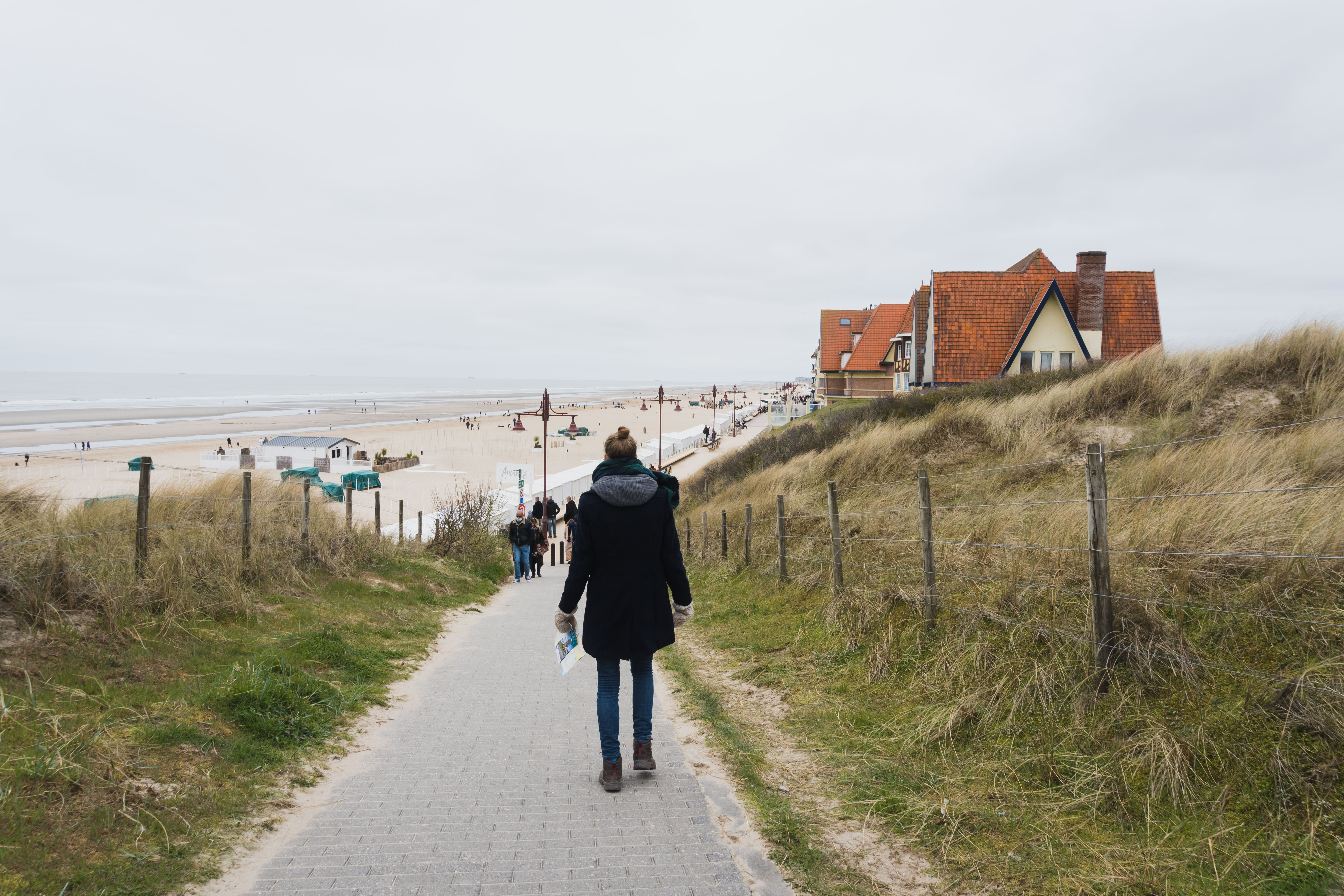
Arriving in De Haan felt like going back to the glory times of the Belgian coast. Known for its Belle Époque architecture, De Haan offers a mix of history and coastal charm. One highlight was the heritage walking route, which tells the town’s rich history, including how Einstein lived there. You can explore more about this walk here.
We stayed at Hotel Internos, located just in front of the legendary Hotel Astoria. Both situated in the center of De Haan, ensuring you’re close to all the main attractions.
Due to Covid restrictions, dining options were limited, so at that time we enjoyed dinner in our hotel room. One memorable restaurant we enjoyed during another trip was Villa Julia, set in an old house with a warm interior. Despite the restrictions, dining in such unique settings added to our experience.
Returning Home: Easy and Convenient
After a weekend filled with cycling, history, and coastal beauty, returning to Brussels by train was simple. We cycled to Ostend and took the train back to Brussels. You can easily complete the journey to Ostend by coastal tram as well.
Final Thoughts on Sustainable Travel
Cycling long distances offers an eco-friendly alternative and a deeper connection with the surroundings. Whether you’re an avid cyclist or someone looking to try something new, this journey from Brussels to De Haan is a great way to explore and relax.
So, pack your bags, hop on your bike, and set off on your own sustainable adventure. Who knows what adventures you’ll make along the way!
Traveling with reusable diapers might seem daunting, but with the right approach, it can be both eco-friendly and manageable. We’ve had a mix of good and challenging experiences, and we’re here to share what we’ve learned to make your journey smoother.
We have made many trips with August during his first 2 years and always took reusable diapers: on a camper trip of 2 months to Spain and France, on our train adventure of a month in Sicily, on our cycling holidays through the Dolomites last summer,… It requires a bit of planning and reflection, but once you’re used to it it works well.
Our Favorite Reusable Diapers
Our top pick is the “Close Pop-in Bamboo Diaper”. These diapers are easy to wash and use, consisting of a bamboo layer, a water-absorbent insert, and waterproof over pants.
For soiled diapers: Simply toss the bamboo layer in the garbage.
For wet diapers: Wash and reuse the bamboo layer 3-4 times until it’s too decomposed.
Another setup we love:
“Bamboolik Cover Duo Snap” outer pants combined with “Anavy Bamboo Diaper with Velcro” and “TotsBots Bamboo Insert”.
Packing Tips
We typically prepare packaged layers in advance, taking 9-10 sets (3-4 diapers per day, adjusting as your child grows). For extra absorption at night, you can add a night booster like the “Close Pop-in Night Insert”.
Benefits and Practical Tips
Washing: Use a bit of eco soap to wash diapers in a lake, shower, washbasin, or toilet.
Drying: Lay them open in the sun or wind, or place them in a well-ventilated bicycle cart to dry.
Reuse: You can reuse the waterproof cover multiple times without washing if it remains clean.
Frequency: In hot weather, do not go longer than 2 days without washing. Use a washing machine every 3-5 days while on holiday.
Challenges & Solutions
Skin Irritation: In warm weather, humidity can irritate your child’s skin. Switch to disposable diapers (eco-friendly versions are available in most hypermarkets) if needed.
Smell: Carry a plastic bag for odor management.
Handling Poo: It’s not always pleasant to handle soiled diapers, but I (Louis) take on this task most often since I care most about the use of reusable diapers.
Additional Tips & Tricks
Wet Bags: Invest in wet bags to store dirty diapers until you can wash them.
Travel Size Detergent: Bring eco-friendly detergent in a travel size for easy washing on the go.
Disposal Liners: Use biodegradable liners inside the diapers to make cleaning easier.
Plan Ahead: Research your destinations for laundry facilities to ensure you can wash the diapers when needed.
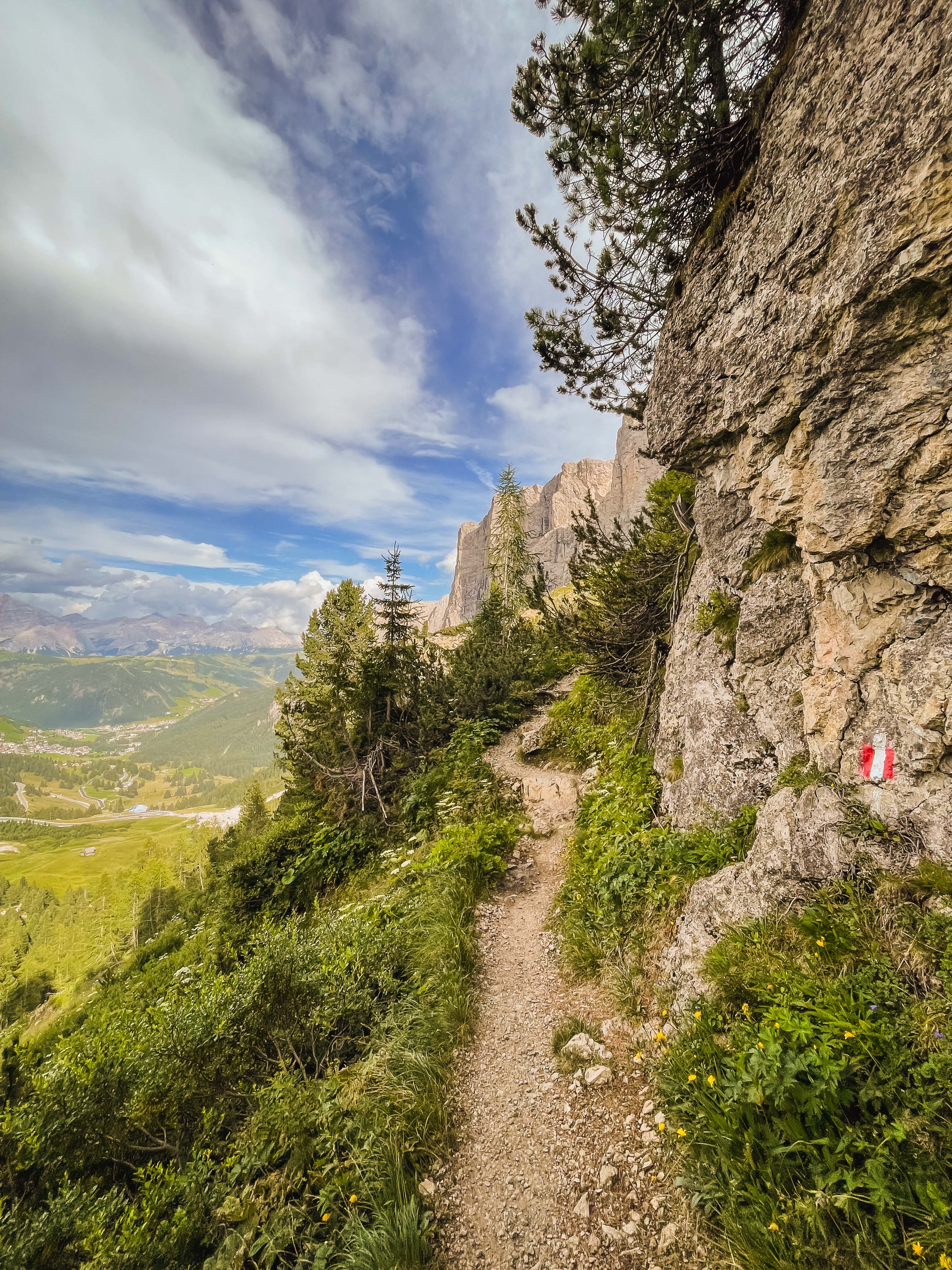
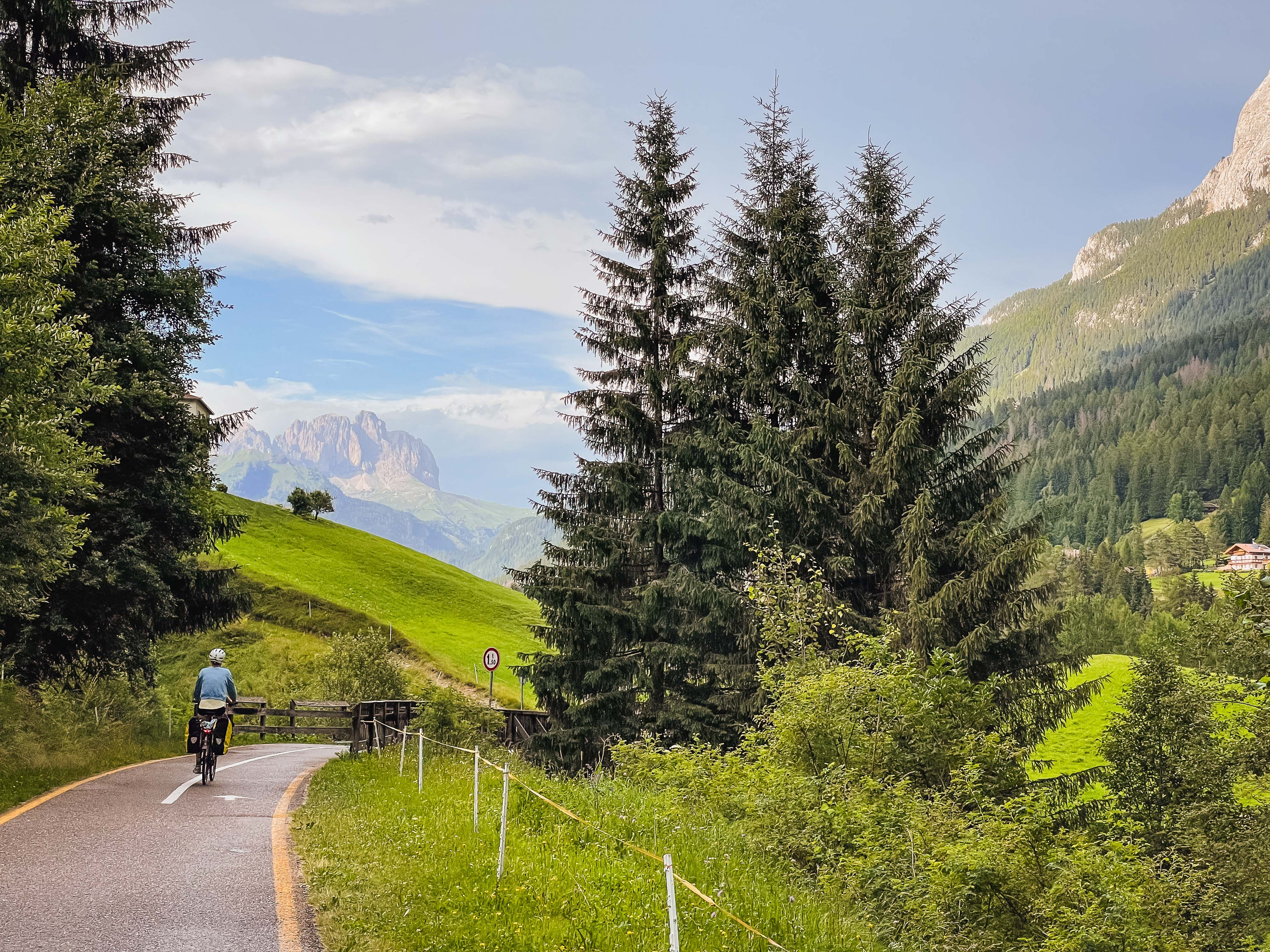
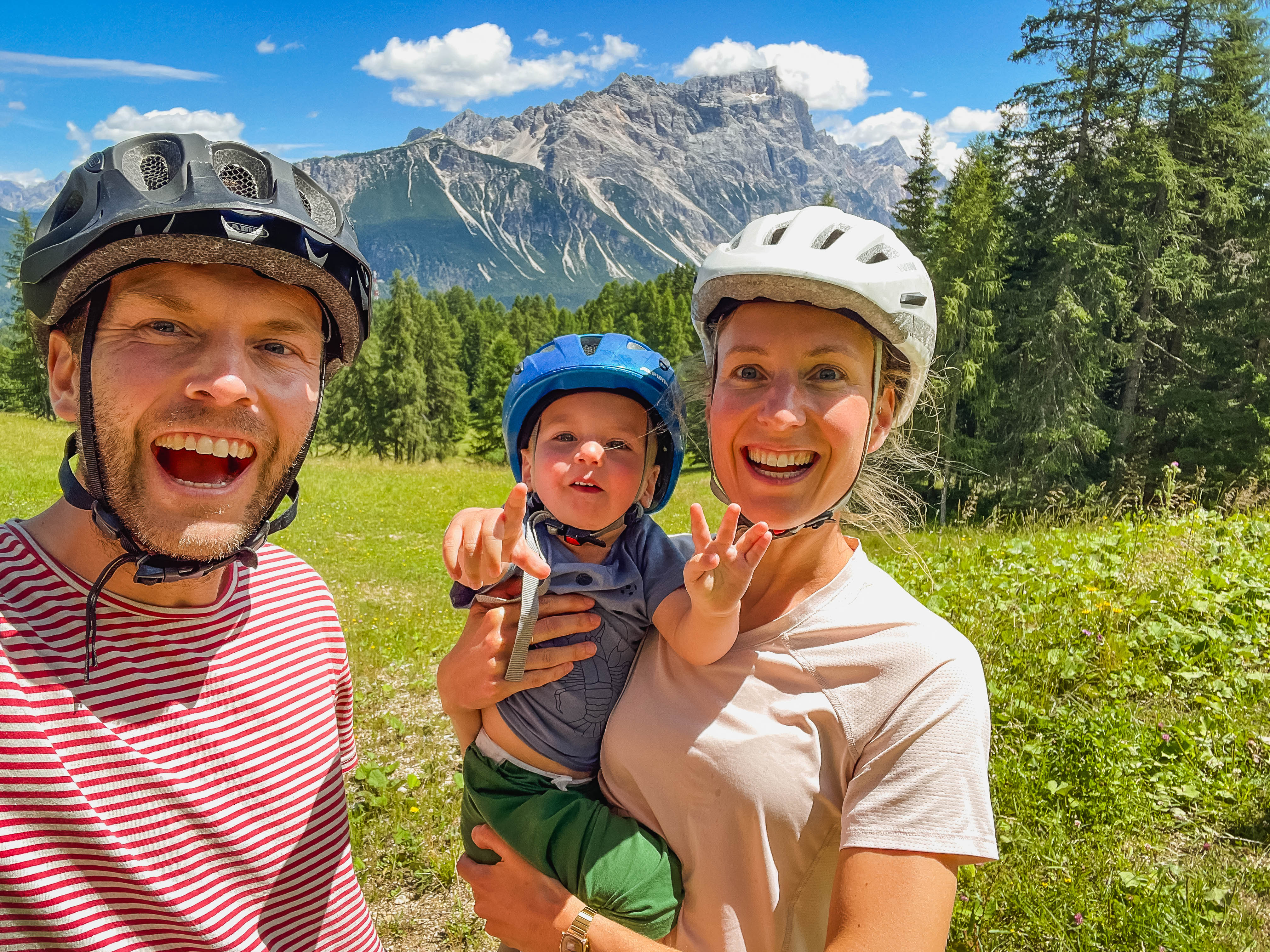
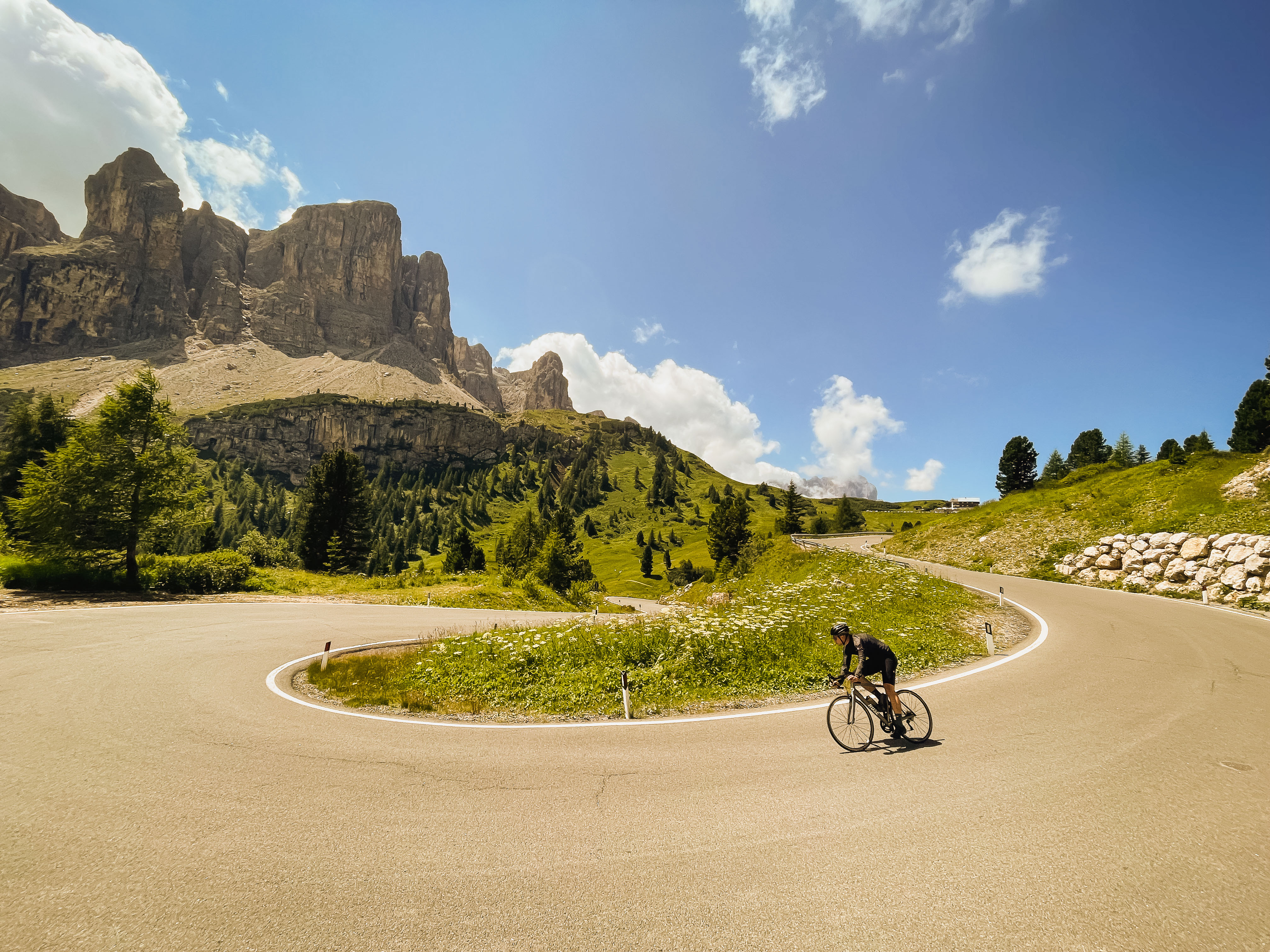
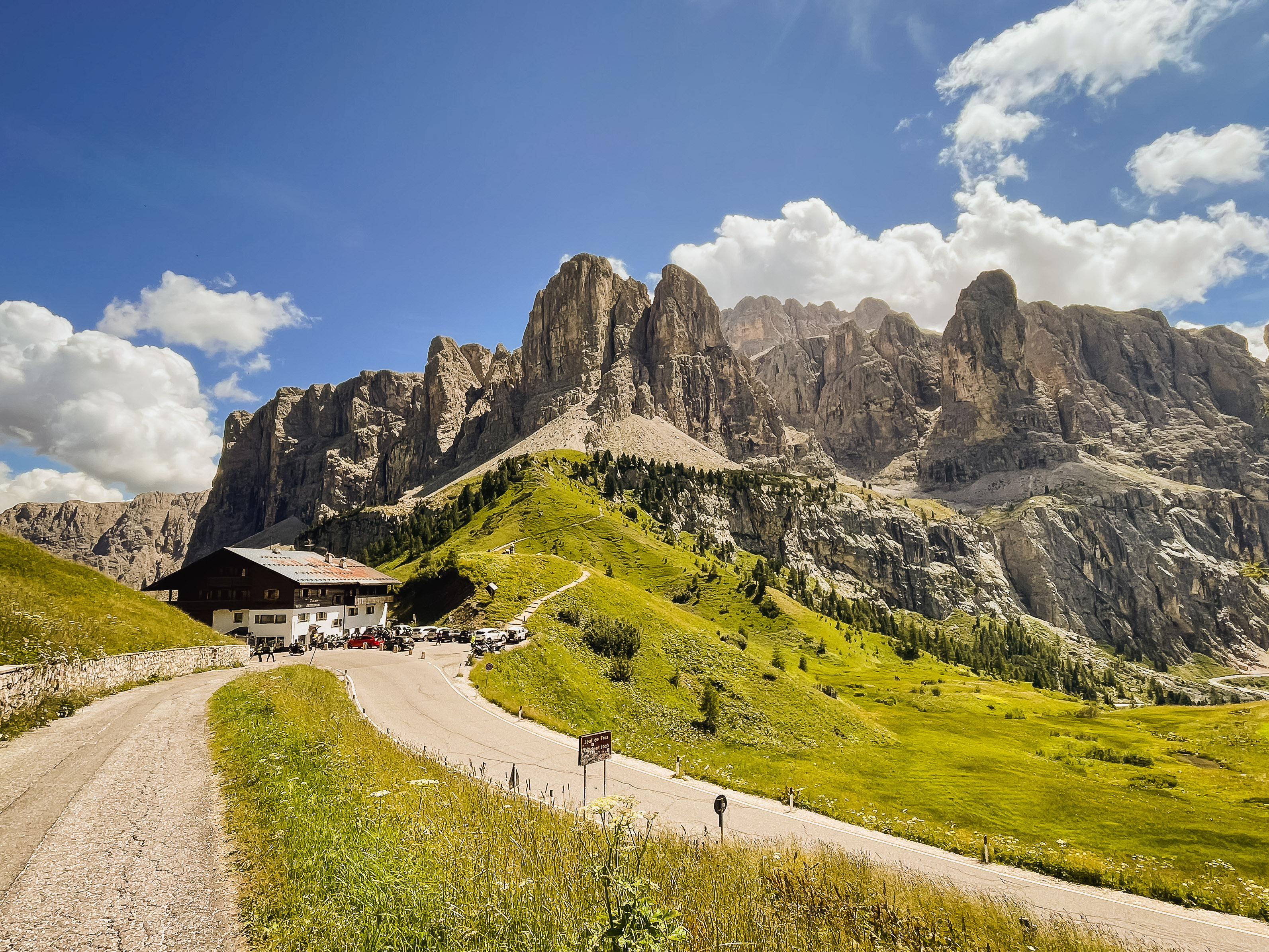
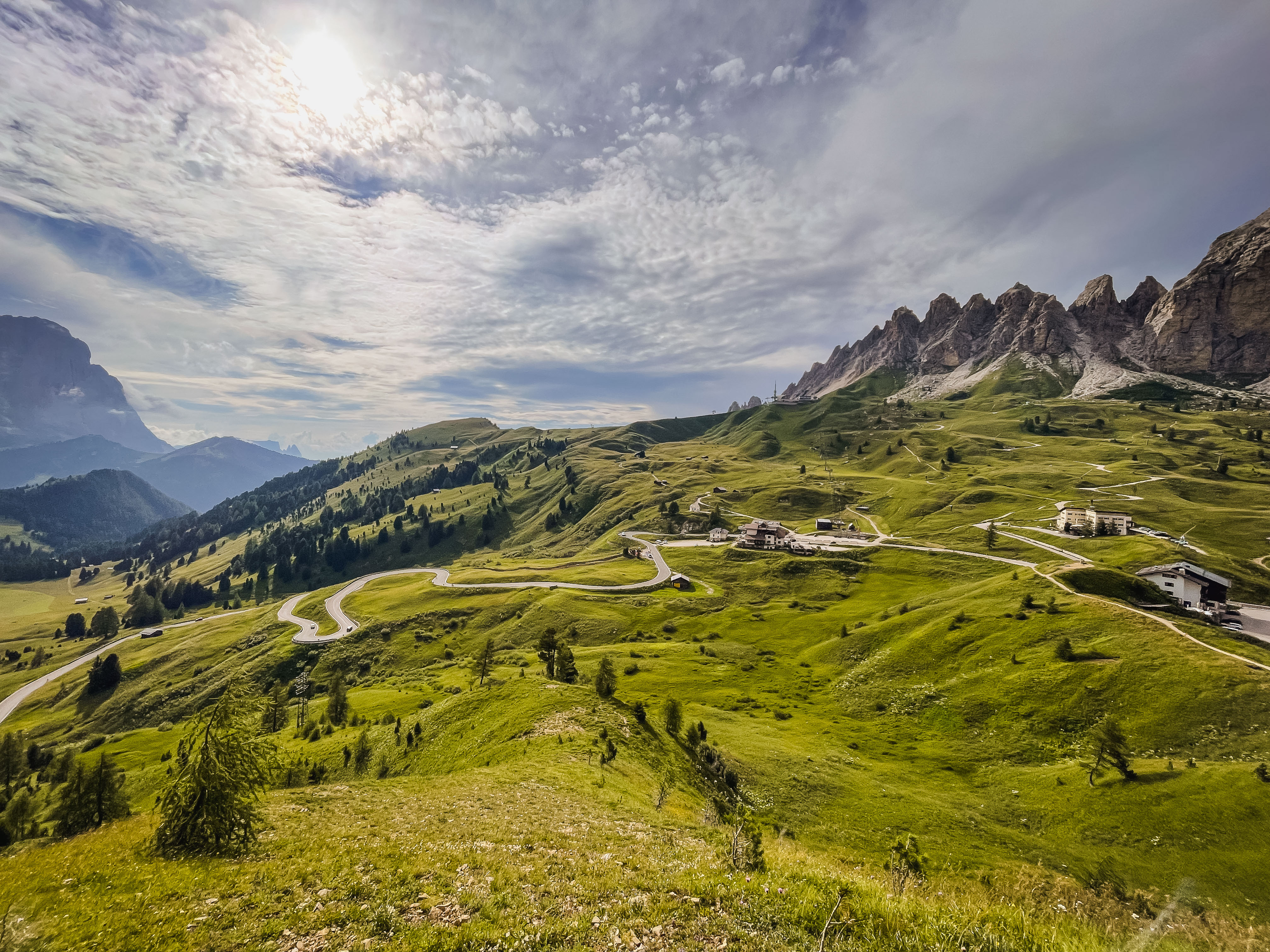
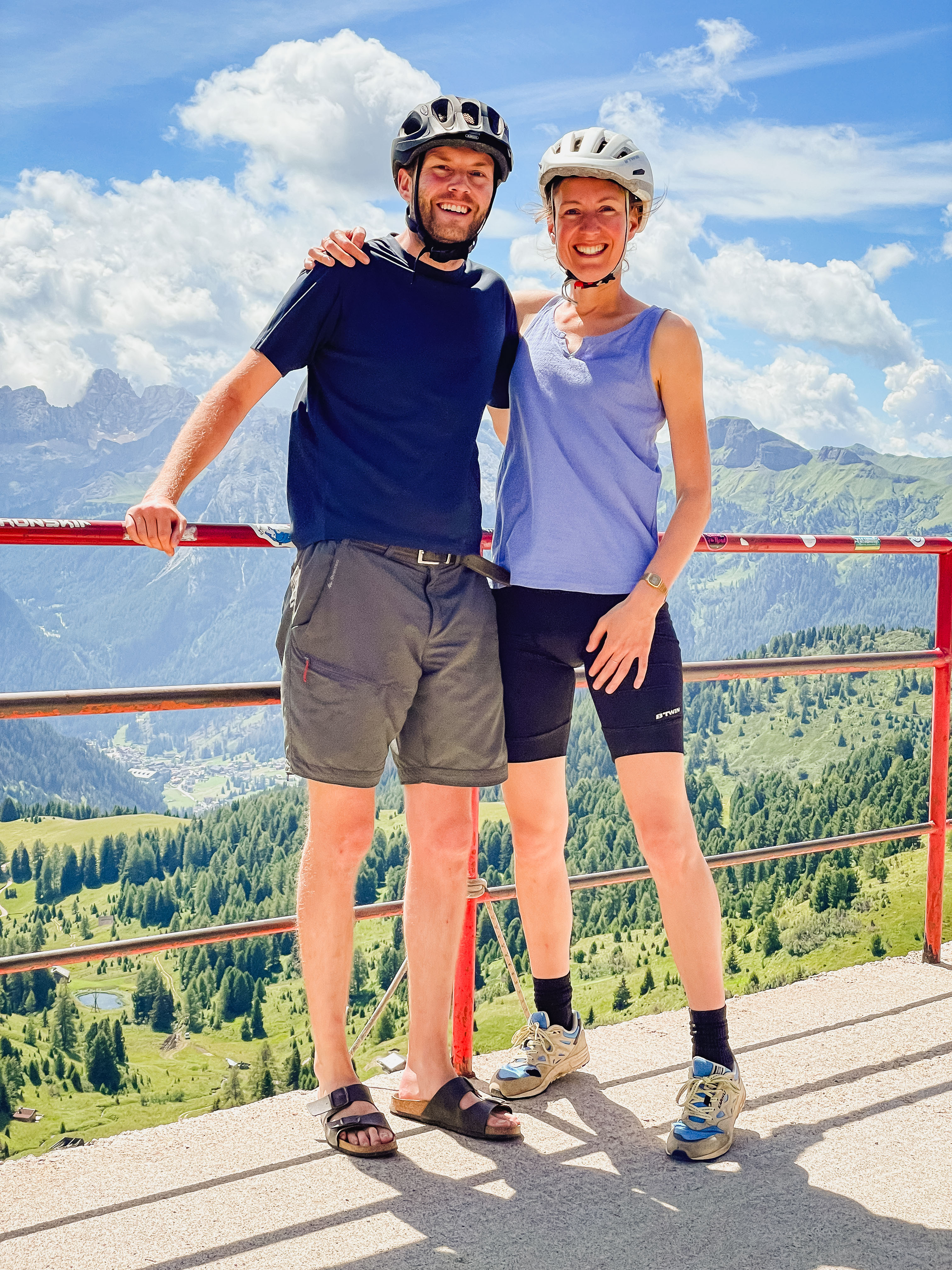
The best memories are made in nature. Spending time slow-traveling with our toddler in the Dolomites was amazing. When researching for this trip, I stumbled upon someone making this comparison list: Himalaya – Andes – Dolomites. I had to laugh since I thought it was slightly exaggerated to put the Dolomites on that list… but after the trip, we fully agreed!
This post is split in 4 parts:
The route through the dolomites
Musts when cycling with kids
Our daily routine while cycling
A day-by-day detail of the itinerary
1. The route through the Dolomites
We traveled by bike a couple of times before, e.g. during our summer trip along the Rhine and through the Black Forest, but never with August. In this post, you’ll find some honest parenting details on how we survived this trip with our 2-year old.
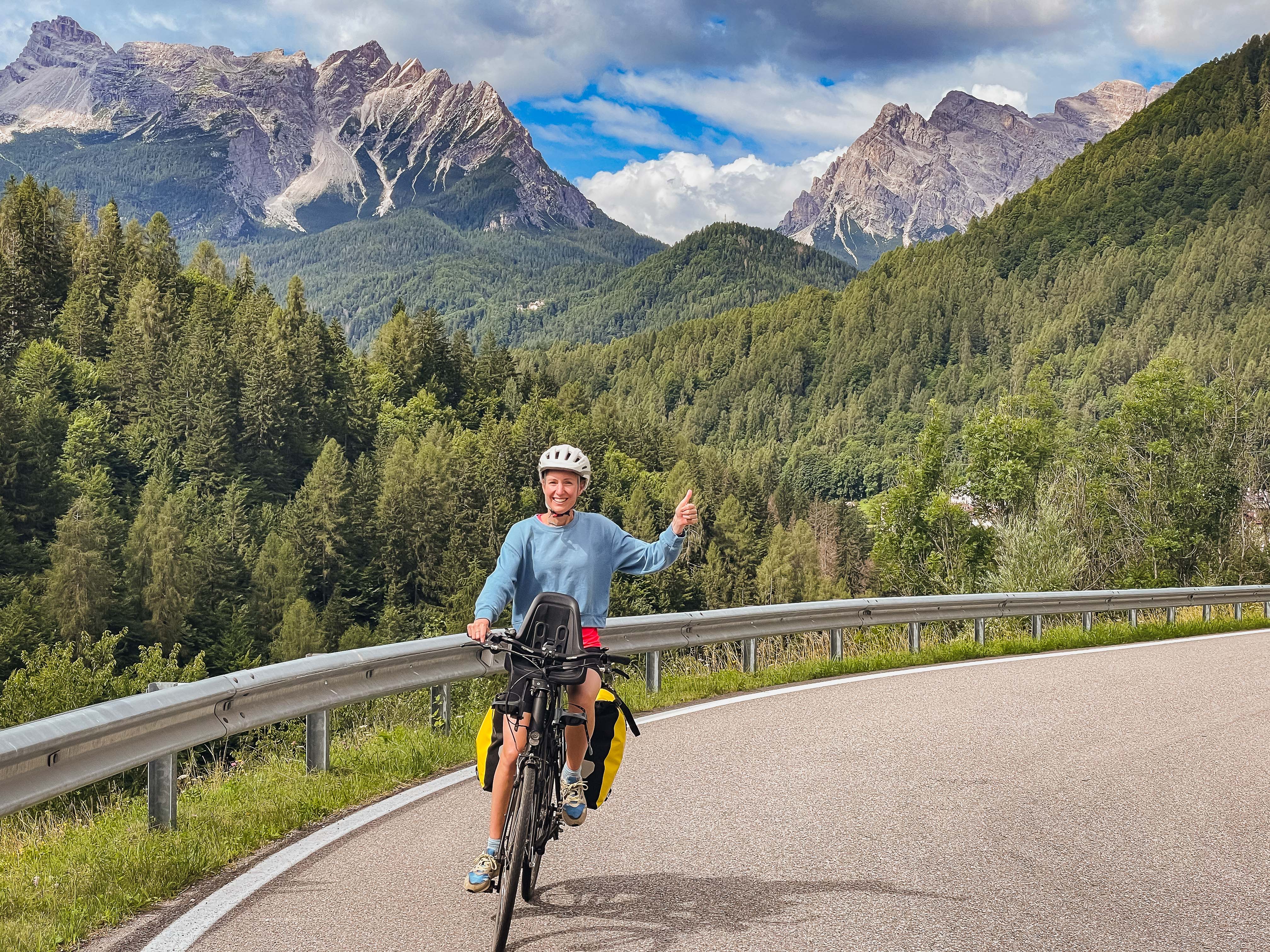
Disclaimer 1: Doing this beautiful bicycle trip with a kid is ABSOLUTELY IMPOSSIBLE without an electric bike! There were many moments when we had a tough time cycling up the passes, even with help of our electric engine. At moments, we would get out of battery and sweat or hardly make it up the 1000m climb.
Disclaimer 2: we did not find a train alternative to get to the Dolomites with our two-year-old todler & two adults; two electric bicycles; a bike trailer and camping gear for all of us. Without a toddler and bike trailer it would have been possible to get to Bolsano and start cycling from there, so let me know if you are planning to do so!
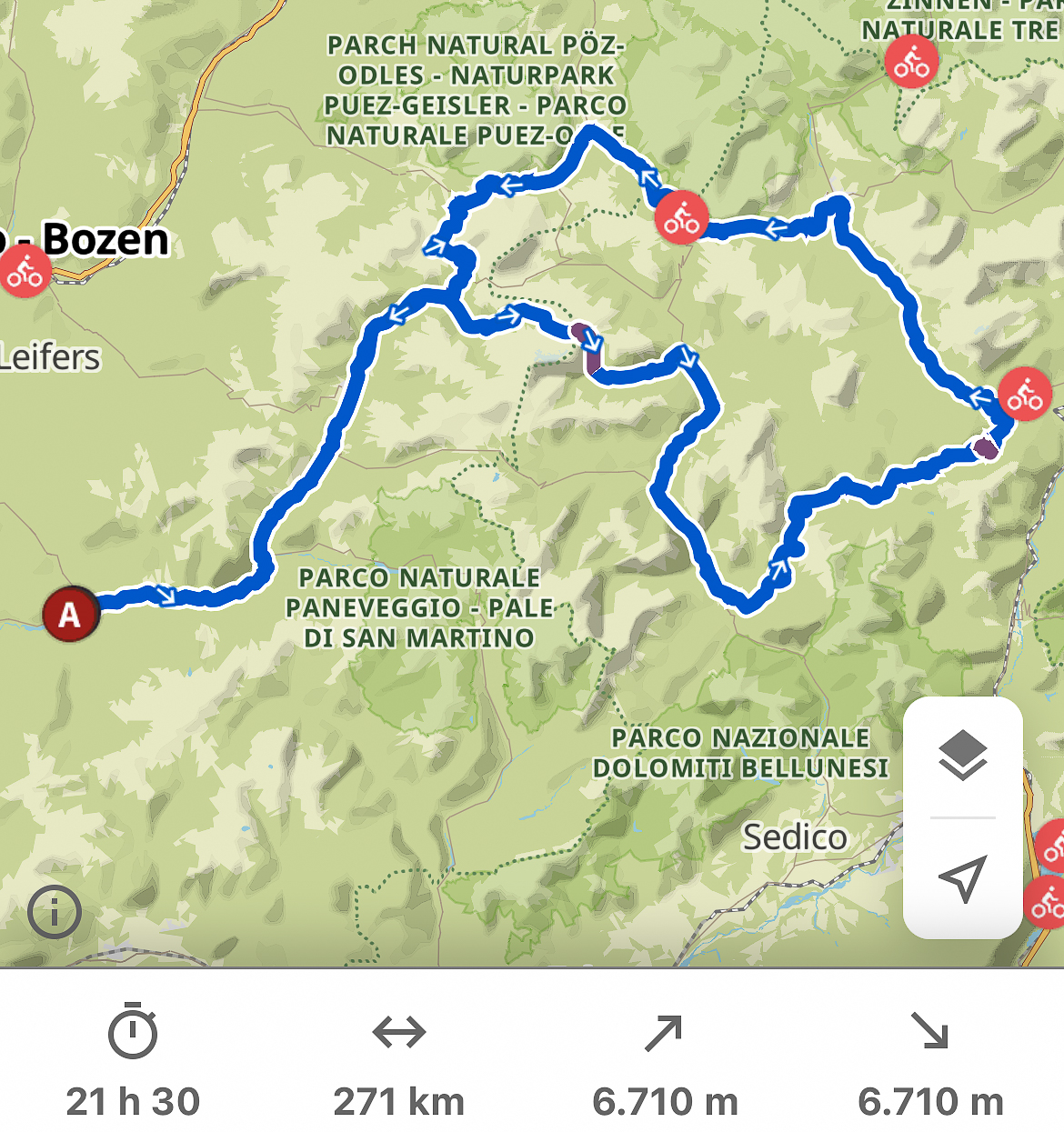
For the route we practically merged the below two routes to create a loop and get back to where we left the car: Dolomites from West to East and Dolomites from East to West (returning via different valleys). We switched from the first to the second route in Cortina.
2. Musts when cycling with kids
If you’re planning to go on a cycling trip with a toddler, this is what you certainly need, on top of the usual kids’ stuff that you would take on any trip:
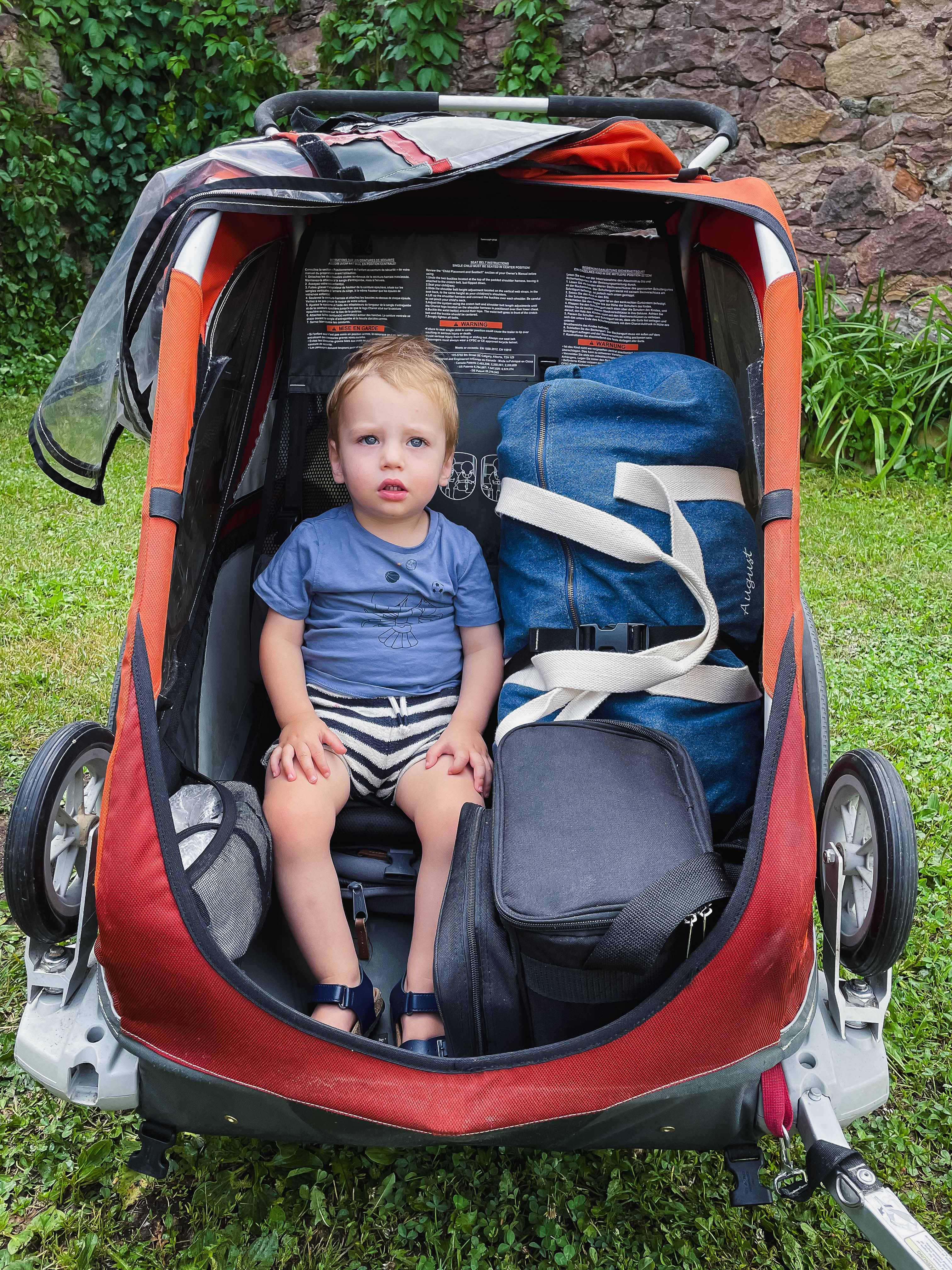
Seat & bike trailer: Bring both a child seat in the front and a Thule bike trailer behind one of the bikes. We switched all the time since sitting in the front allows us to look around, sitting in the back is more for playing and taking a nap.
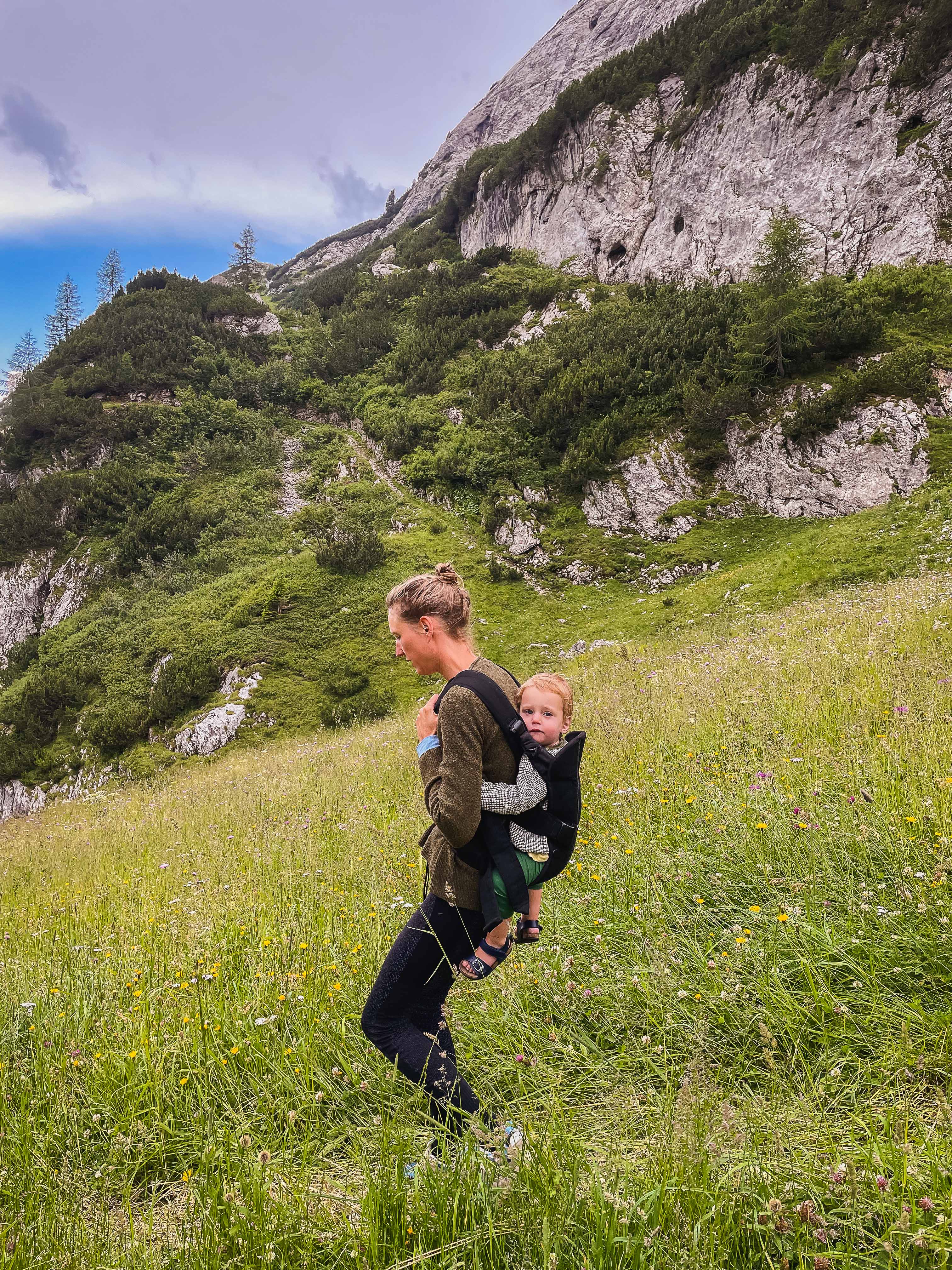
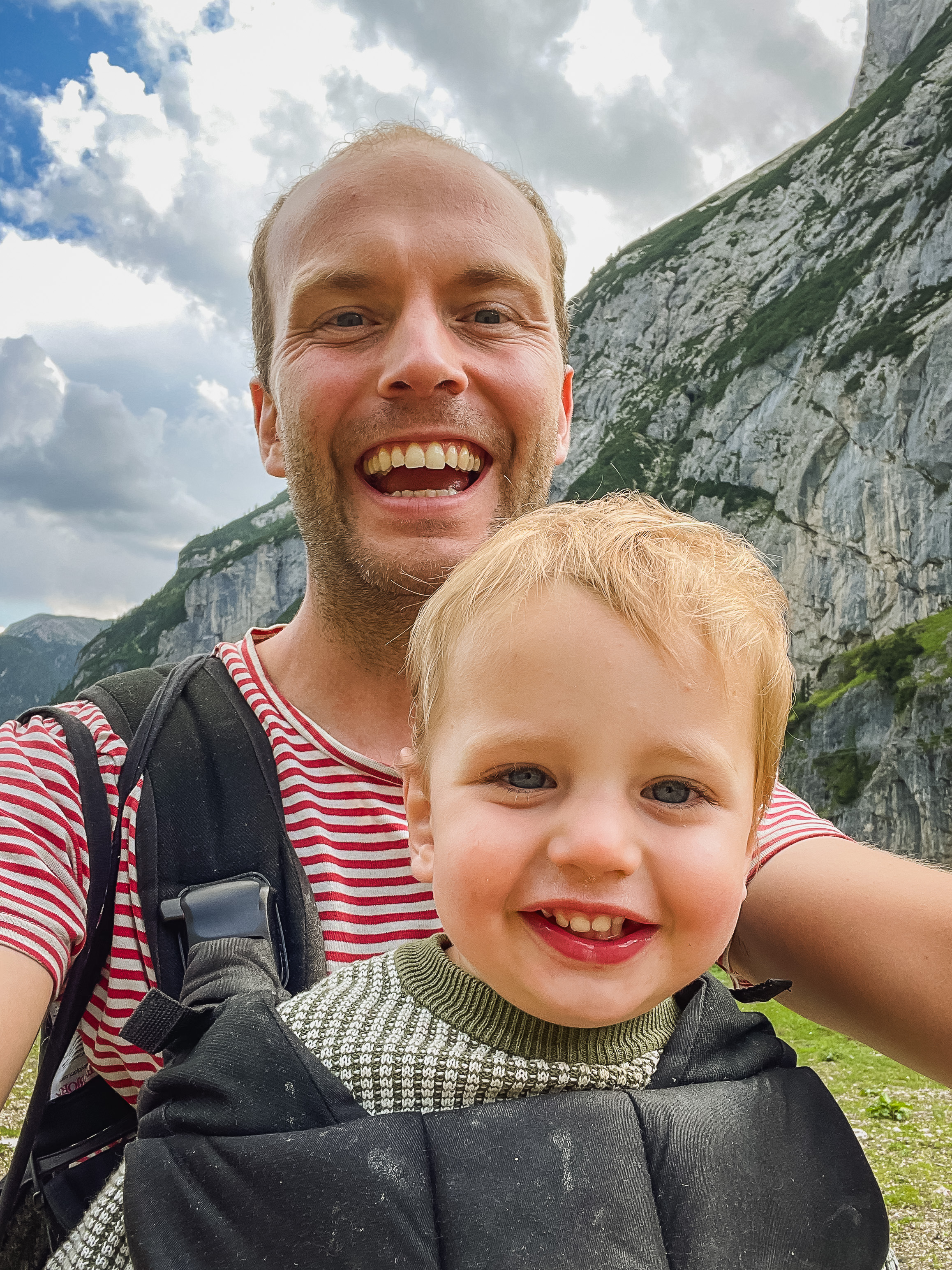
Baby carrier: Take a light baby carrier backpack for short hikes in the mountains where the bike trailer cannot be used as a stroller
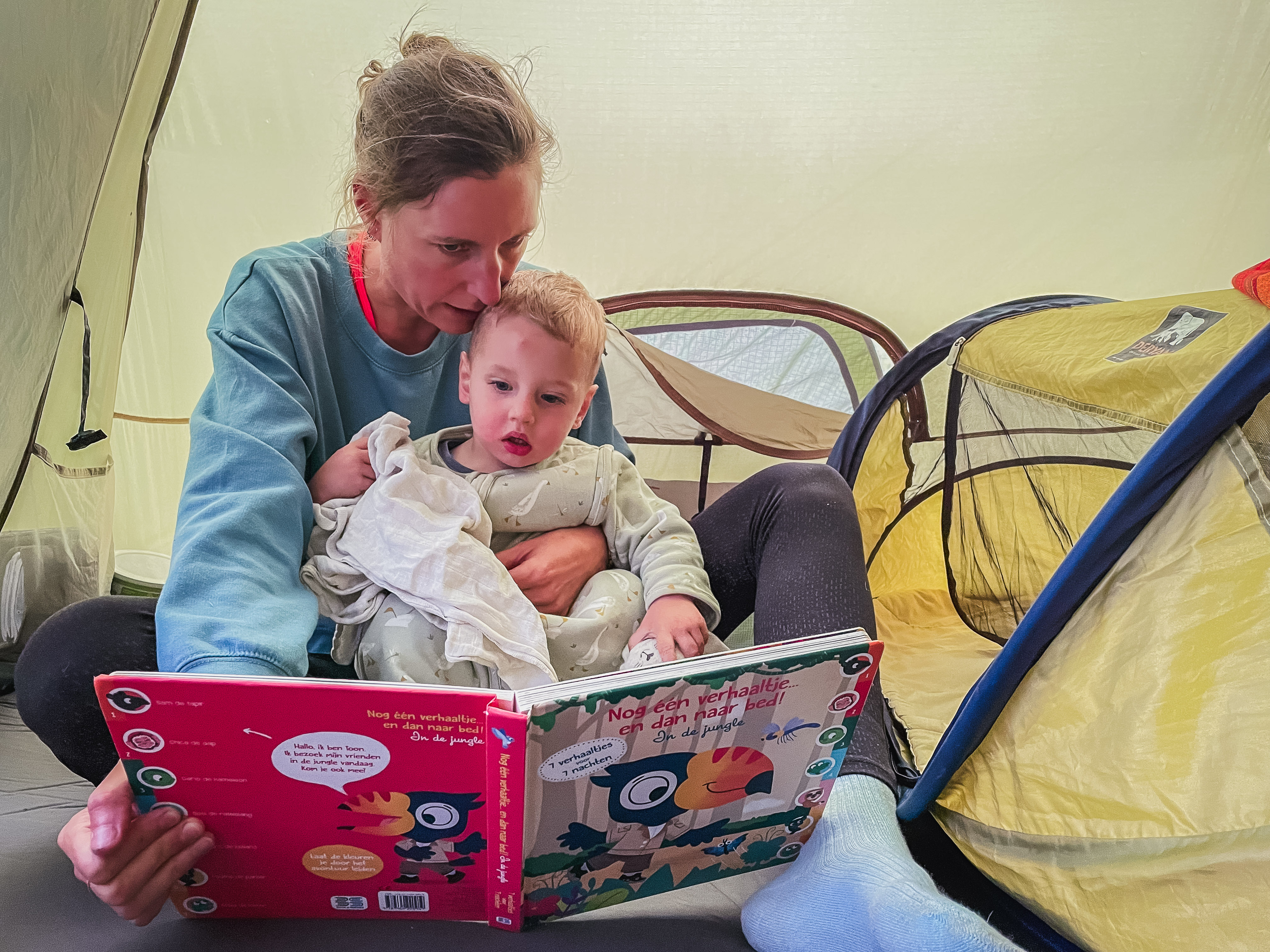
Baby sleep tent: We put the little tent inside our tent at our feet at night time. He got so used to it that he sleeps as well in the tent as in his bed at home. See the third tip for more details on our previous post on kids on trains where we tell you a little more about the tent.
While cycling, our typical day routine with 2-year-old August would be as follows:
5:30-6:30 Louis sneaks out of the room, goes running, reading a book, journaling
7:30-8:00 Wake up & milk for August (he drinks his milk cold – makes life easy while camping), get ready for the day
8:00-9:30 Breakfast
9:30-10:00 Pack our stuff
10:00-11:30 Start cycling or if we stayed in the same location, one of us would take 2 hours of me-time and the other would make a hike. We often started with August in front of Tine’s bike so that August could look around (and does not yet fall asleep).
11:30-13:00 Give August his lunch while taking a break… change his diaper and then he slowly falls asleep in the bike trailer behind Louis’ bike around 12:00 or 12:30.
13:00-14:00 Tine & Louis have lunch while August is taking his nap – we take the bike trailer as a stroller onto the restaurant terrace. Warning: we had to be inventive to keep August out of the sun while sleeping…not easy when the roads are curved and the sun comes from a different side every couple of minutes. When he woke up after 2 hours nap we would give him some more of our food or fruit.
14:00-17:00 Visit or cycle: often we would either cycle a bit more, visit a city, do a hike in the mountains, or plan shifts taking me time to read/chill/write.
17:00-18:00 Find a good camping spot or hotel. We traveled in July and August which is high-season, but we did not reserve any hotel or campground in advance. We would often call the day itself either in the morning or sometimes just half an hour before knowing if we would make it to that city or want to stop earlier (in case of August being unhappy on the bicycle or bad weather).
18:00-19:30 Get installed, have dinner together or if there’s a nice restaurant in the hotel we would already give August his dinner and after that put our phones on WhatsApp as baby phone while August is sleeping and we’re having dinner. We would often wash out August’s re-usable diapers by hand in the shower, and let them dry during the day in the bike trailer. More on travelling with re-usable diapers in a seperate blogpost – coming up.
21:30-22:30 Tine & Louis sleeping time
Like what you read? Do yourself and us a pleasure by subscribing to our blog by leaving your email addres below:
4. A day-by-day detail of the itinerary
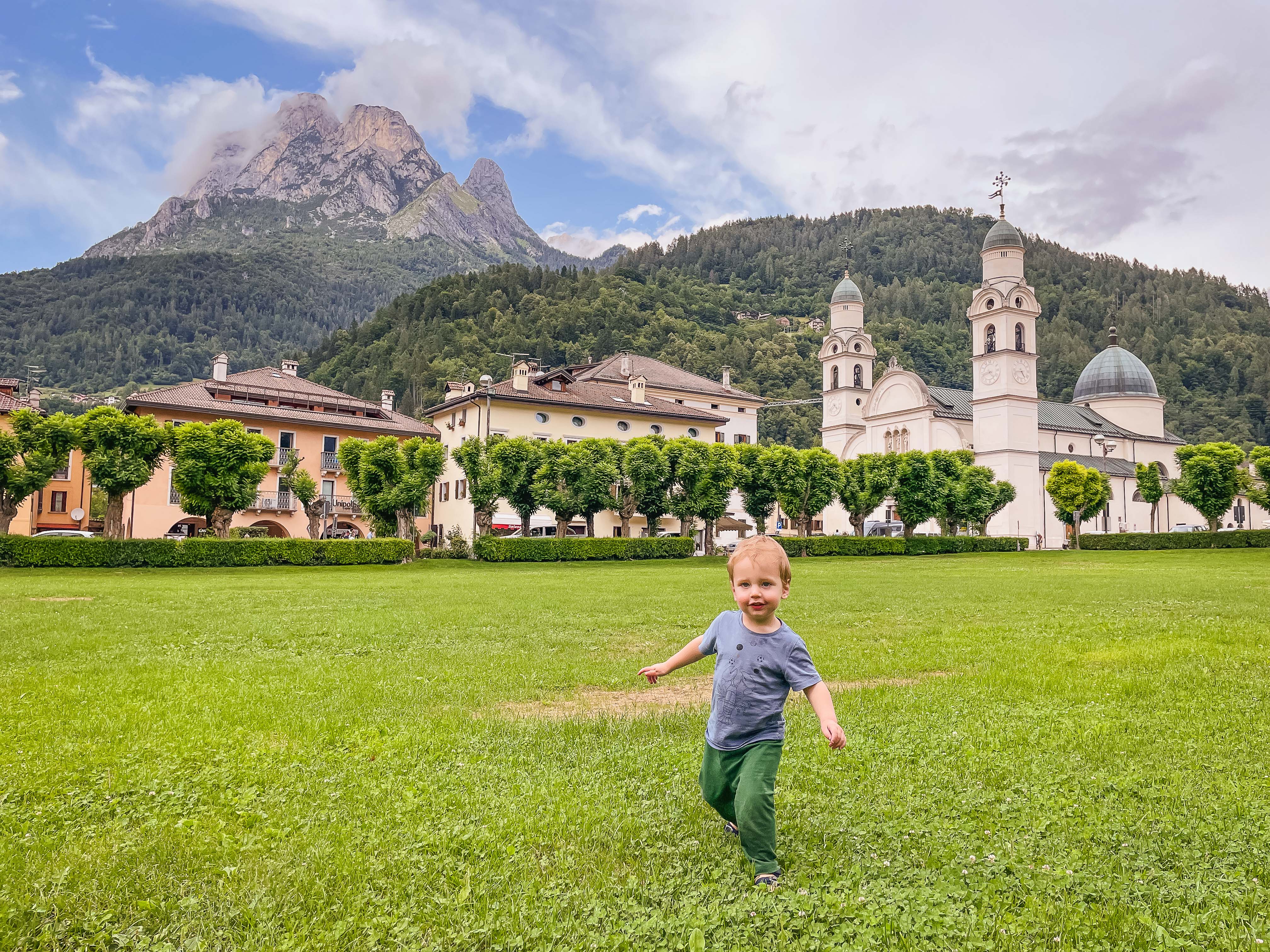
Day 1: start in Castello-Molina di Fiemmeto Pozza di Fassa
On the first day, we started slowly after having spent the night in Hotel Italia. We cycled past the waterfalls – Cascate dell’Avisio di Cavalese, where we had heavy rainfall and stopped cycling for an hour.
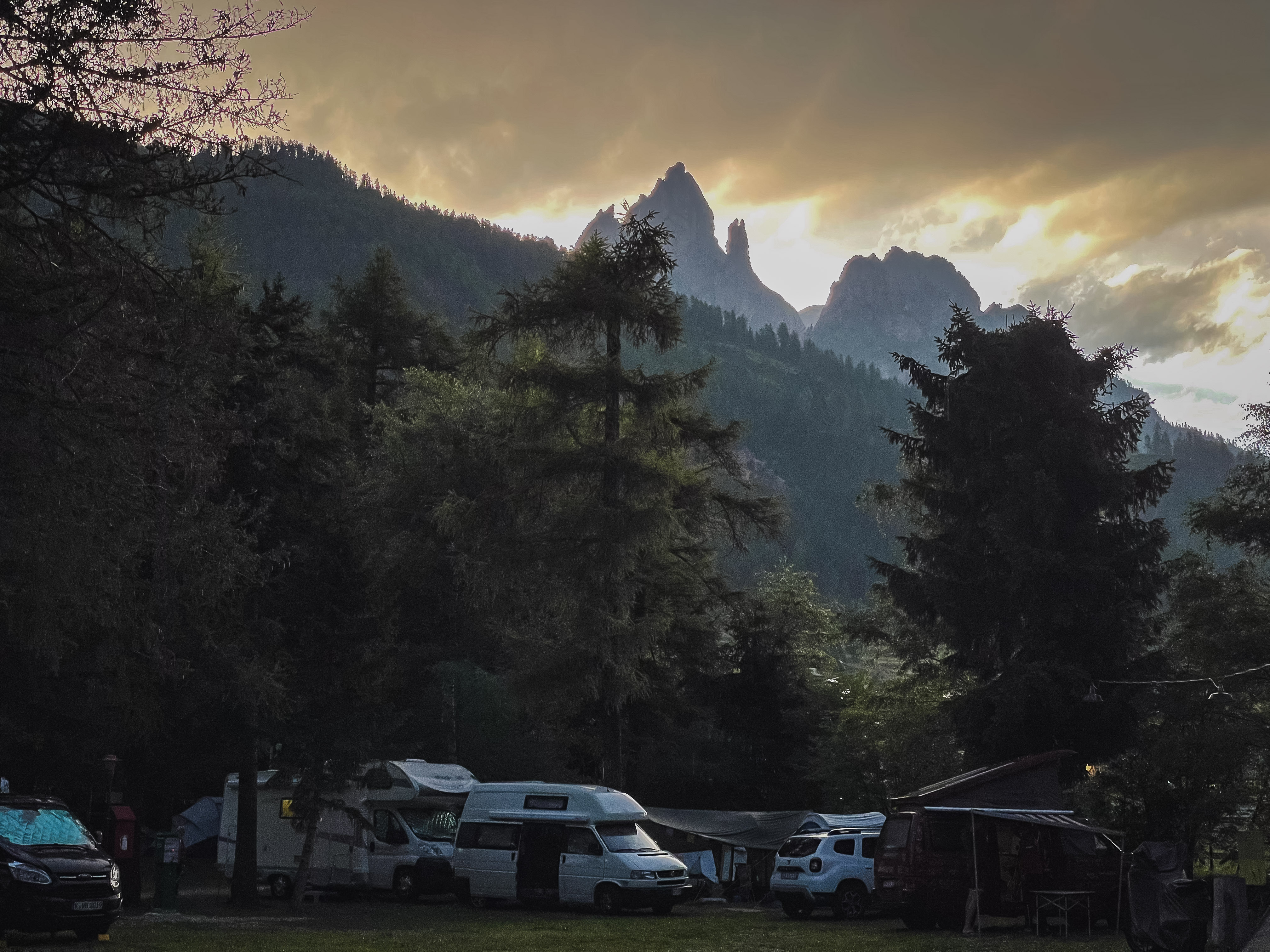
We booked an (expensive) camping in Pozza di Fassa: Camping Catinaccio Rosengarten. Since August went to bed around 19:30 we did not have the time to go to a restaurant and had takeaway pizza in front of our tent… in between two rainfalls.
Day 2: to Passo Fedaia
The second day started very beautifully, with views of impressive mountain ranges and a steep climb. We took a break to have lunch in the restaurant La Maison Fredarola while August was sleeping in his bike trailer.
When we wanted to hit the road for the second part of the climb and after having charged our batteries, we found Tine’s bike with a flat tire. When I pumped it up again we noticed it only went flat very slowly… so rather than spending an hour there trying to fix a flat tire of an electric bike, we inflated the tier every 20 minutes. With only a big hour of climbing the Passo Fedaia, we made it to Rifugio Capanna Bill. For the last part of the road we took a little closed-down road next to the hydro reservoir.
Day 3: we stayed at Passo Fedaia in Rifugio Capanna Bill
With beautiful mountains surrounding the Passo Fedaia, we decided to stay for two nights and go for some hikes. In the morning we took turns of 2 hours each to go for a hike with August while the other had some me-time. In the afternoon we took the cable car and went for a hike higher up. The Rifugio had a restaurant so we could have breakfast and dinner there. For lunch, we always had a good stack of food with us in our bags.
Day 4: to Agordo
And guess what… rather than fixing the flat tier, we decided to inflate it every 20 minutes and cycle to a bike repair shop where they fixed it for 10 euros. It saved us a lot of frustration and clumsyness on the road.
We had lunch in Agordo, visited the city, and decided to cycle a bit more uphill before searching for a camping spot in the wild. We were unlucky: The local multinational had organized their international family day in Agordo and fully booked all hotels in the surroundings. Our first pick to camp was in the garden of the school of a small village called La Valle Agordina. We filled our water bottles at the little fountain, and enjoyed the local playground, but we could not find any electricity to charge our bicycle batteries… and with more than 1000m climbing foreseen for the next day, we sure needed that.
After talking to some people in the village, they showed us their little forest and field where we could camp and offered to charge the batteries in their house. Tine had fun building a bonfire and August slept super well in his little tent, inside our bigger tent.
Day 5 to Villa Chele in Pralongo – Val di Zoldo
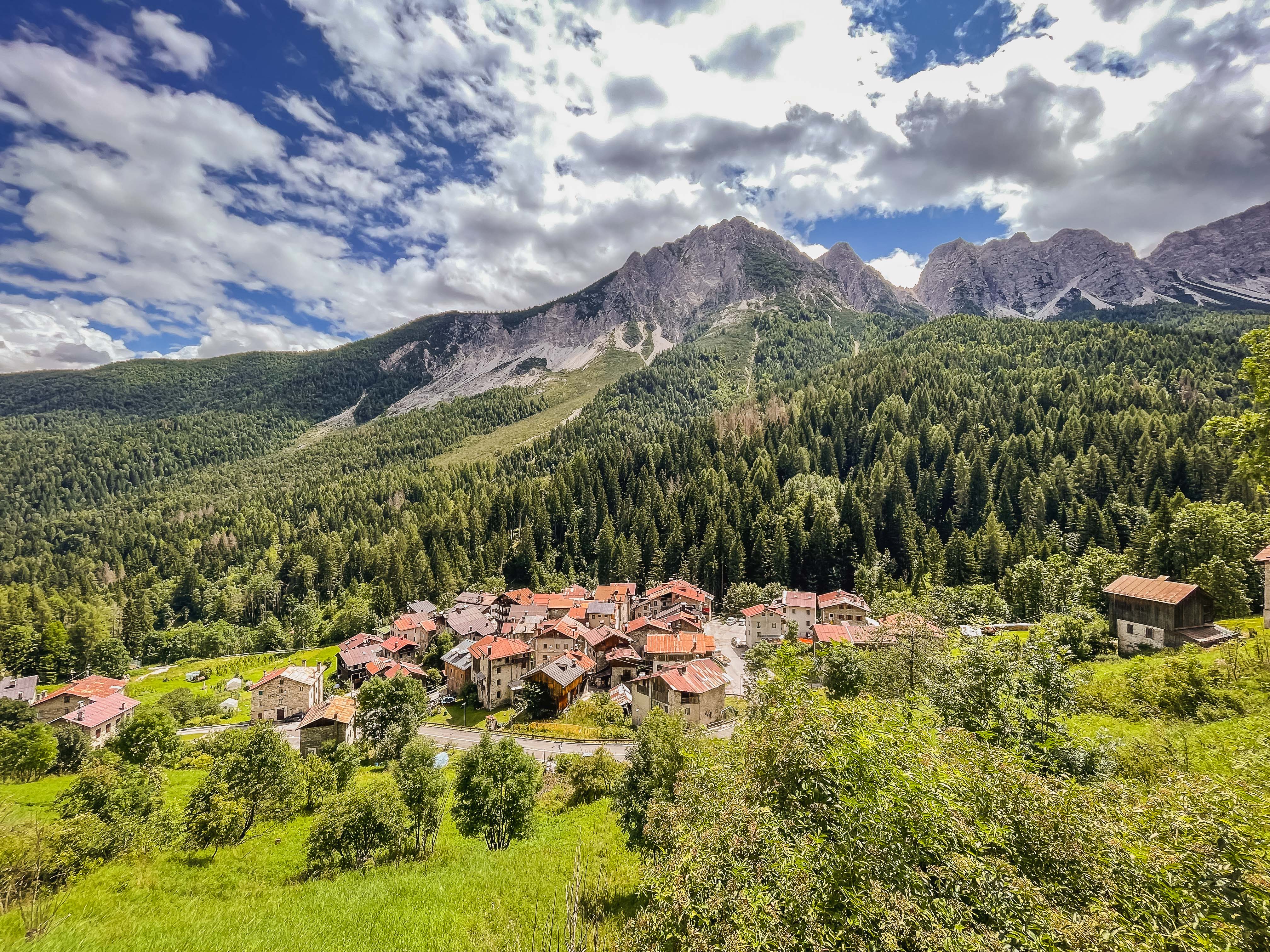
We climbed the mountain until Rifugio Passo Duran where we had lunch. We were rewarded by the impressive views of Chiesa, a beautiful old village with many charming wooden houses.
After that, we continued cycling downhill, with a small climb at the end to reach the charming room we booked with Louisa in Villa Chele. The host is amazing. She immediately volunteered to take care of August while we carried our bags up. We could do our laundry there and she borrowed us her hiking backpack for toddlers to do a bigger mountain hike.
We had dinner in Restaurant El Taier, a couple of 100 meters down from Villa Chele, and enjoyed the sunset from the hill next to the village.
Day 6 & 7 we stayed in Pralongo – Val di Zoldo
The next day she explained she had to take care of her grandkids in Belluno and that we could drive along to the city in her van… so we took a lovely road trip with sixty-something years old Louisa. We talked for hours, where she shared her interesting life story – from Argentina to Germany to Italy – travels by boat – falling in love – … An encounter with a woman full of wisdom. It gave us the perfect “Celestine prophecy” vibe full of magic. If you haven’t read the book yet: this is your call!
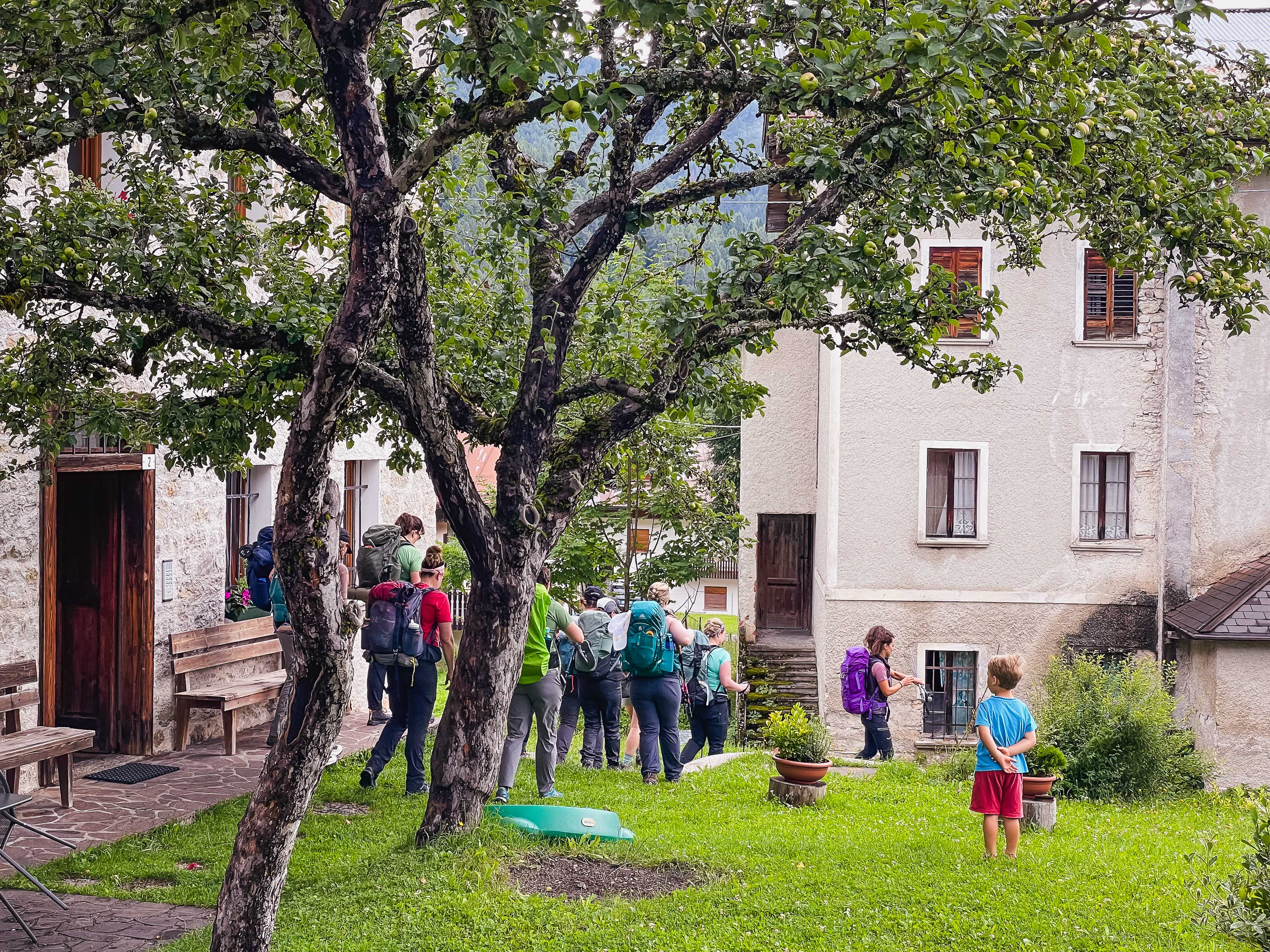
In the mornings, Louis would sneak out of the room and go for a long run in the mountains and read his book, while August and Tine would be calmly sleeping. On one of the mornings in Villa Chele a group of women hikers was preparing to head for the mountains, while one took out a box of cards called: “Nature meditation cards”. We bought the same deck and still enjoy it once in a while, a nice gift idea!
Day 8 to Cortina d’Ampezzo
This was a legendary day: we had to take a good 1000m climb again, The majestic roughness of the mountains is impressive, and while cycling you have all the time to enjoy it and look around.
After that, we continued our trip to Cortina d’Ampezzo where we booked a camping ground. We had to go to Camping Cortina, because Camping Rocchetta was already fully booked. The latter is a nicer campground according to the reviews… but the Pizza at Camping Rocchetta was good and August enjoyed the playground a lot.
Day 9 to Cinque Torri and San Ciascian
Before continuing our trip, we visited Cortina and had breakfast there.
While climbing up the next col, the views over the Cortina valley are nice, so worth stopping for.
After a couple of hours, we reached the cable car to Cinque Torri. We did not plan all of this upfront, but when searching we saw that it was certainly worth going up for a hike around the rocks of Cinque Torri.
We continued cycling for a little while until we reached B&B Hotel Frohsinn for the night.
Day 10 to Passo Gardena
As we never knew what we would find on our route and had quite some flexibility in our schedule, we would never reserve any hotels or campgrounds in advance… so we were extremely happy to find a free room in Hotel Cir. A very nice place on top of the Passo Gardena, with a good restaurant, nice terras with relaxing chairs, and the most impressive views of the rocks around.
Day 11 we stayed in Passo Gardena – Hotel Cir
Since the hotel was so nice and nature so impressive, we decided to stay a second night and take the time to relax and take half a day of me time each, while the other would take care of August.
Day 12 to Moena
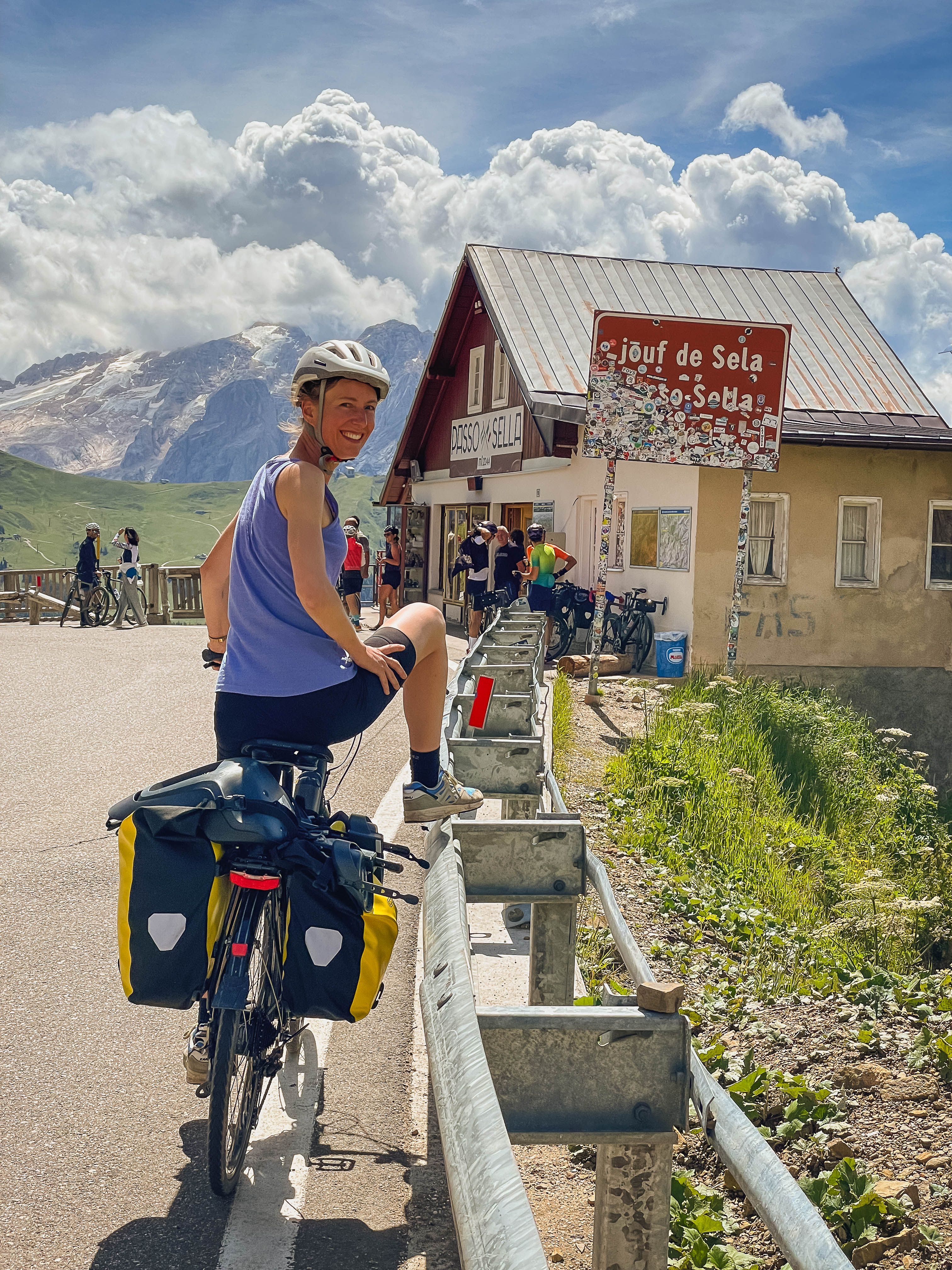
We climbed the Sella Pass before closing our loop through the Dolomites in Canazei, the city where we passed as well on our second day. That night we stayed in Hotel Catinaccio, a nostalgic hotel that had its best days… but the old charm was pretty funny and August enjoyed the pool a lot.
Day 13 to Castello di Fiemme
On our last day, we rolled down the hill, along the river with a day of fully separated cycling lanes to our start location. It was an easygoing day to close this beautiful trip through the Dolomites.
In case you are planning to take this trip, please reach out with any questions! It would be great if we could inspire others to have a similar adventure with their kids.
Disclaimer: I’m definitely biased in this post 😉 since I have been working on Moonlight Express and for European Sleeper
If you’re looking for a cultural and fun weekend escape from Brussels or Antwerp: jump on the direct night train to Berlin!
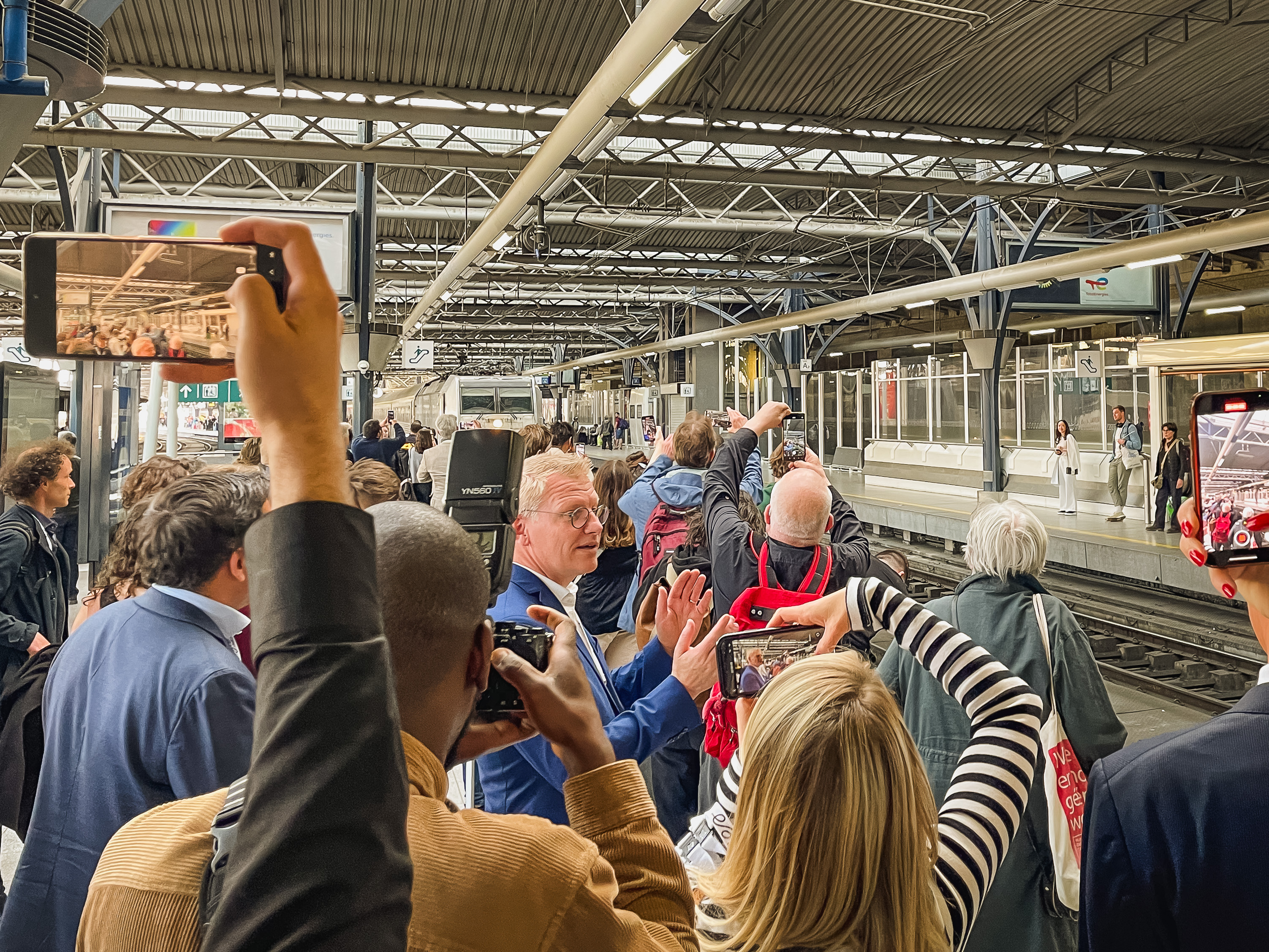
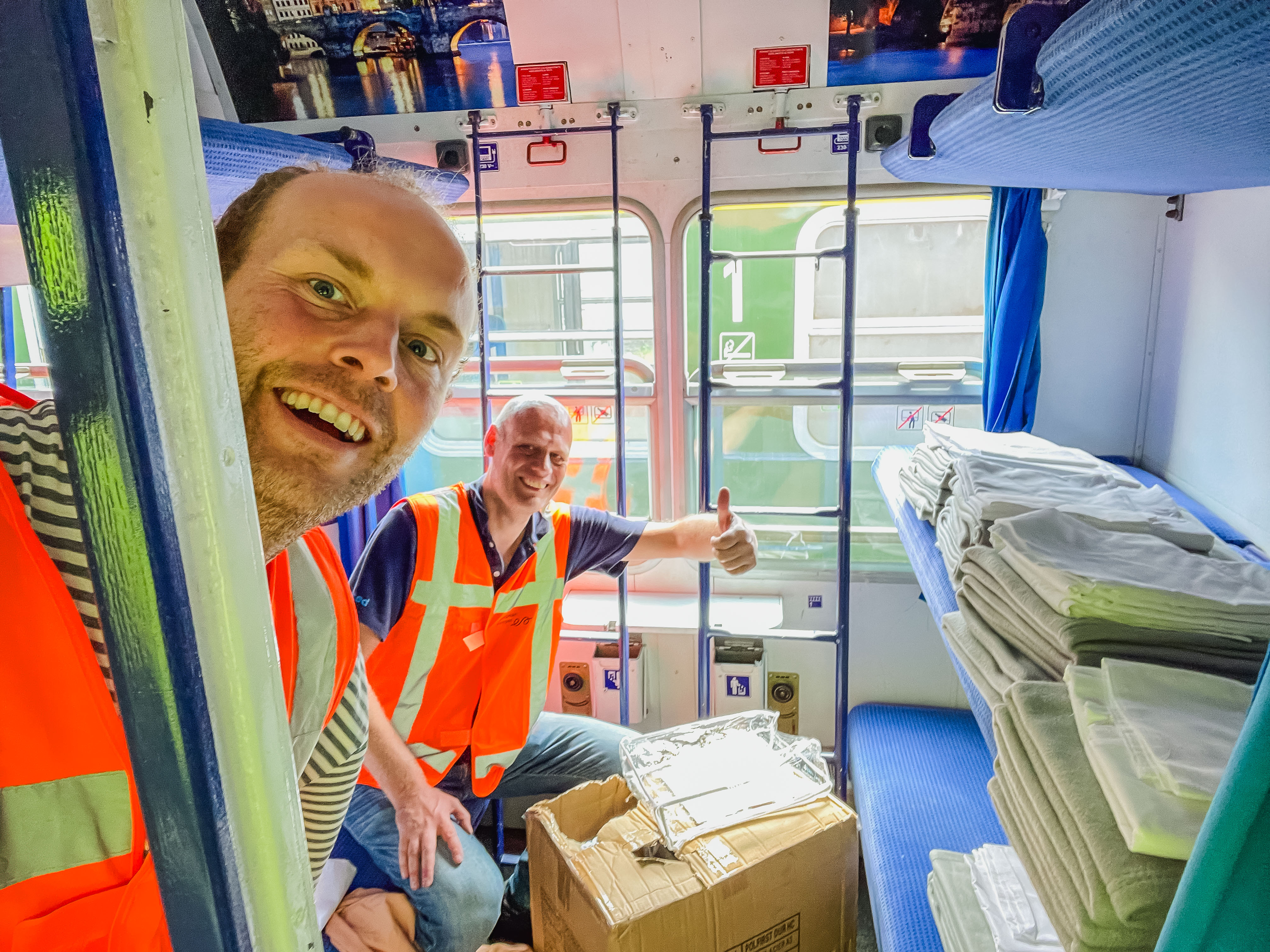
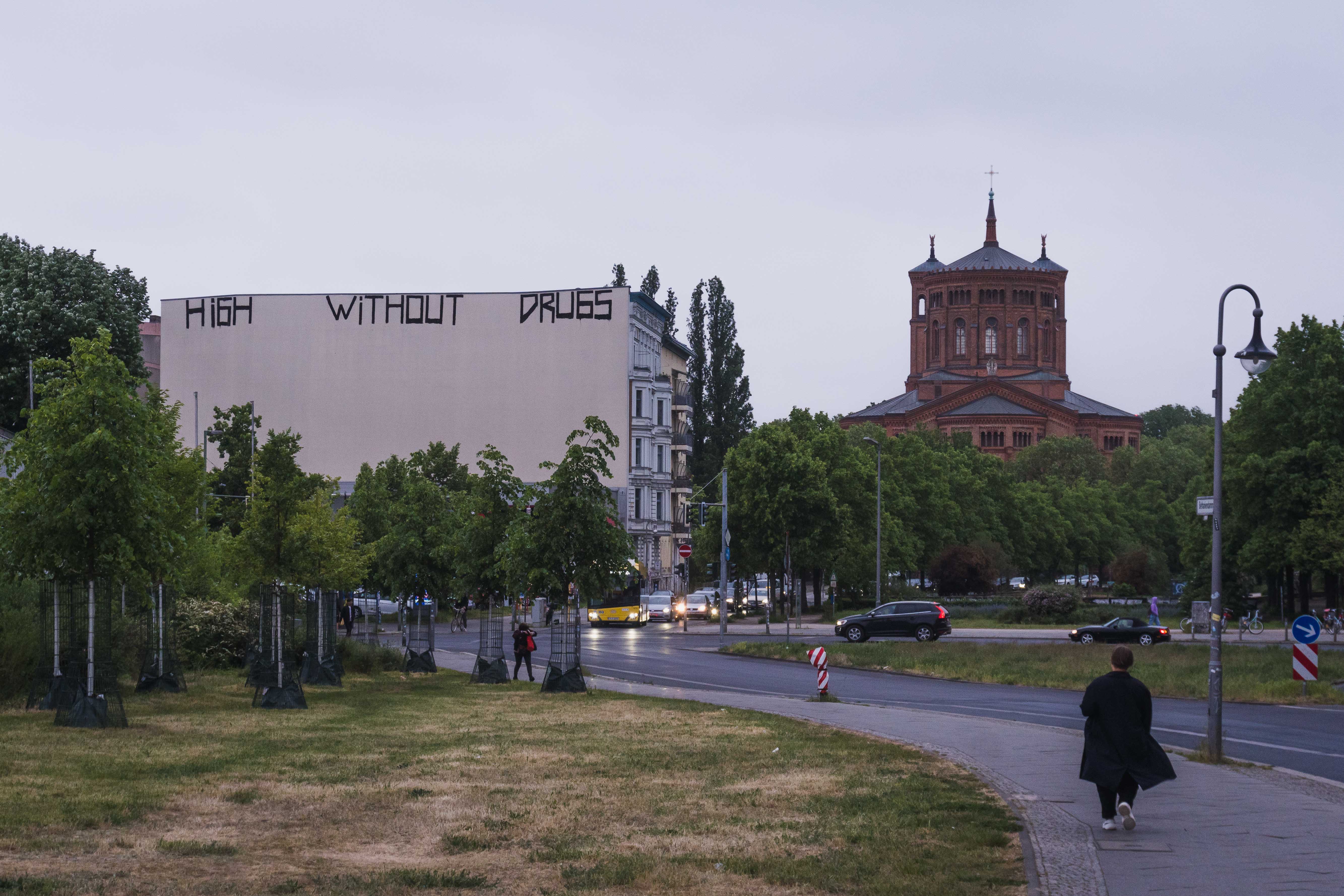
In May our night train from Brussels to Berlin started circulating. With hundreds of cooperative shareholders that contributed, the night train could finally start circulating on the 25th of May 2023. I traveled to Berlin to be part of the first trip, enjoyed Berlin for a couple of days, and helped a bit on the preparation of the maiden trip. To manage expectations, it’s important to know that the coaches are old, so the experience will be a nostalgic one rather than a luxurious trip! In the future, new coaches will be renovated and built for European Sleeper, but in the short term, these coaches are the only available ones.
If you’re planning to take this trip with kids and want to have our best tips & tricks, make sure to check out our article about train travel with kids.
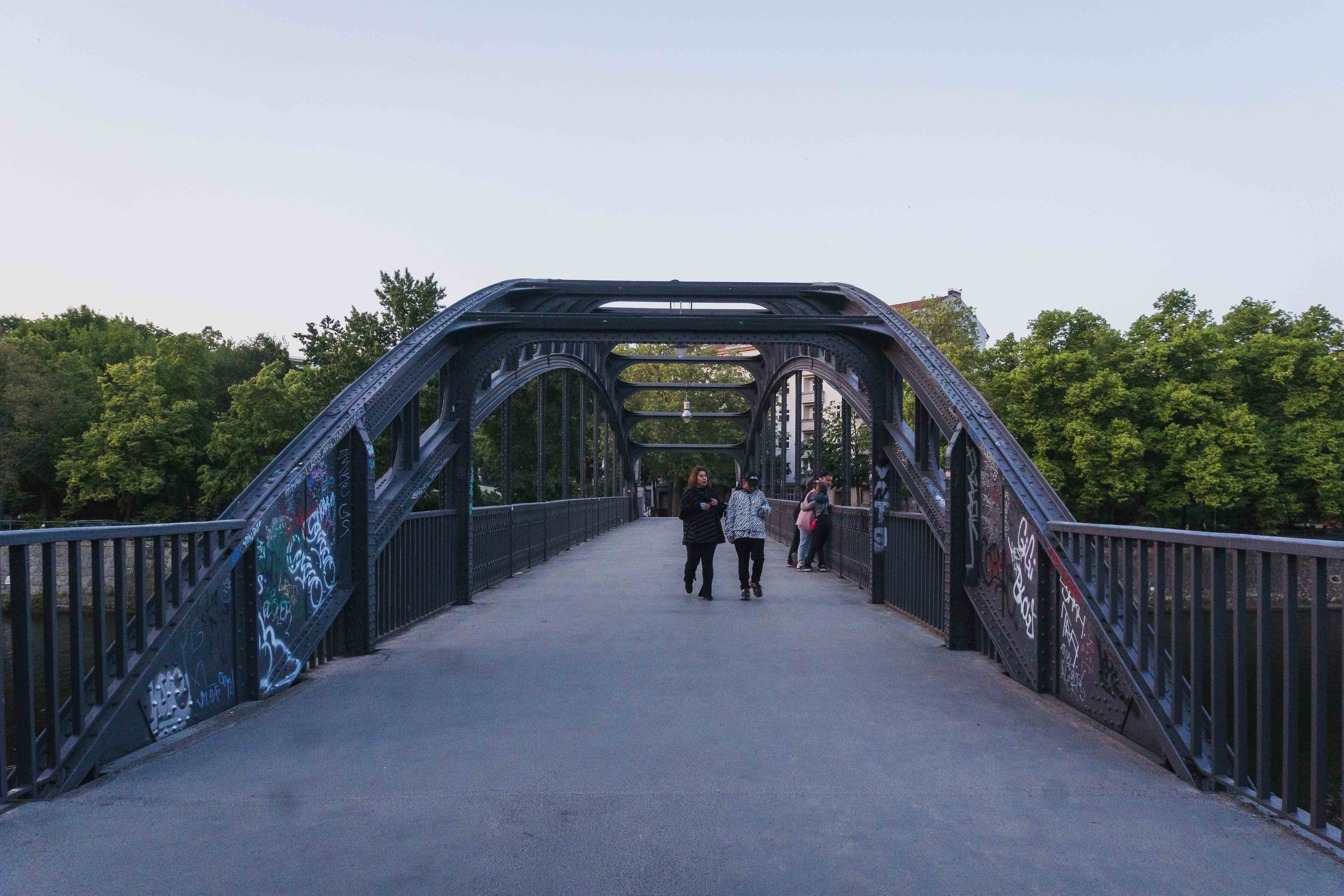
It was not my first time in Berlin, so I did not feel pressured to try to see all the highlights. It’s fun to just do what you feel like and leave the rest for another trip. The places I hang around this time:
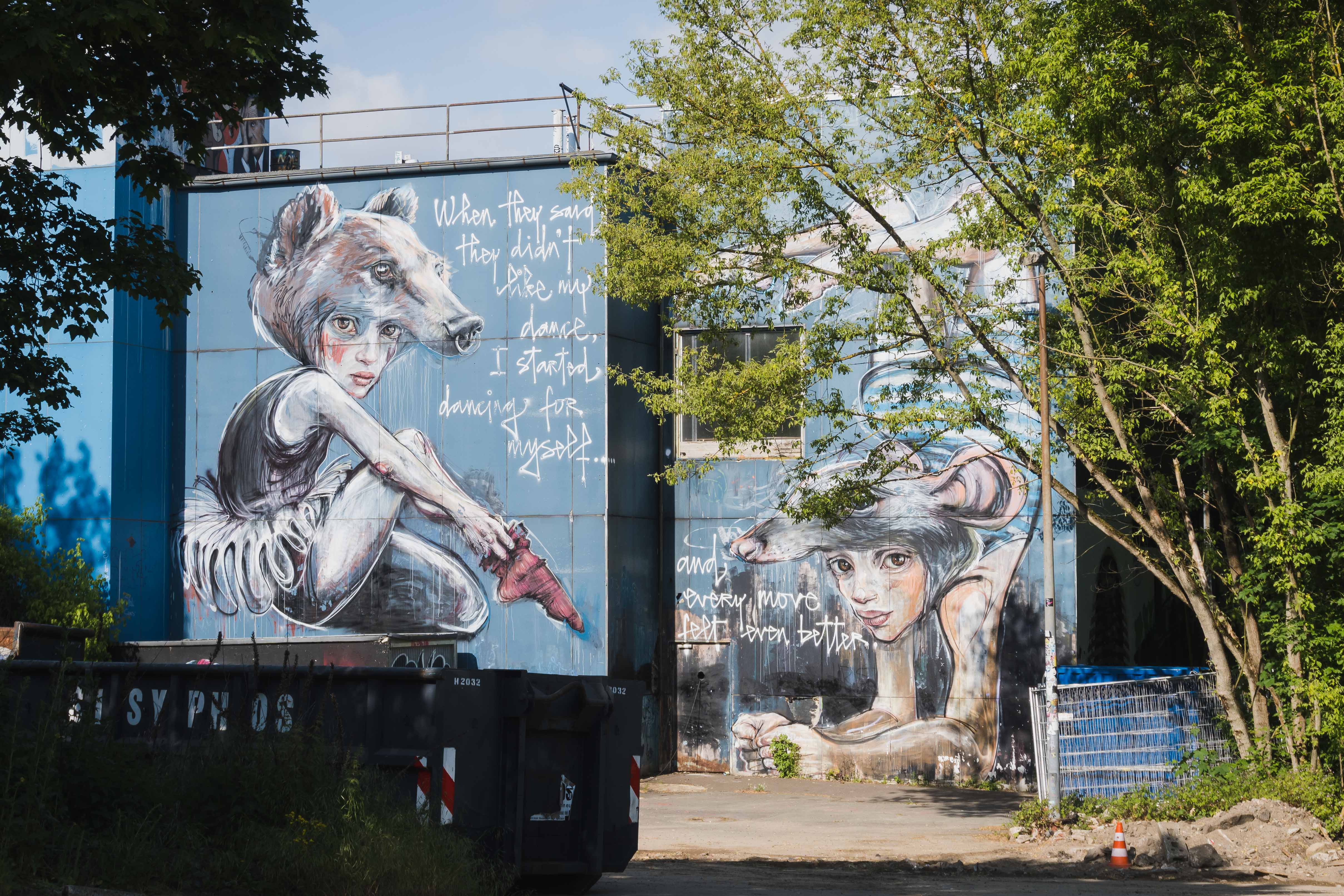
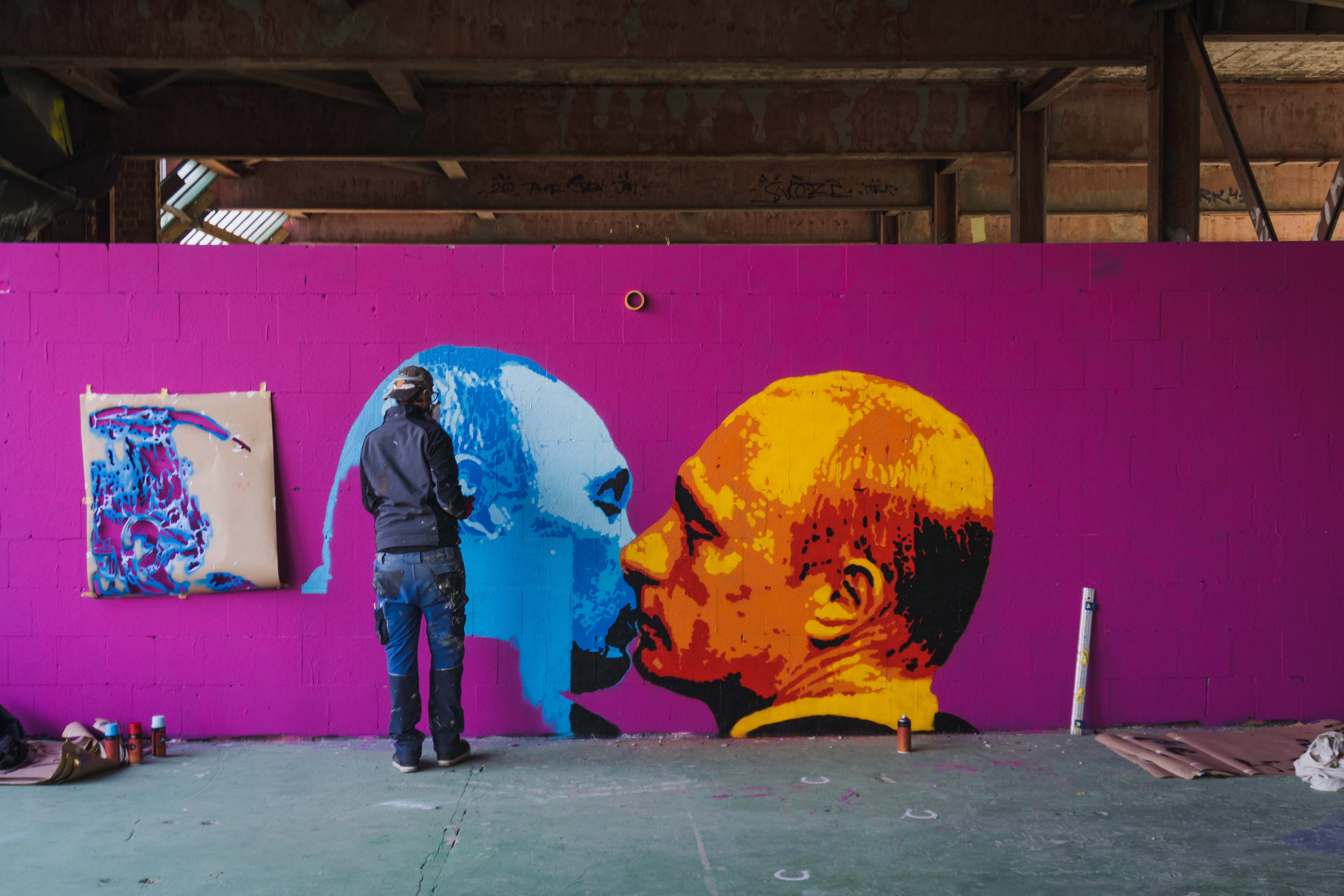
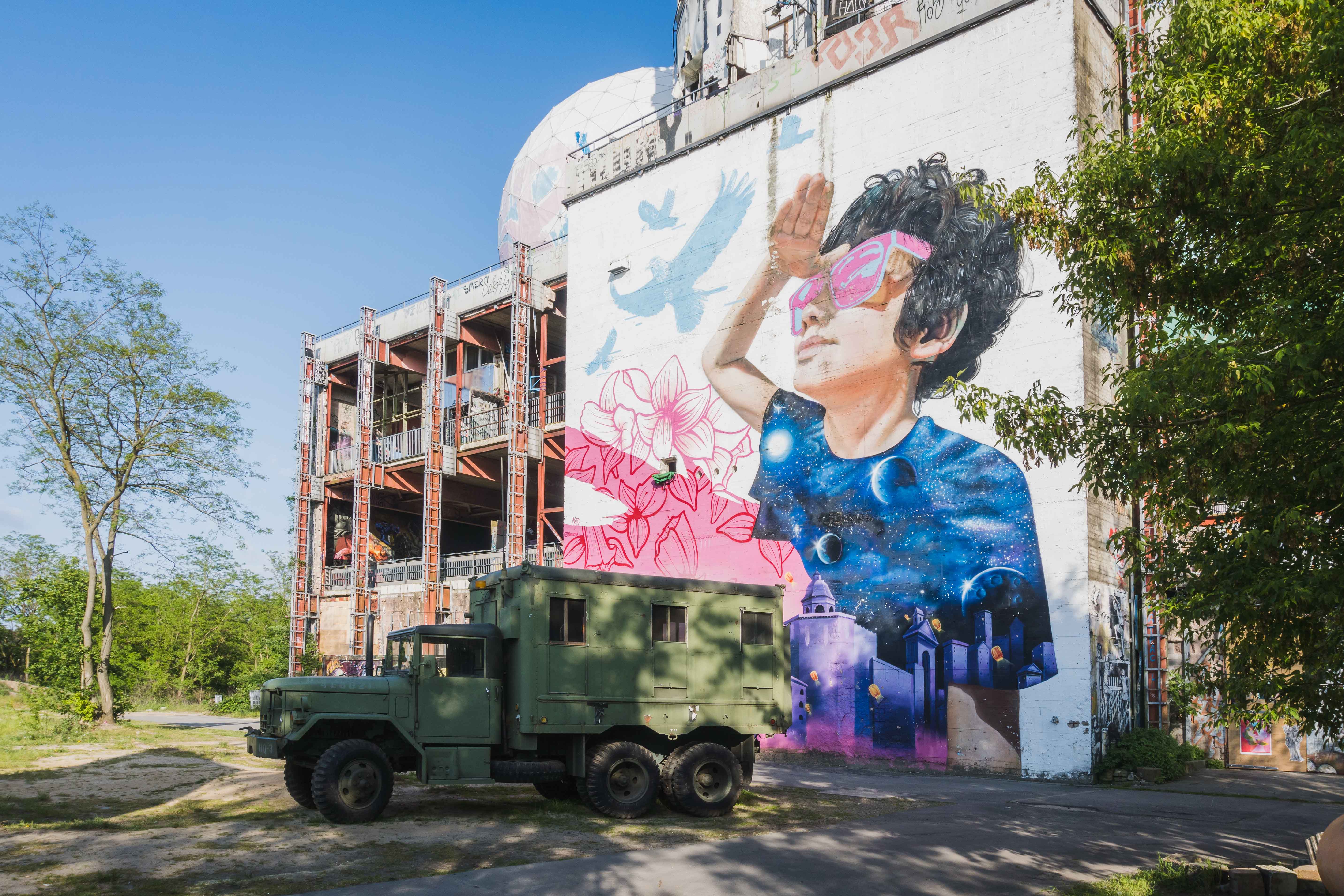
Climbing Teufelsberg – a beautiful hike in nature, climbing a mountain built based on the debris of World War II. On top, you can access the old military buildings full of graffiti (access for 5 euros)
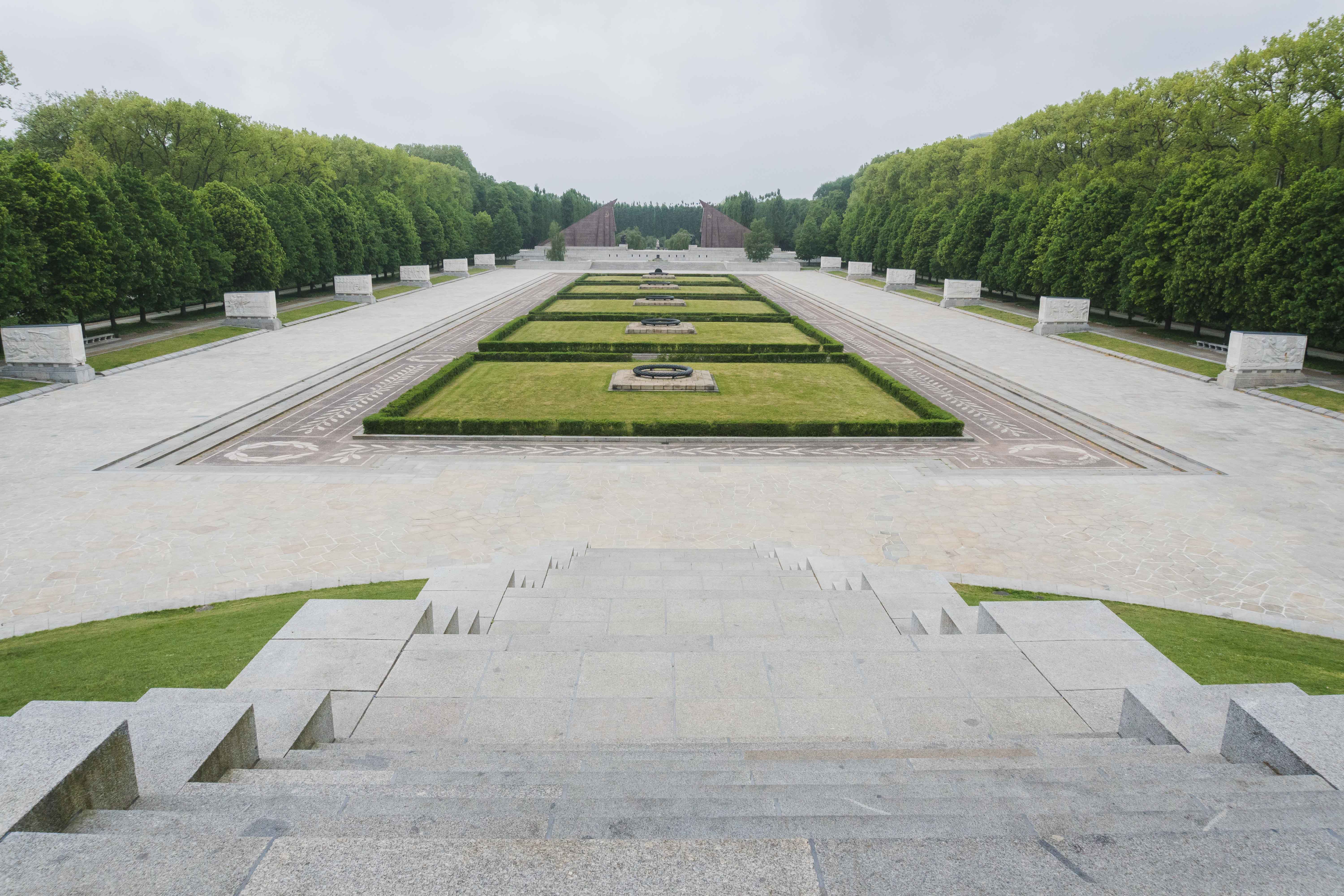
Soviet War Memorial Treptow – a free guided tour through the impressive soviet memorial with Guruwalk
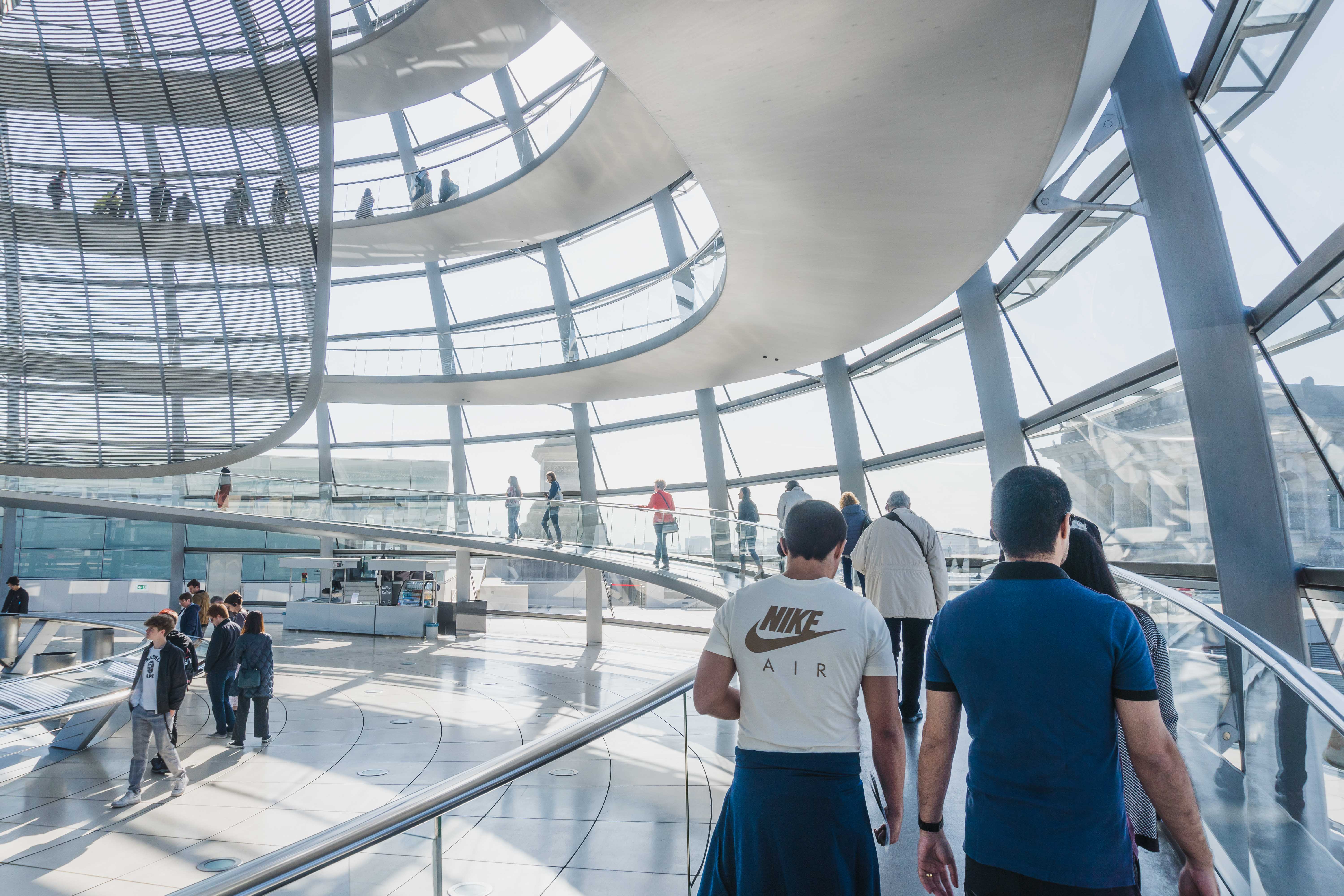
Reichstag – Free visit to the rooftop for impressive views, you do need to reserve online in advance.
East Side Gallery – Berlin wall
Museum island
Brandenburg Gate & Memorial to the Murdered Jews of Europe
While wintertime can be very cold in Berlin, the city is full of incredible museums and restaurants so that even on the coldest days you can still have an amazing trip. Of course hot summer weather is even nicer for enjoying the many parks, beer gardens, and nature around Berlin.
Just book a trip with European Sleeper and find out for yourself 🙂
When traveling to the World Aviation Festival to hold a presentation on Sustainable Aviation Fuel (SAF), I wanted to make a statement. That’s where I needed the website of The Man in Seat 61 to guide me towards the best train itinerary to get to Lisbon. For more info on why I was at the World Aviation Festival, check out the video at https://www.green-trail.eu/
I would have taken my first flight in 4 years, only if I could buy a ticket with truly transparent SAF certificates… which was not possible. I tried all I could to buy fuel straight from different producers, but none were capable of selling it to me within the first 6 months. So I decided to go to Lisbon by train!
It took me two full days to go and another two to get back. It was a beautiful trip, but a tiring one. Before Covid, I would have been able to travel to Madrid on day 1, and the same evening take a night train, waking up in Lisbon the next day… but that train has been canceled leading to a hilarious situation: it takes 3 trains with transfers in the middle of nowhere to get from one capital to the next. All details of the trip can be found here on Seat61.com. I took a stopover in Madrid where I slept in the Latroupe Prado hostel and had some good tapas in El Alambic around the corner.
It’s important to mention that for the return journey, the transfer time in Badajoz is too tight with only 10 minutes in between, while the bus-like train that takes you there always has a delay of 10 minutes or more. We were very lucky that the high-speed train to Madrid waited for us and that we arrived just 13 minutes late… since the train would have left 2 minutes after anyway, with no more options to make it to Madrid that night except for a 500 EUR taxi or a hitchhiking adventure.
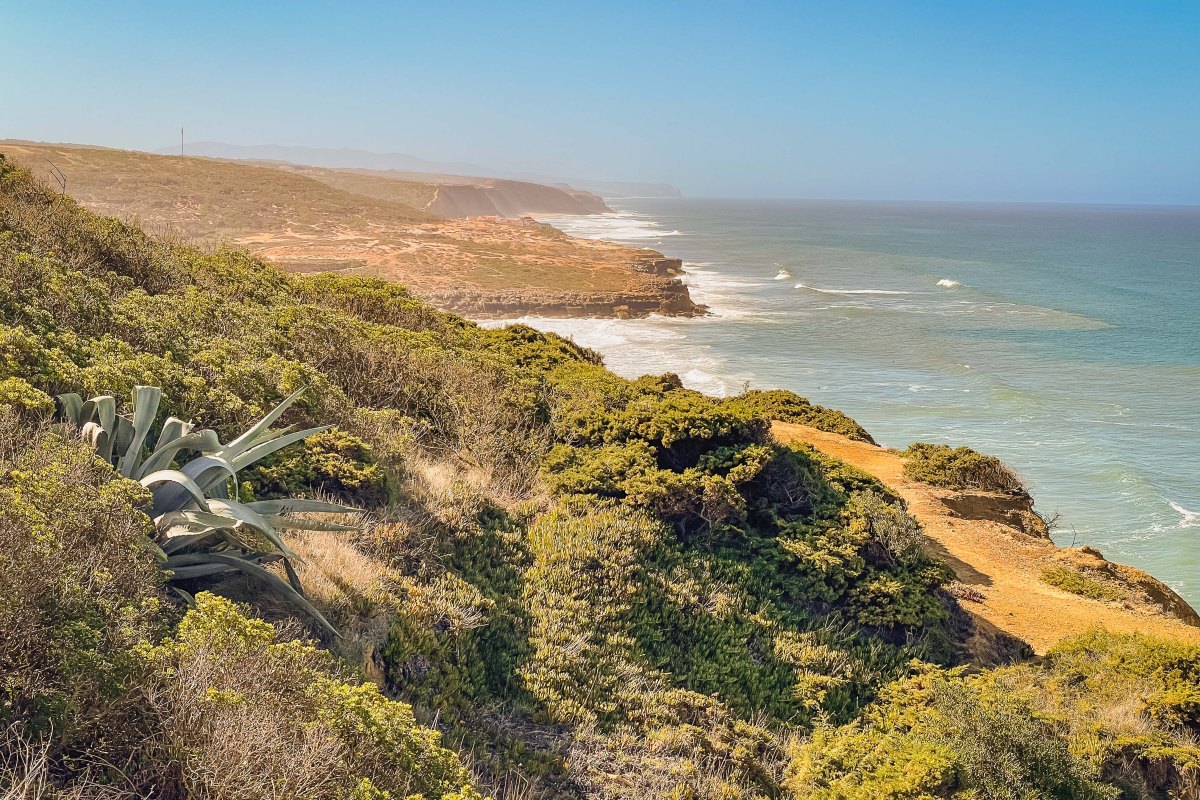
I went to Portugal for work and spent some days in Ericeira and Lisbon. For 9 days I took a small backpack and my folding bike… and given the many train connections to get, I would definitely recommend packing light. If you are not in a hurry, you certainly want to split the travel into 2 or 3 segments so you can enjoy it more. Possible stops are Barcelona, Madrid, Entroncamento, or Badajoz.
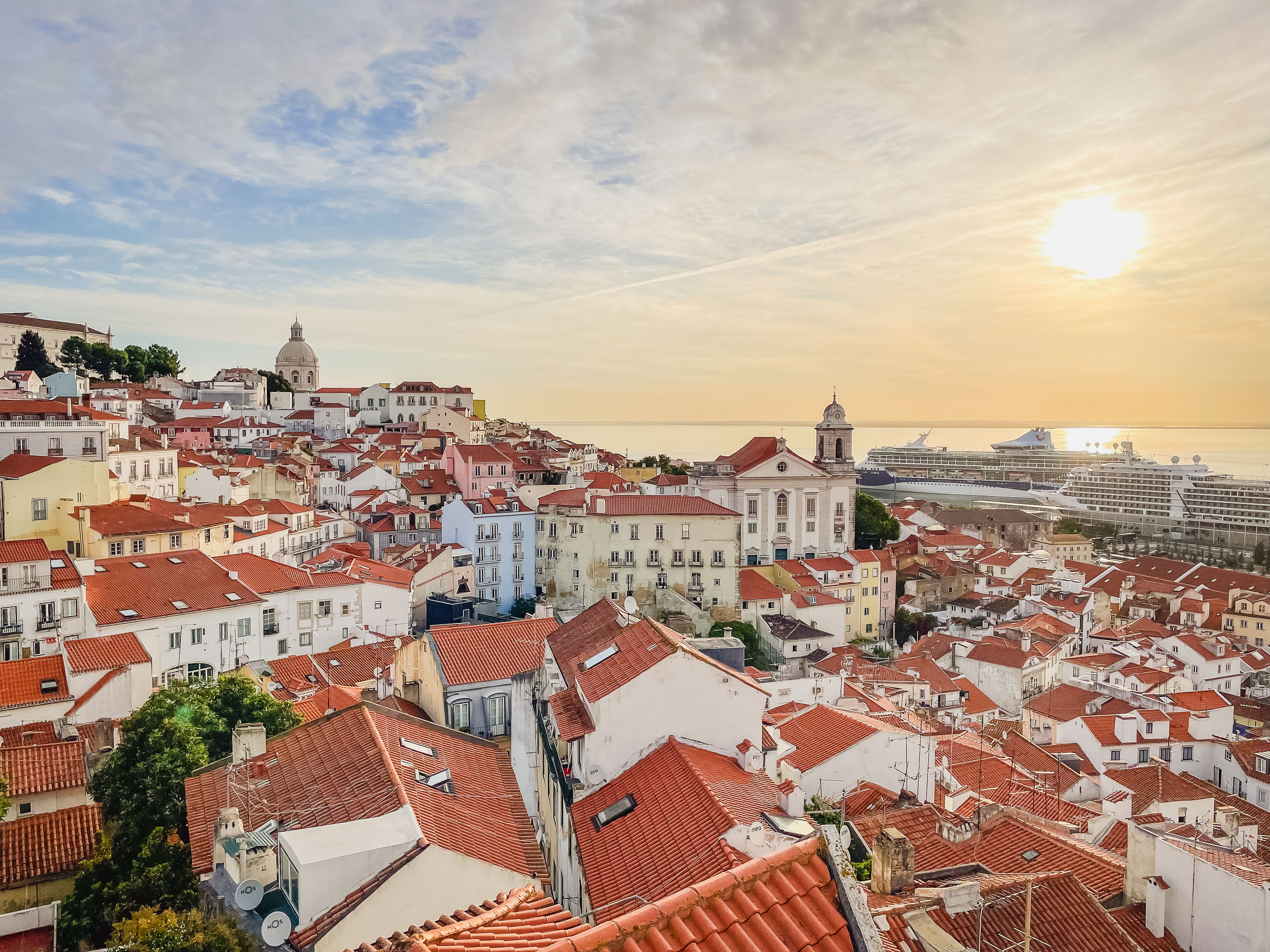
Recommendations in Lisbon
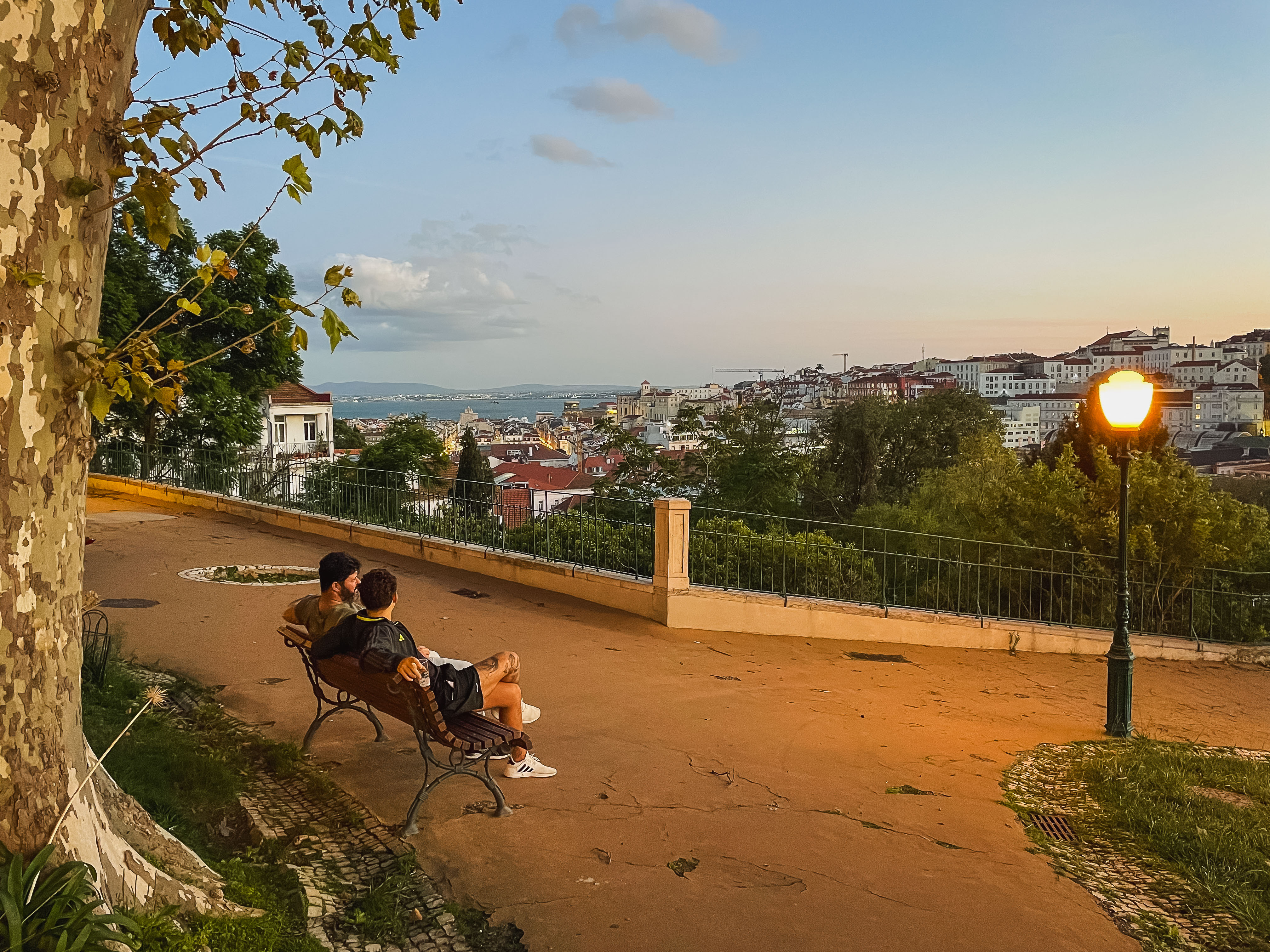
Miradouro da Senhora do Monte – nice views for sunset
Secret garden – bar with concerts and basic restaurant, just under Miradouro da Senhora do Monte
Sao Vicente de Fora – monastery
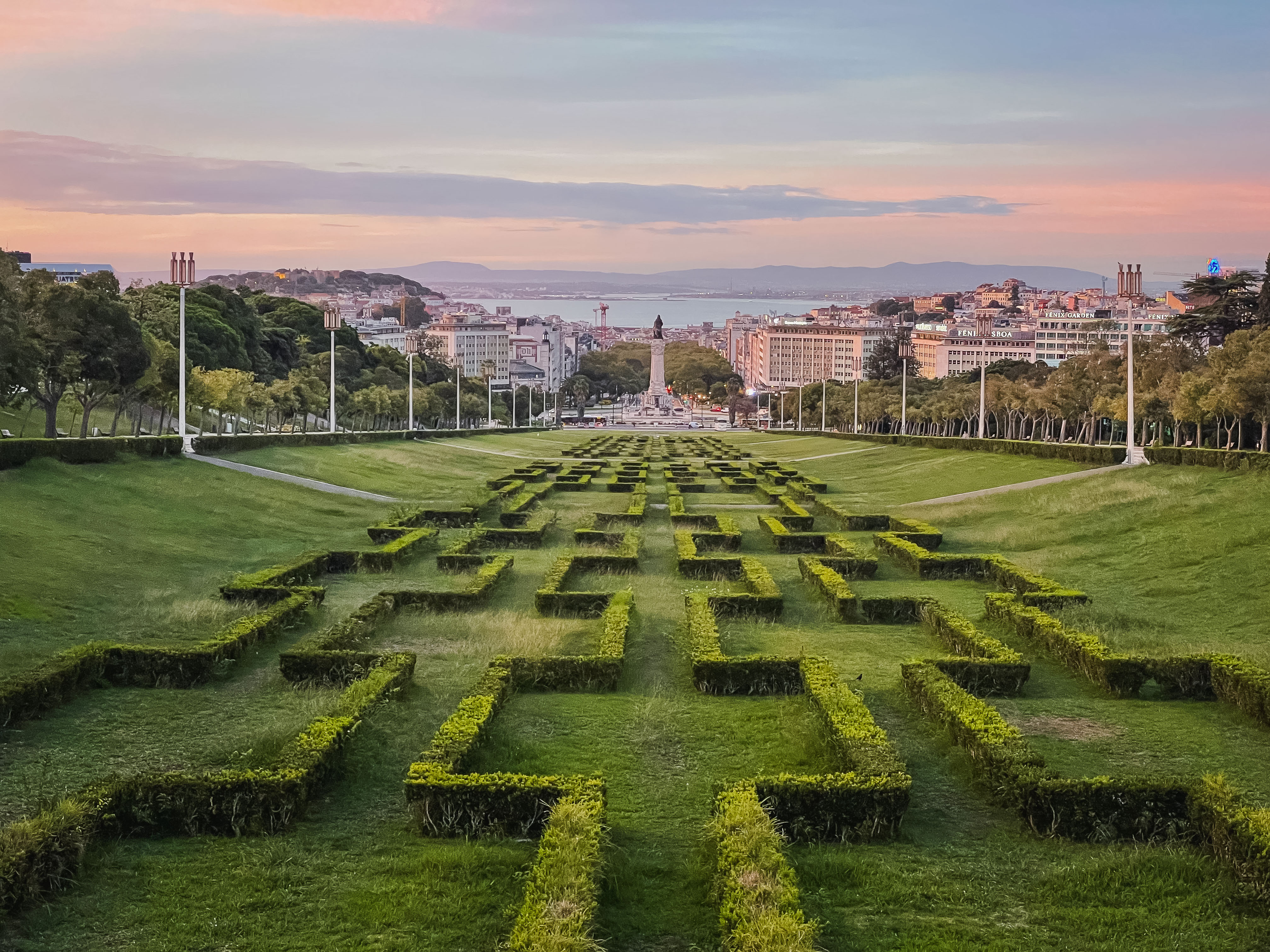
Parque Eduardo VII – a nice big park in the city center
Jardim do Torel – also with nice views
Viewpoints from Largo Portas do Sol
Ruta de Sao Pedro de Alcantara – for the famous tramway going uphill
Santa Justa Lift – take cash or you don’t get in!
Praça do Comercio – big square on the waterfront
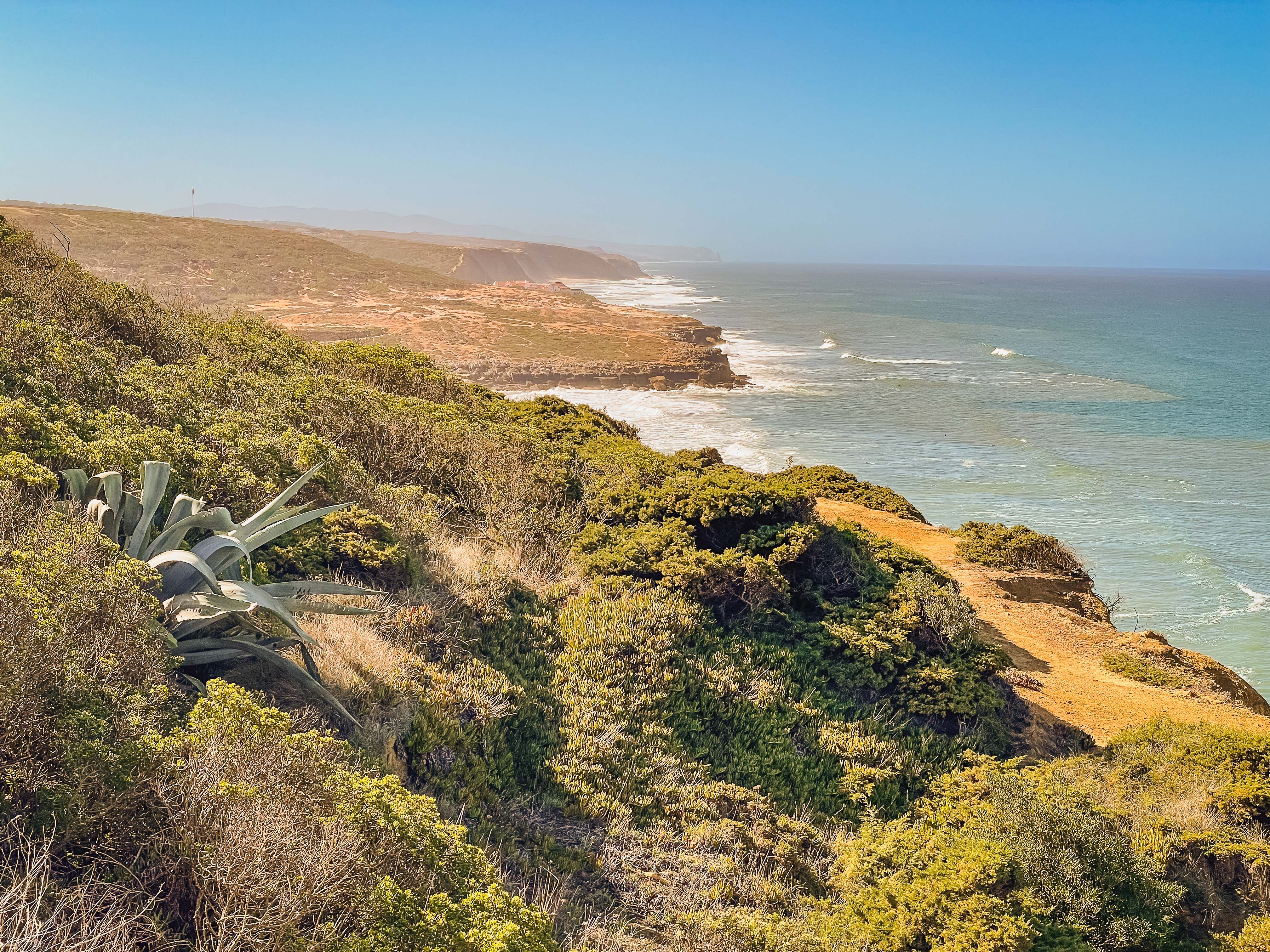
Recommendations in Ericeira
Getting there: you can get there easily by taking the direct bus from Lisbon Campo Grande to Ericeira.
Selina hostel: If you’re traveling alone, stay in the Selina hostel with yoga in the morning, a small swimming pool, a healthy breakfast, and a good restaurant.
Surf: There are plenty of surf schools. Depending on the swell, beginner classes get canceled on some beaches. You might want to consult multiple schools and ask for the maximum number of students per teacher, which should be 4 or 5 max and not 10 per teacher… leading to a lot of frustration.
Mountainbike: we rented mountain bikes, and did an incredibly beautiful tour with a guide from Take Off e-bike for 35 euros per person only.
Skatepark & halfpipe: Boardriders Quiksilver Roxy flagship store has its own huge halfpipe and skatepark. They also offer all kinds of surf and skate courses.
Sunset locations:
Mar das Latas – wine bar with perfect views for sunset
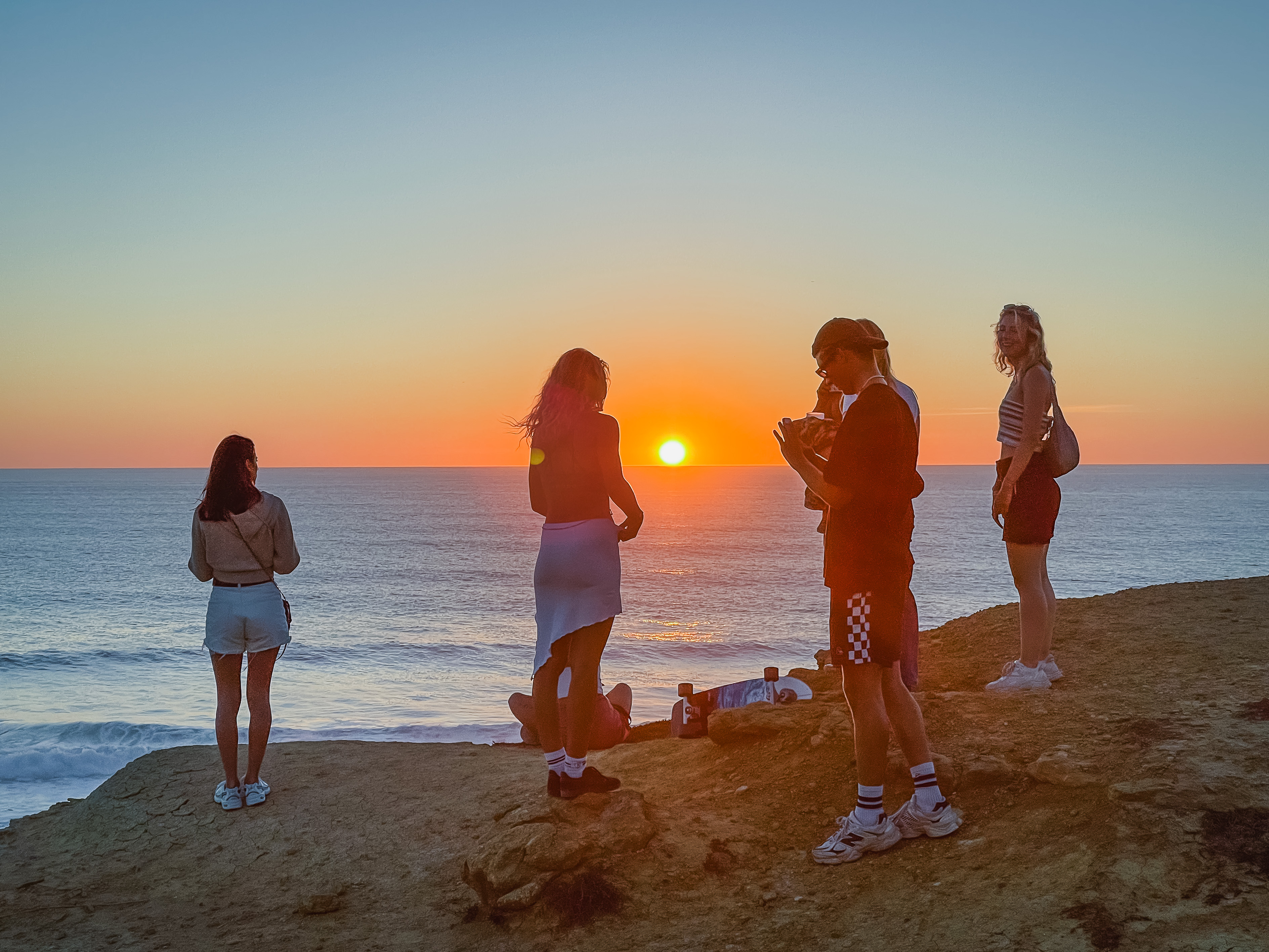
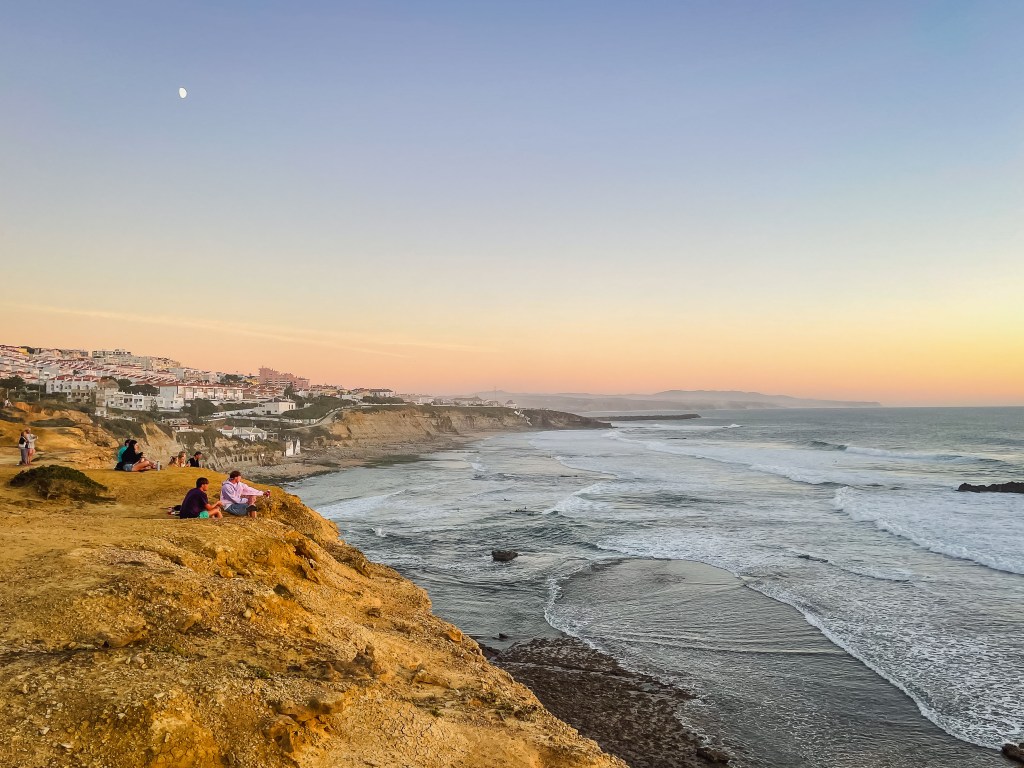
Praia da Empa / Pedra Branca reserve – views from the top of the rocks for sunset
Restaurants:
La Popular Taberna
Mar d’Areia – fish restaurant
Howm by Maikai
Mar das Latas – need to reserve, always full
So, Brussels to Lisbon by train is an option if you have some time. If you need to rush it in the shortest possible time frame it soon feels like a bit too much. Perfect for a holiday trip, less perfect for work 😉
Some months ago I booked a surprise weekend in Lustin, close to Namur. To get there we jumped on the direct train from Brussels-Schuman to Lustin and took our folding bikes along. It took only 1h13 minutes to get from Brussels into this lovely spot in nature.
With a weekend ticket you pay only 12,20 EUR p.p. going and back, only downside is that it requires you to leave Brussels after 19pm on Friday evening.
We stayed in La Fête au Palais, a small hotel on top of the hills next to the Maas river. The boss kindly picked us up at the railway station to bring us up the hill (inform him in advance). The hotel is no-nonsense and nice. The rooms with terrace towards the river are a pleasure to hang out and cost 109 EUR/night. You want to reserve well in advance since it’s fully booked most of the year. The restaurant of the hotel has a beautiful terrace so on Friday evening we ate at the restaurant of the hotel.
While going on a hike on Friday afternoon we encountered a small snake and some lovely shiny cockroaches… The big surprise came in the evening in front of our room when we heard some nibbling noises and got to see some beautiful racoons. They are a true ecological problem in Europe since they are an exotic species disbalancing nature by killing too many birds, squirrels and lots of fruits and plants. Apparently there’s hundreds of them in the Belgian Ardennes.
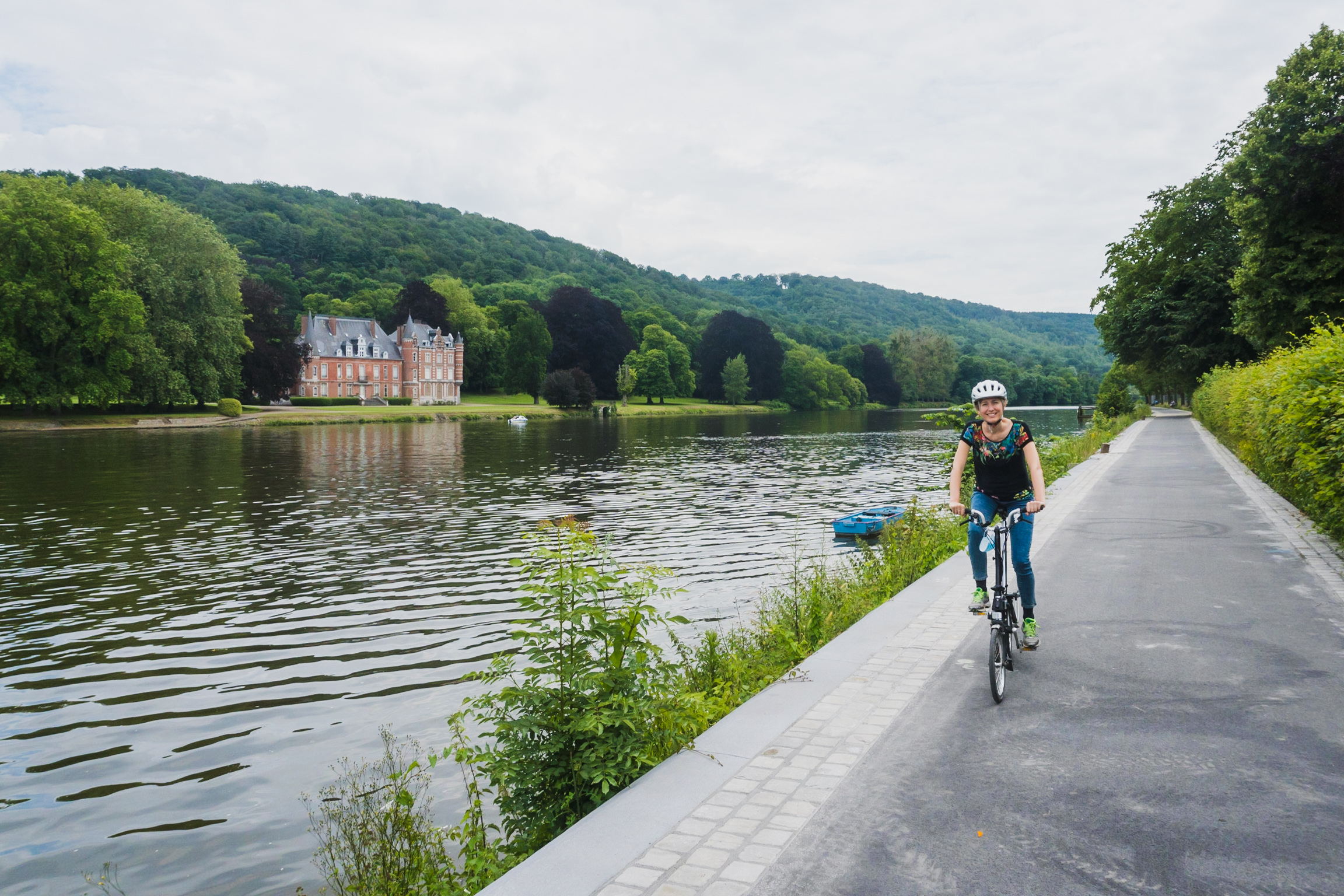
After a good breakfast in the hotel, we filled our Saturday with a nice hike and a long cycling trip along the Maas river. We cycled from the hotel all the way to Namur. Made a stop to picknick, chilled at the local hipster beach bar ‘The Flow‘ and cycled back. In the evening we ate at Pizzeria Venezzia, the local restaurant in Lustin, which is at walking distance from the hotel, following a small hiking trail.
On Sunday we first took a walk in nature, following the local tracks indicated through the woods. In the afternoon we took our bags from the hotel and rolled down the hill by bike.
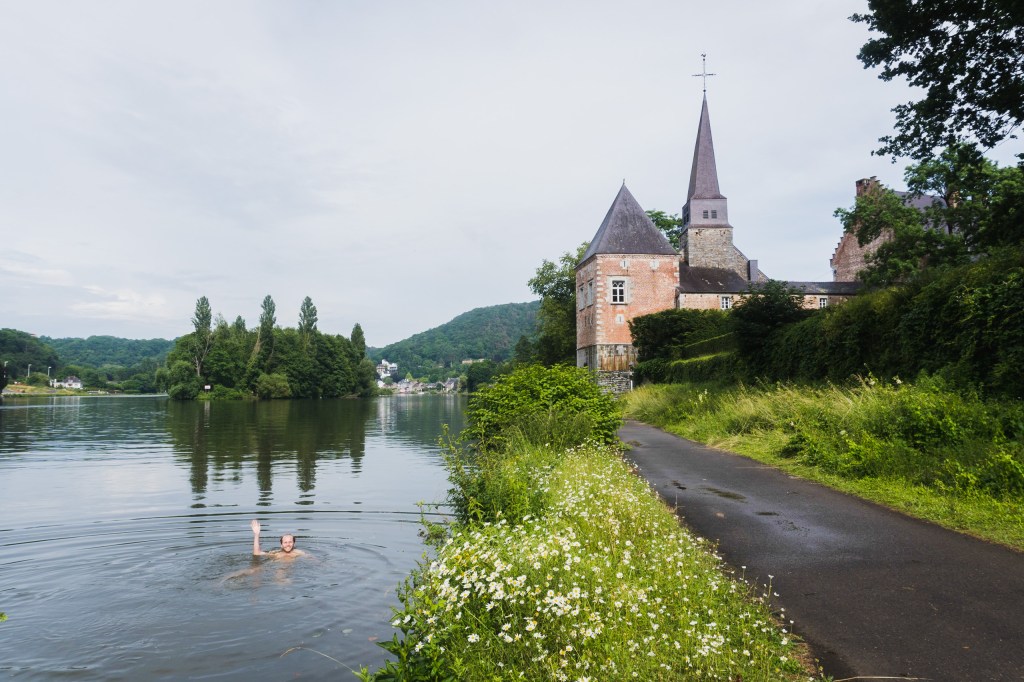
As you might remember from other blogposts, I enjoy swimming in rivers… The Maas river is a very beautiful and calm river to swim in, with stairs all along the riverbanks.
We followed the Maas river until we got to Yvoir where we took the train back to Brussels (eating vegi takeaway on the train from Jin Xiu next to the station).
All in all, it’s an easy trip from Brussels and a perfect escape into nature both in summer and wintertime. There are also airbnb’s around the railway line from Brussels-Schuman to Lustin. On the hills around the Maas there’s a lot of forests with hiking routes to discover. No excuses to stay in the city!
During the second week of our cycling holidays we entered into the woods of the Black Forest. The days were filled with a mix of cycling on mountain routes, some city tripping and a good bit of relaxing and reading.
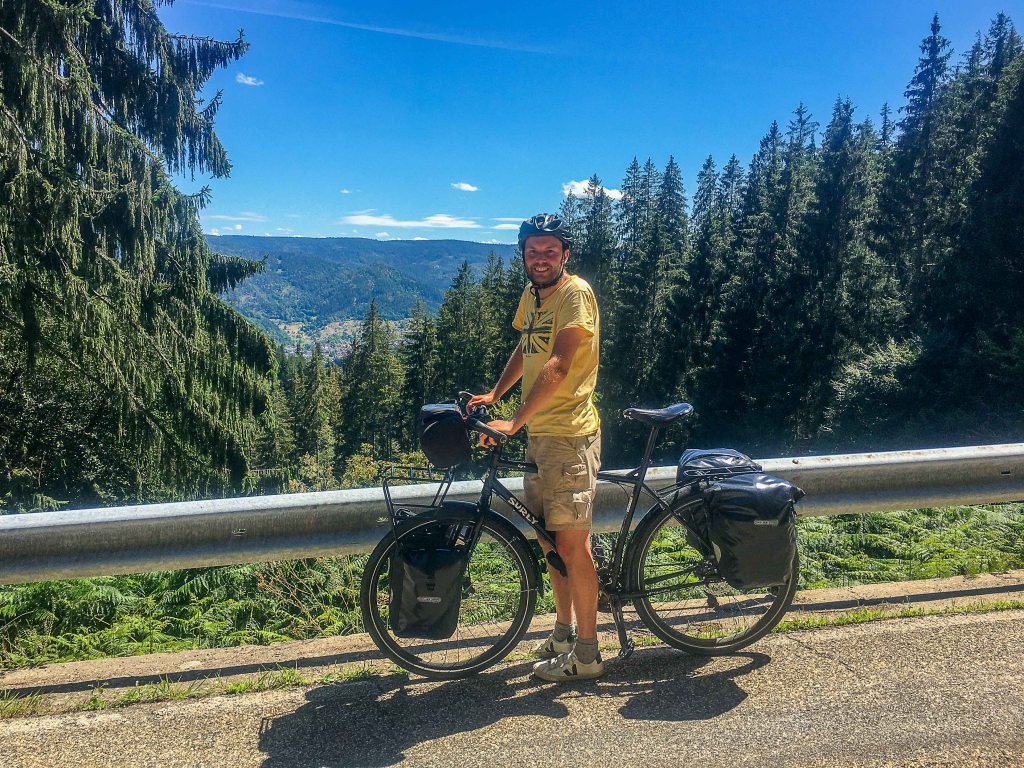
It was our first time climbing 1000 metres with a fully packed bike. It felt really rewarding to suffer for a bit, before having an impressive view. A long downhill only adds to this positive experience.
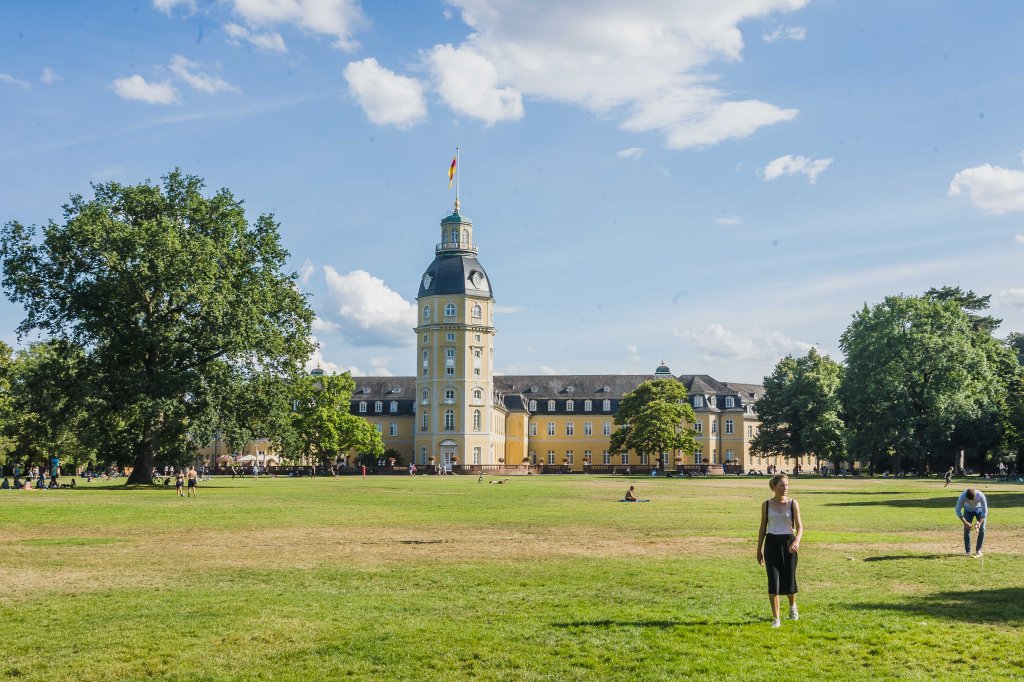
Karlsruhe
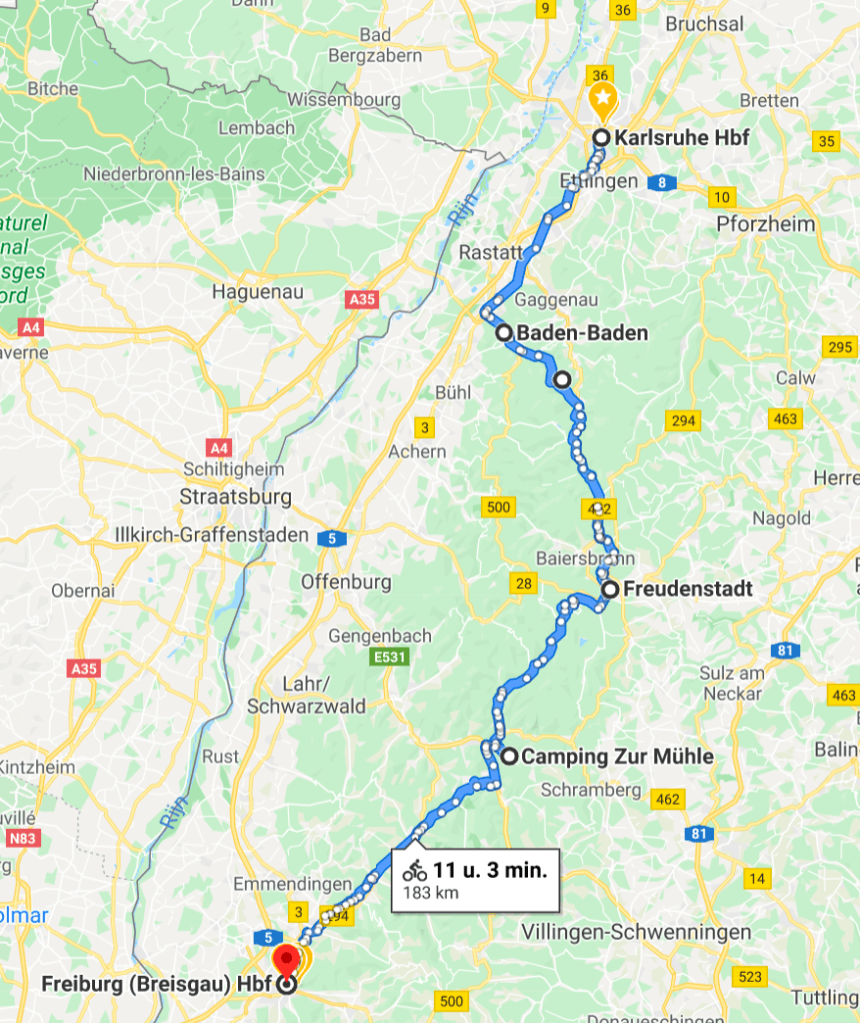
Spread over a full week we took the following route:
Karlsruhe
Baden-Baden
Freudenstadt (camping Langenwald)
Wolfach (Camping Zur Muhle)
Freiburg (2-day city trip)
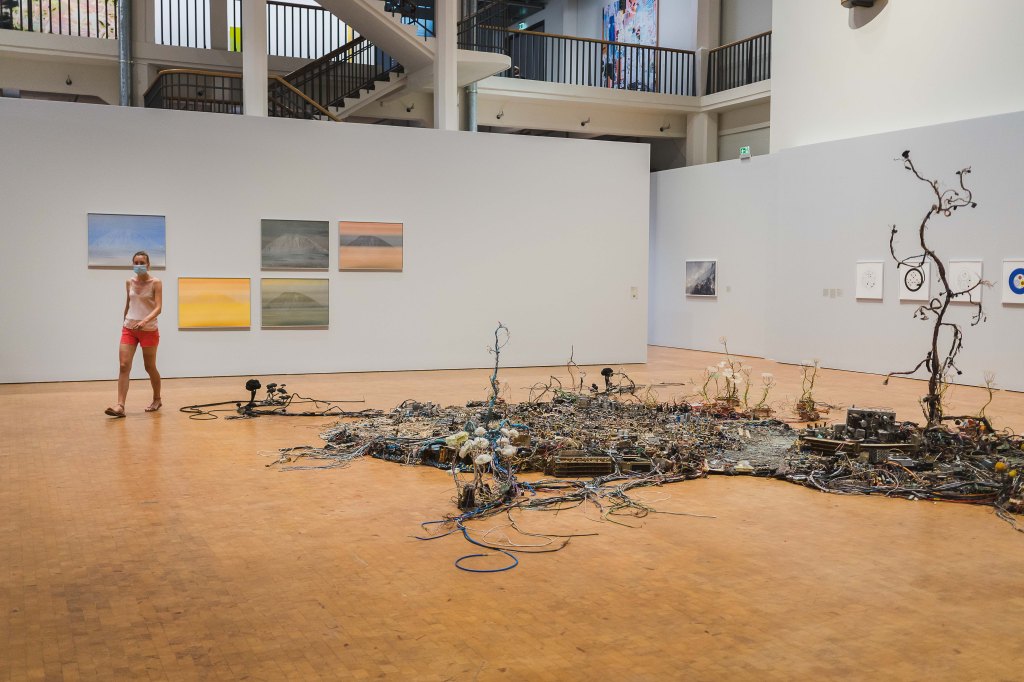
Museums in Karlsruhe – Make sure to check out the ZKM Centre for Art and Media
To spread the trip and keep time for some hikes, we took the cycling very slow. Sometimes we only cycled for an hour or two in a day, e.g. the trip from Karlsruhe to Baden-Baden.
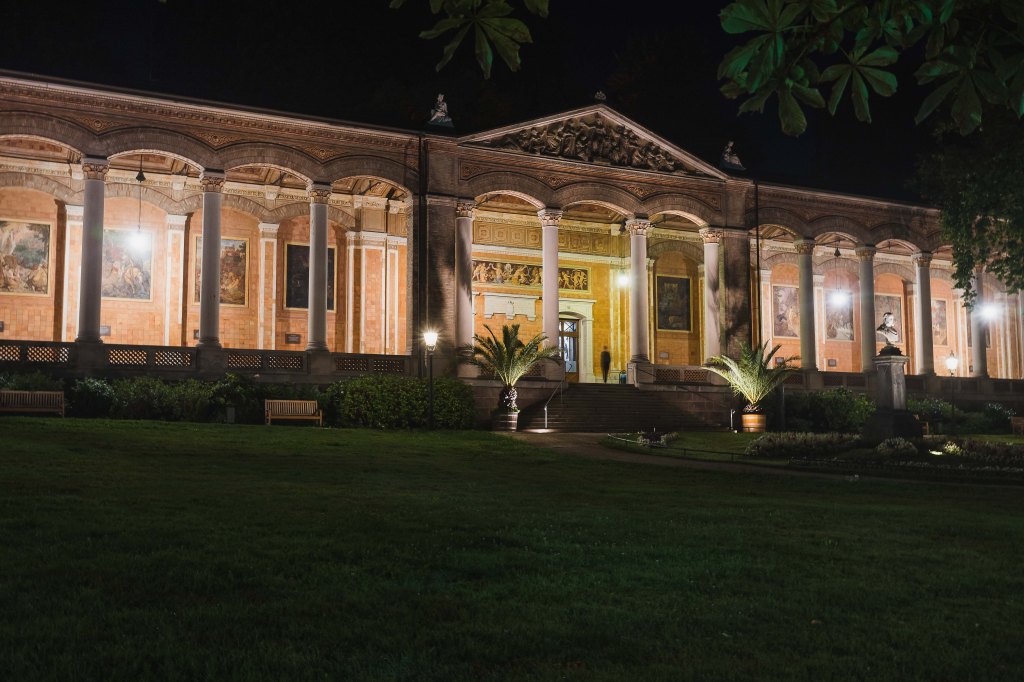
The Trinkhalle of Baden-Baden
Baden-Baden used to be a fancy bathing city where travellers from all over Europe would go relax in the Roman baths. So we checked-in at Hotel Beek and went to the local baths just next door.
Baden-Baden
The city has plenty of old architecture, with some old hotels, springs, baths, a casino, etc. so we did take plenty of time to discover and stroll around by daytime, at night and again the next morning.
After climbing up 500m, going down another 500m and slowly climbing 500m again by bike, we arrived at camping Langenwald. It’s a lovely natural camping with the best bathrooms we have ever seen in a campground. The place is great to hike in the woods and mountains, with routes leaving straight from the back exit.
Happy face, sunburnt legs
After spending two nights in camping Langenwald we continued to our next stop, before heading to Freiburg. On the road we stopped to visit a bear sanctuary, which was nice, since they try to give mistreated bears a better life… but, even on a big plot of land, it’s still sad to see captured bears. Therefor I’m not going to promote it here.
On our way to Freiburg we had to do quite some climbing again. But just like all the other times, the views are extra rewarding after suffering a bit. Luckily we took more then 2 litres of water per person with us, since under the bright sun we were sweating a lot.
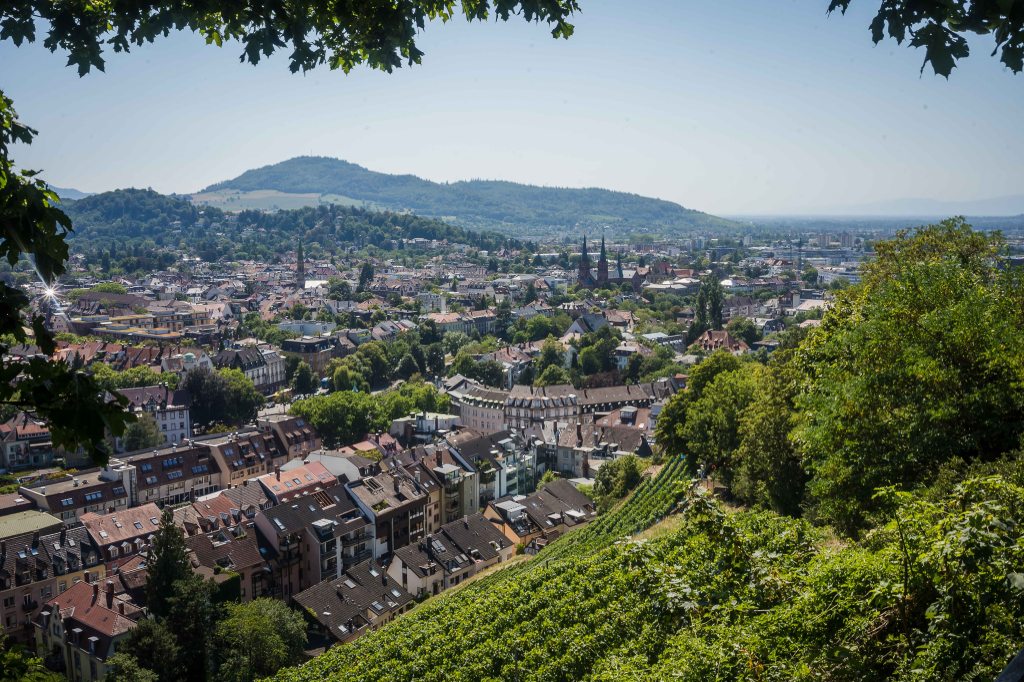
In general we only stayed one night in most of the places, so it was nice to stay multiple days in Freiburg. The city has lots of both new and historical highlights. The Vauban quarter is a sustainability hotspot with plenty of innovative ways of building, living and circulating. The historical centre and the hill-side view are another must see.
If the weather invites you to cool down: buy some beers and swim at the wasserterrassen in der Dreisam.
Wasserterrassen in der Dreisam
And since we like to spend more money on food then on hotels, we were happy to discover that Freiburg had quite some nice restaurants as well: Wolfshohle as a fine dining restaurant with a star, The SKAJO rooftop bar, breakfast at Manna, … plenty of nice places to discover.
Our original plan was to cycle back to Belgium through the Vosges region, but COVID numbers made us change our plans, and stay longer in Germany. One week before heading back home, we went to the railway station for some information on how to get back to Aachen, with our bikes on the train… And we discovered every realistic train connection was completely booked weeks before. We decided to go for the adventure of taking 7 trains in a row to get back to Brussels. And surprisingly, there were no delays what so ever. Transfers went smooth and there was plenty of space for the bikes. Sometimes we had to take off the bags to make some space for fellow travellers, but overall it was a positive experience. On top, the views from the trainride along the Rhine were impressive.
We were not alone traveling with our bikes on the trainViews from the train driving along the Rhine for most of the route
This was our first real cycling holiday of more then a weekend, so we didn’t really know how we would feel about it. No need to say more than quoting Tine on the way back: “Hey why don’t we do the same along the Donau, or the Thames”. I’m sure this kind of trip will be repeated.
Very shortly about our gear:
Tine’s bike had two big waterproof Ortlieb bags at the back, I had a bit more space with 5 Ortlieb bags dressed all over my bike. We took all our camping gear, clothing, lots of food and water.
For the Eurovelo 15 you certainly don’t need special bicycles at all, since it’s mostly flat and you just decide what camping gear you want to take along. My Surly did well, and our Schwalbe tires even better: not a single flat tire during the full two weeks.
Next to sharing a cycling route, I want to share a couple of logic principles that I realised while cycling around in Flanders during my last trip. Find the three key concepts at the end of the article.
For this trip I randomly searched a route to go from Brussels to the desolated village of Doel. Then I continued to the closest camping spot and from there the next day to another campsite not too far from Brussels, so I could make it to Grimbergen on time for Christmas evening.
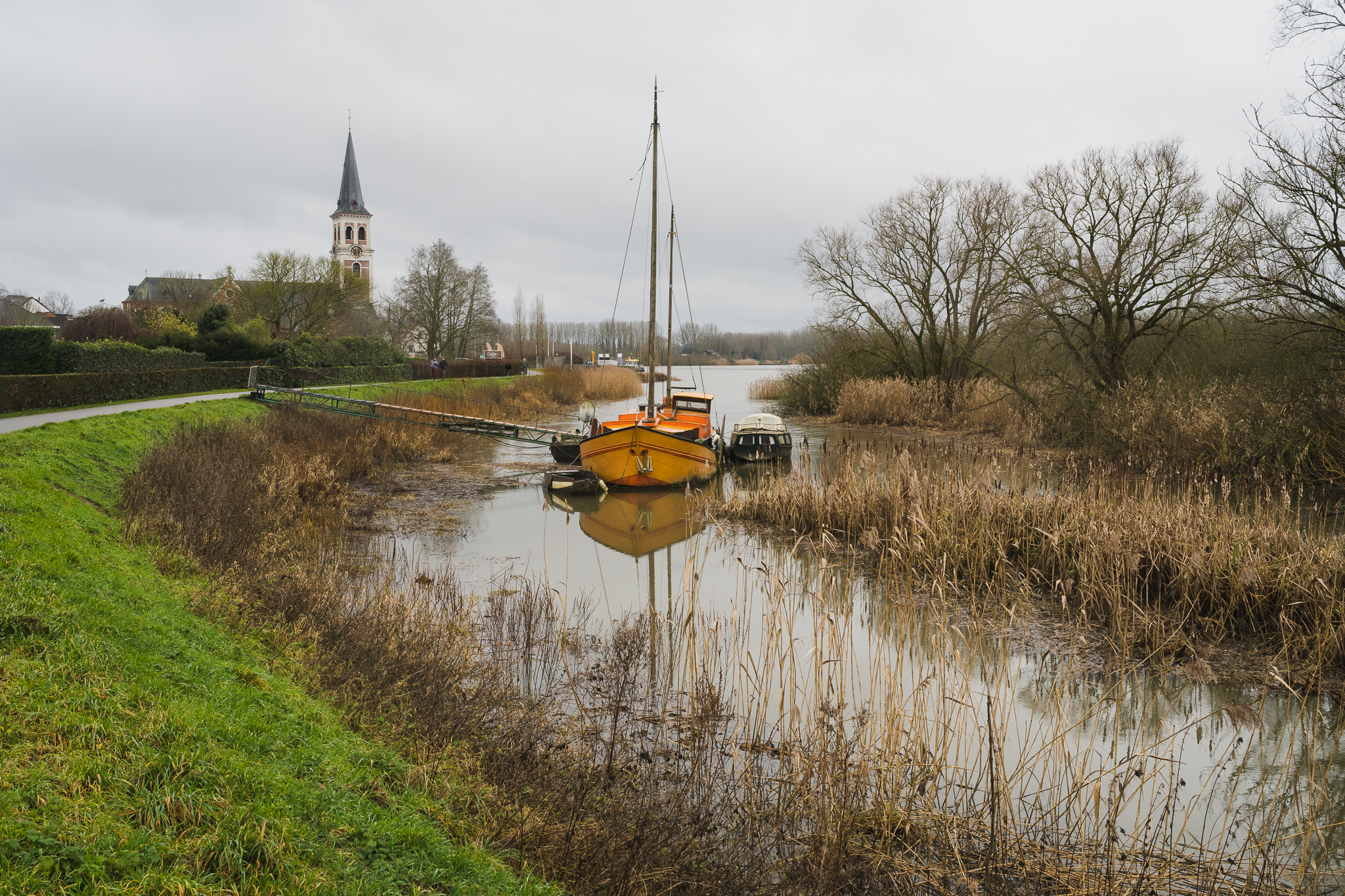
Planning the trip, I soon saw that on day 1 I could follow a very long part of the Schelde river, and on day 2 I could follow the Dender. In between I found the network of old railroads that are now cycling routes.
Day 1: 95km. After leaving Brussels, it takes a couple of kilometers before you end up in the countryside, but as soon as you reach the banks of the Schelde in Briel it’s all nature. You cycle past Sint-Amands on a perfect trail that continues for kilometers.
Depending on the time you have, you can take a straight route to Doel from Temse, or continue until Kruibeke. Before arriving in the desolated city of Doel, you cycle through the Port of Antwerp, along railroads, cranes and industry. In rainy weather it has something moody but beautiful.
From far away you see the nuclear power plant of Doel as a landmark on the horizon.
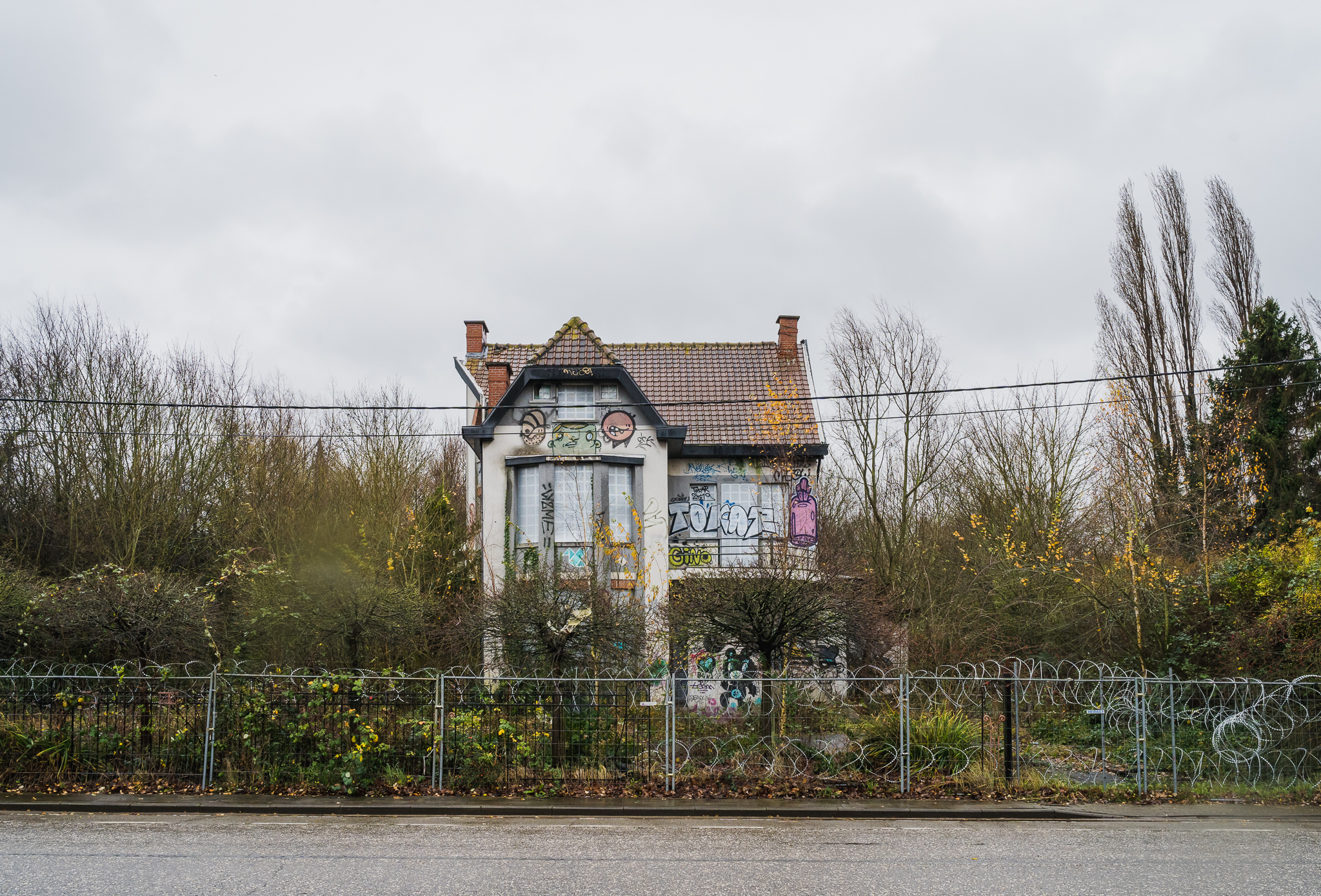
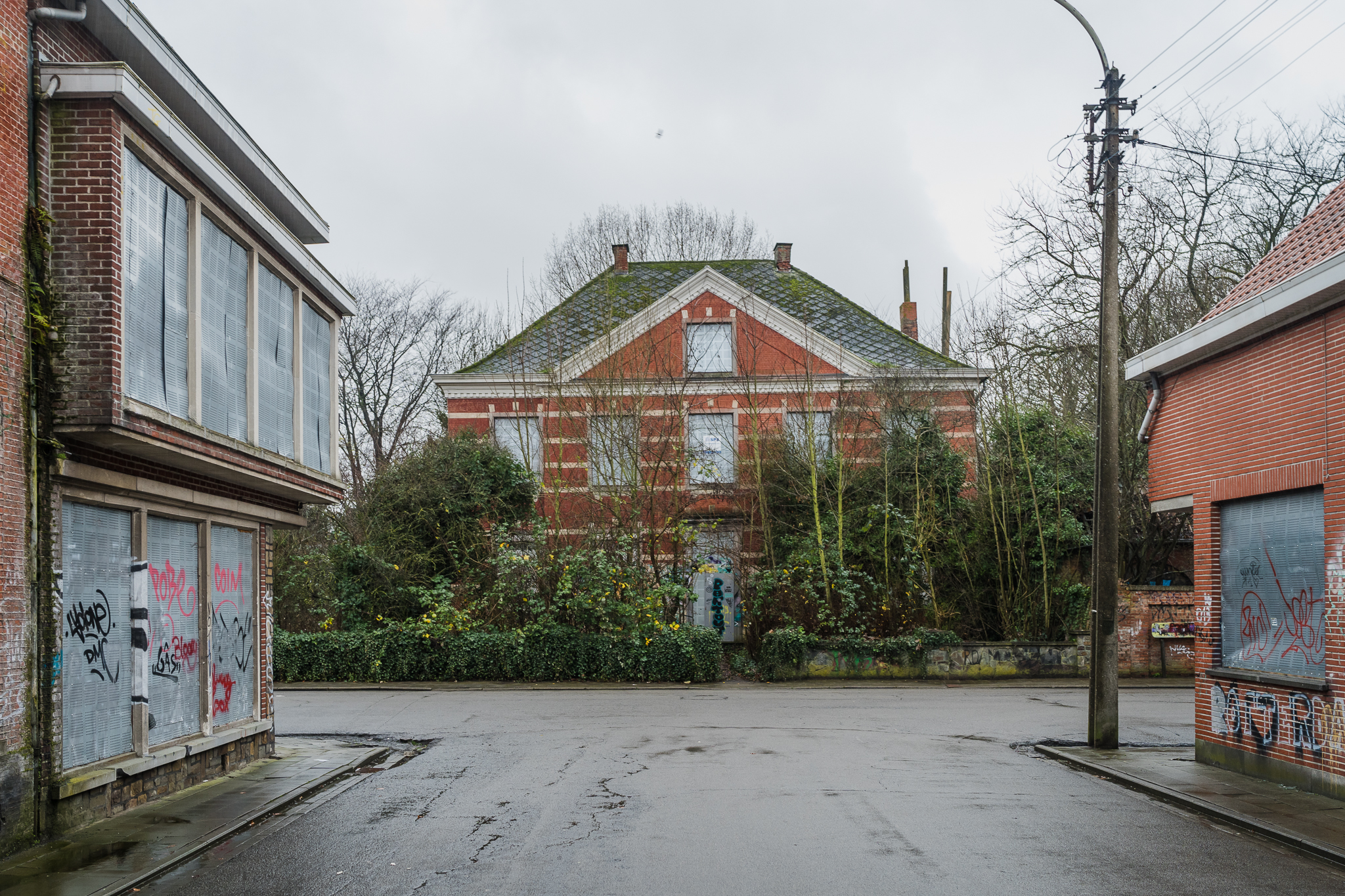
A couple of kilometers further you enter into the main street of Doel. There you find almost all houses locked up and spooky. This is where a controversial story starts of the extension plans of the Port of Antwerp.
If you do not know the story, just search for ‘Doel’ in Wikipedia. A long story short (sorry): the whole village had to disappear to construct a new dock for large ships, property has been bought and villagers left. The construction permit was not granted and plans were not executed. Very few people stayed, but some new people live there now, with very low rental prices. Nevertheless, the place is very desolated and looks like a ghost town.
After visiting the village, I cycled to the camping spot of “Bivakzone Stropersbos”. Just before entering into the woods, I warmed myself with a good diner in De Boshoeve. It had been raining all day, my feet were soaked and in the tent it wouldn’t get any warmer.
The campsite is located in the middle of the forest with rivers and lots of water surrounding it. It had been raining for days in a row, so I was lucky to find 2 square meters that were not muddy to pitch my tent. With a good winter sleeping bag I managed to stay warm during the rainy night.
Day 2: 60km. On the second day I followed the old railroad to Sint-Niklaas. From Dendermonde to Okegem, I took the route following the Dender river. This route is at least as beautiful as the one next to the Schelde.
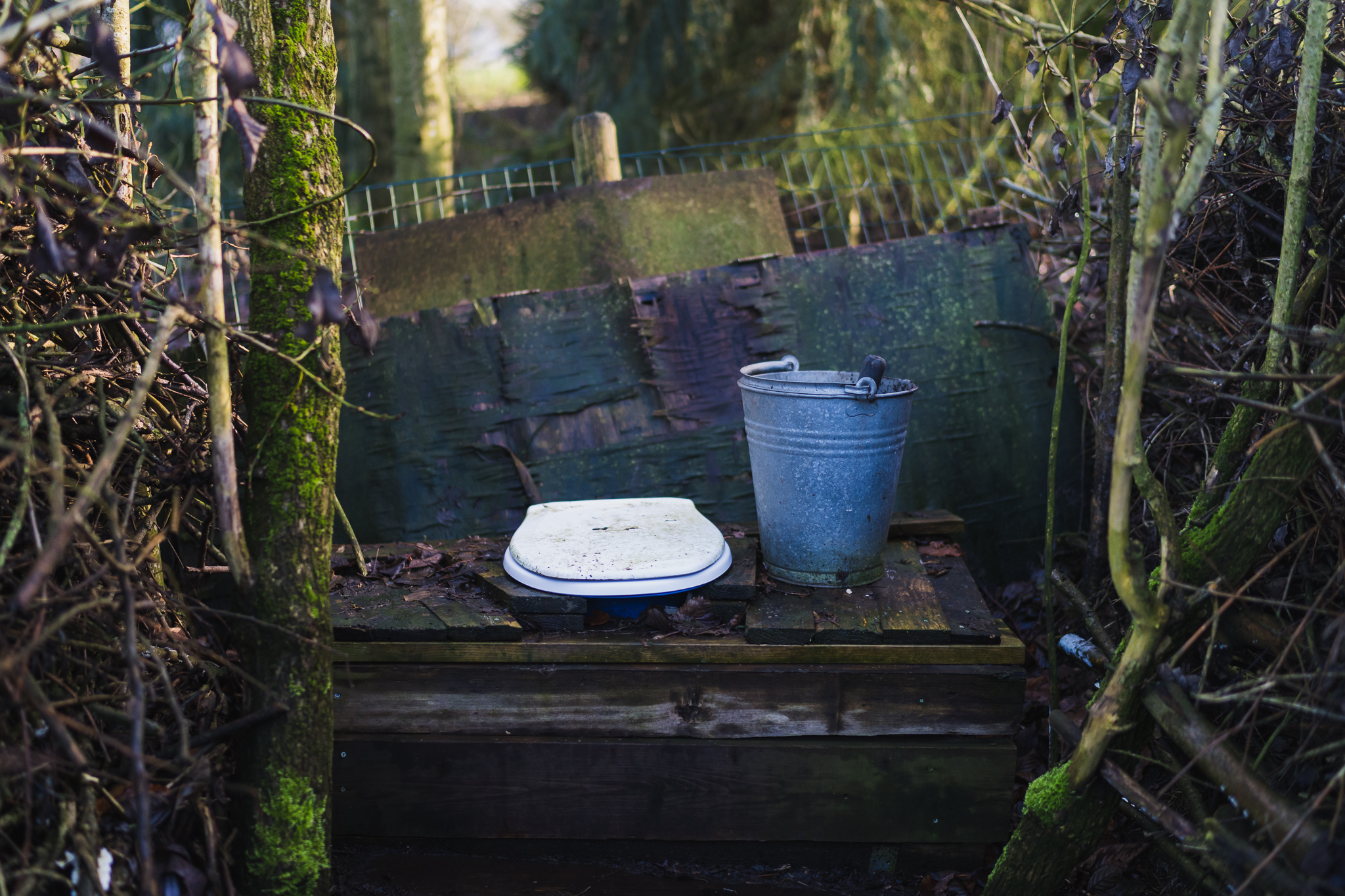
I camped at the campsite of Neighembos with views over the Dender valley. It’s located in the back of a private garden, but with an SMS reservation you can stay there for free.
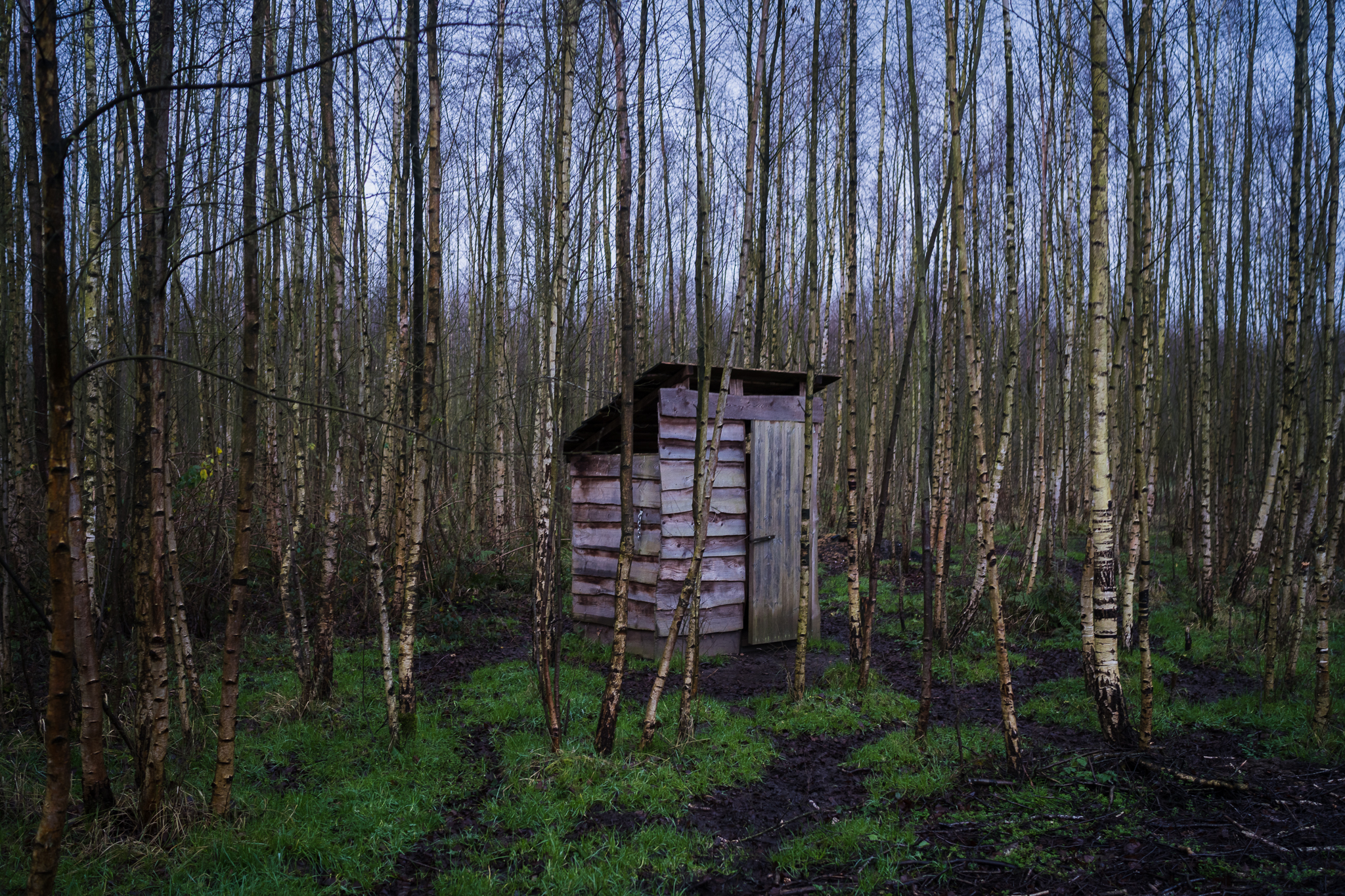
The open air toilet certainly has its charm, but on rainy days you don’t stay there very long.
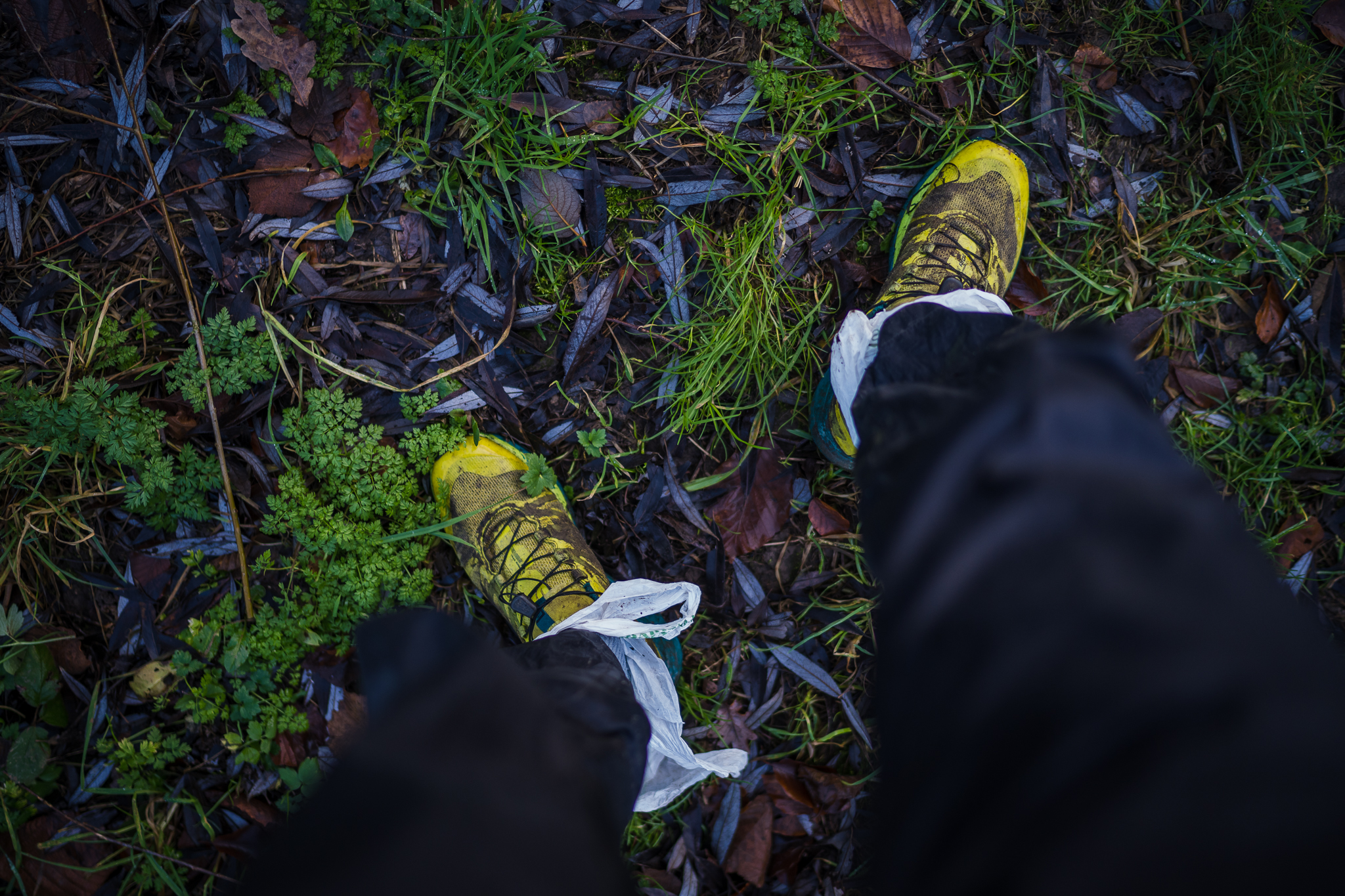
Day 3: 40km. It sounds like a very short route, but with ripped plastic bags in my shoes and wet feet for three days in a row, I was happy I wasn’t at the other side of Belgium. Again a good lesson learned: proper gear does help. Either rain covers for the shoes, or rainproof shoes.
Cycling around in the neighbourhood is fun: villages with the names of “Woestijn” (= desert) and “Drie-Egypten” made me frown, but the place is beautiful.
On my way back I circled around Brussels to go to Grimbergen.
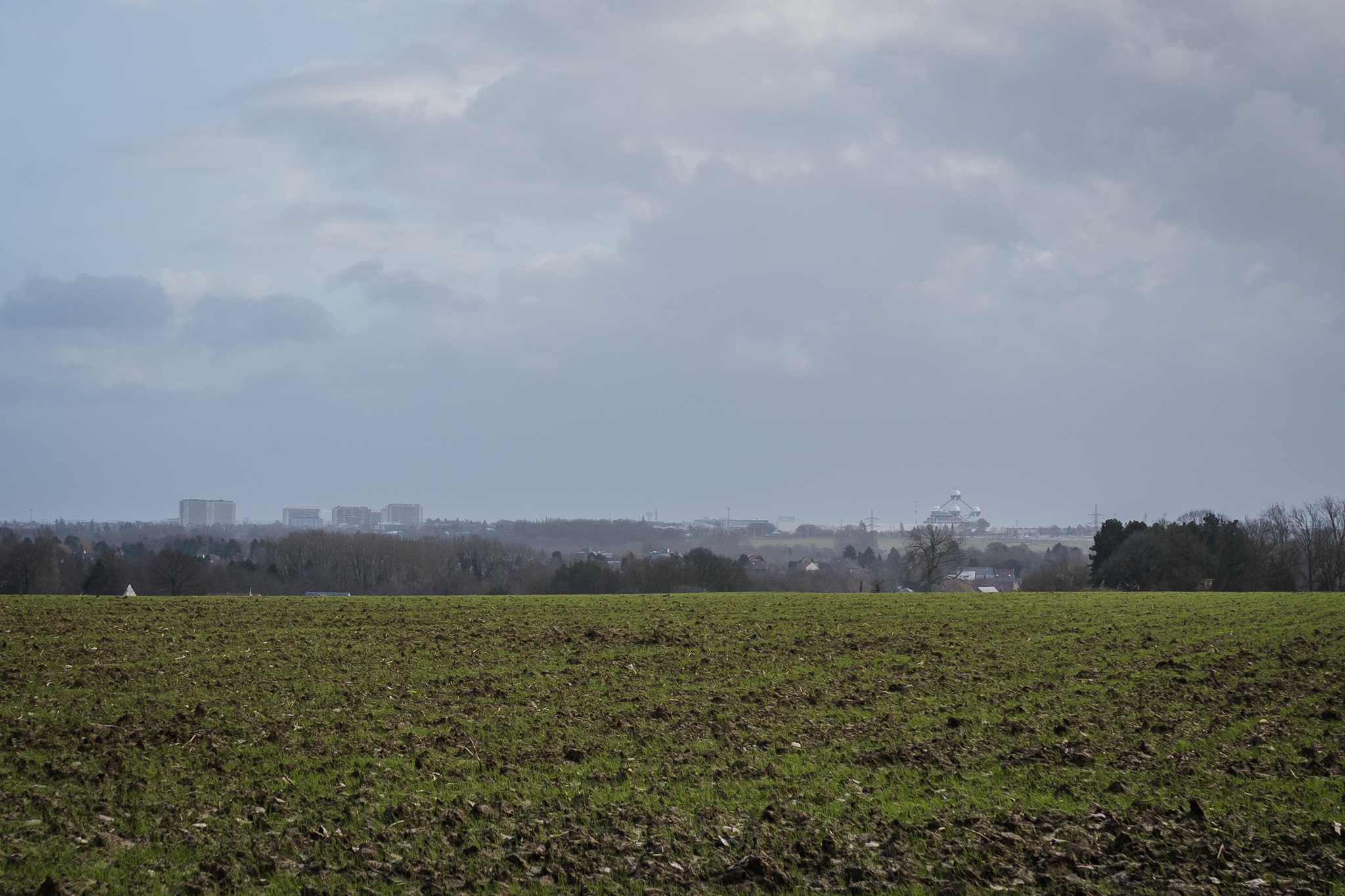
Before getting to Grimbergen I discovered one of the most beautiful views on the skyline of Brussels: de Heirbaan in Meise. While cycling through nature you see all the landmarks of Brussels in a tiny version next to you, which makes Brussels look very small.
To conclude, this was a nice route, getting lost on my tour bike, camping in nature and reading books in the tent while it’s raining and 3°C. I’ll do this route again during the summertime.
The three concepts that can make your cycling trip a blast, no matter if it’s a one day trip or a full week holiday:
1. Paalkamperen: plenty of beautiful nature camping spots spread over Belgium. You can use them for free all year round. If you start planning a cycling-camping trip, it’s a good way to start planning around some good sleeping locations. All of them have a dry-toilet, a dedicated camping zone, some have a fire pit or a bbq. Check out the map on bivakzone.be. A similar system exists in The Netherlands.
2. Old railway lines: you might have found out yourself already that all over Europe old railway lines have been converted to cycling paths. Most of them cross nature in a safe and efficient way, so if you use them for longer distances it ensures you of a nice trip. Check out this overview for Belgium or if you want to try it out in another country: UK railway lines. If you would rather cross Europe on even longer distances, than make sure to have a look on Eurovelo. You can find routes that go straight from Brussels, over the Alps all the way to the heel of Italy (Eurovelo 5).
3. Canals: take a map, see if there’s a waterway and chances are big there’s a nice cycling path next to it. I cycled along the Schelde and Dender rivers for hours. It’s fast and it’s beautiful.
At the end of September we took the direct train from Brussels to Marseille. In six hours we got from rainy Belgium to this lovely port city. We spent 3 days walking, cycling visiting some museums and hanging around.
Marseille is a Mediterranean city full of different influences. A port city with a rough edge. It feels a bit like Brussels but with better weather. A port city with all of its colourfull aspects: diverse cultures, incredible architecture, beaches, restaurants. We could live here!
Day 1
On our first day we arrived around lunch and registered for the Velib bike sharing system. It only costs 1 euro for seven days. (30 min for free, same bikes as in Brussels, same way of unlocking etc.)
The direct train we took from Brussels to Marseille was rather pricy at our time of the year, so we paid more than 200 EUR per person going and back. The comfort on the other hand is great: you step into the train in Brussels-Midi with a coffee and a nice breakfast, and you arrive in the center of Marseille by noon.
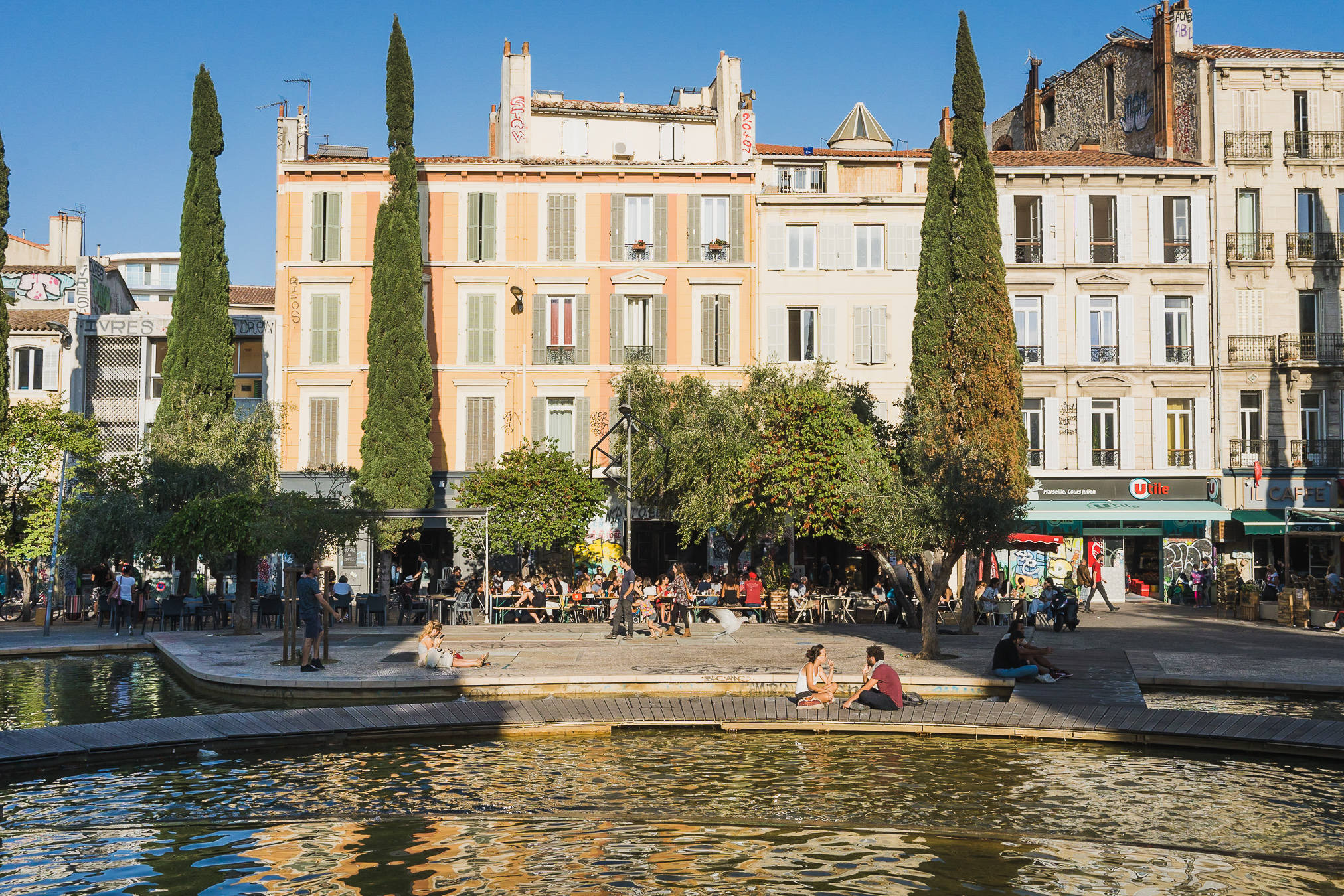
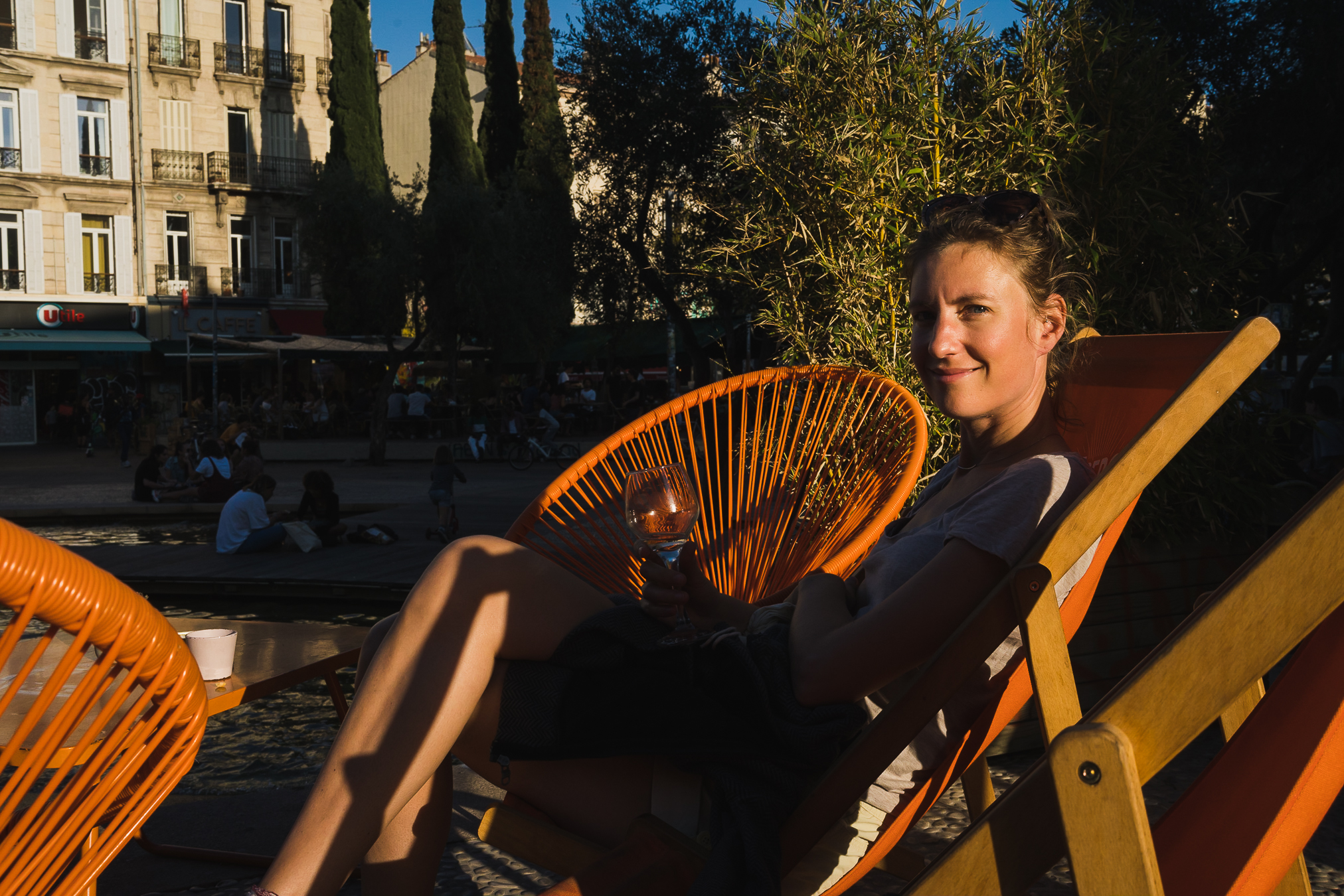
We checked-in in our Airbnb and started discovering at the Escaliers du Cours Julien. Colourful stairs lead to an arty neighbourhood with nice terraces around a fountain where we had Aperol’s at L’escalié.
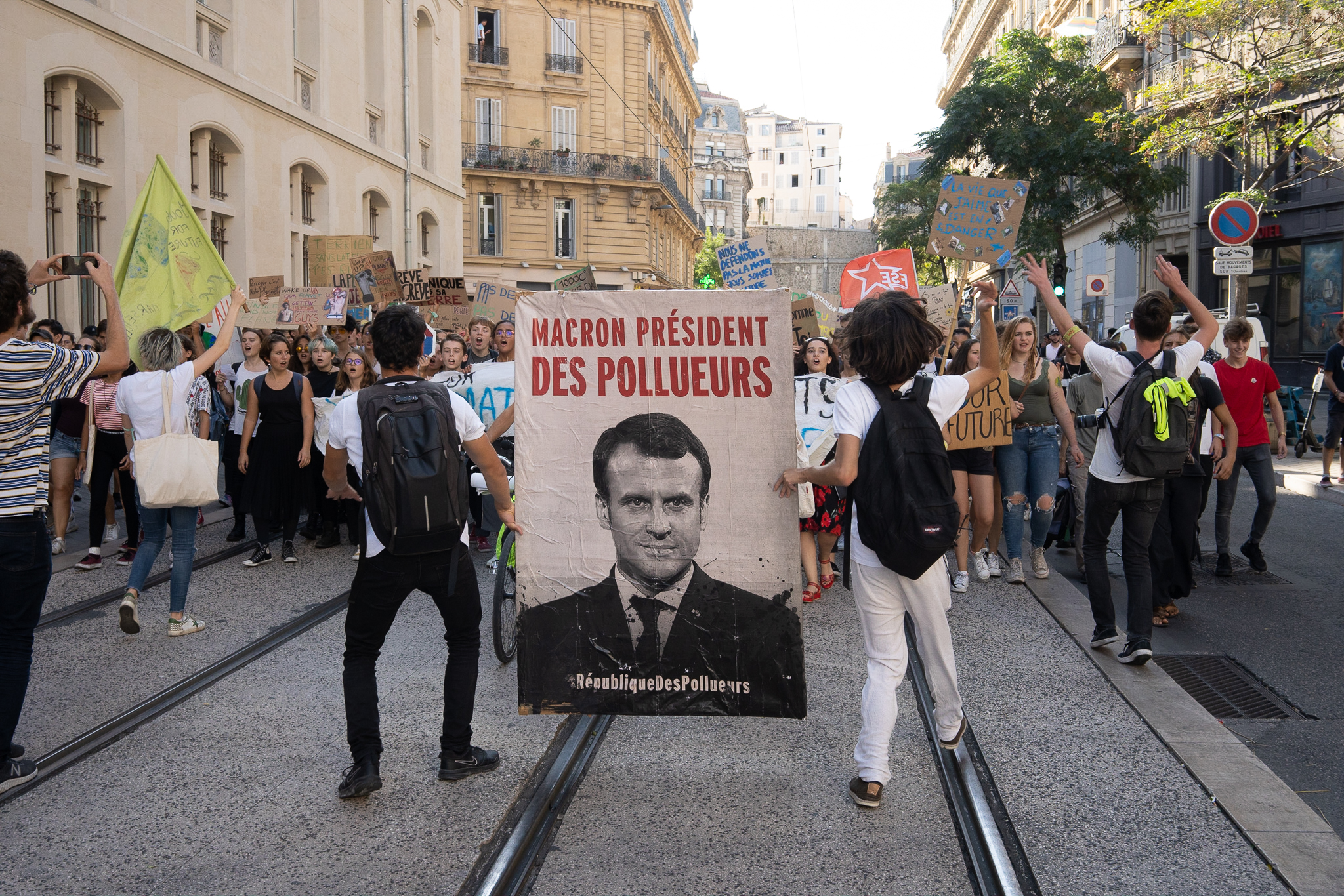
In the meantime we joined the local Youth for Climate strike at L’Ombrière to take some photos of their protest and continued our visit of Marseille.
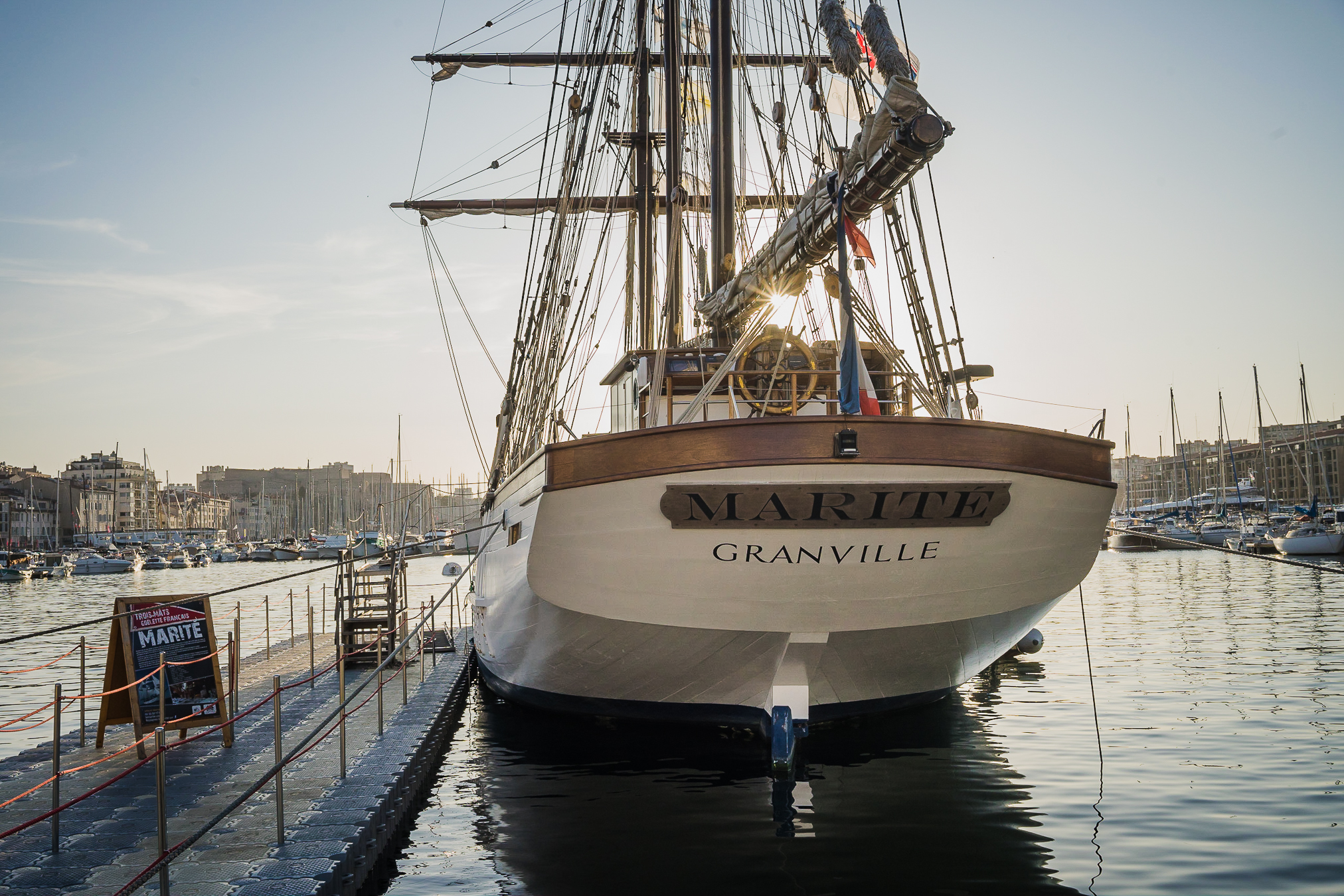
Afterwards we spent some time around the Vieux Port, the old harbour. It’s a nice walking neighbourhood, but hotels and restaurants around here tend to be touristy (and more pricy).
For dinner we just strolled into the backstreets around our airbnb and for convenience picked out a good looking Brasserie (similar to the ones you find all over Paris).
Day 2
A piece of impressive architecture of Le Corbusier is the Cité Radieuse. A very special apartment block designed in 1952 that is still inhabited today, mainly by architecture and art lovers.
When you visit the inside you can observe how different functions were integrated into one building: a supermarket, bookshop, doctor, school, library, … The apartments are duplex’es that are puzzled as Tetris blocks into the building.
After an extensive visit we took a big cycling and hiking tour: From Cité Radieuse to the (foggy) views from the Notre Dame de La Garde, to the MuCem and to Corniche Kennedy.
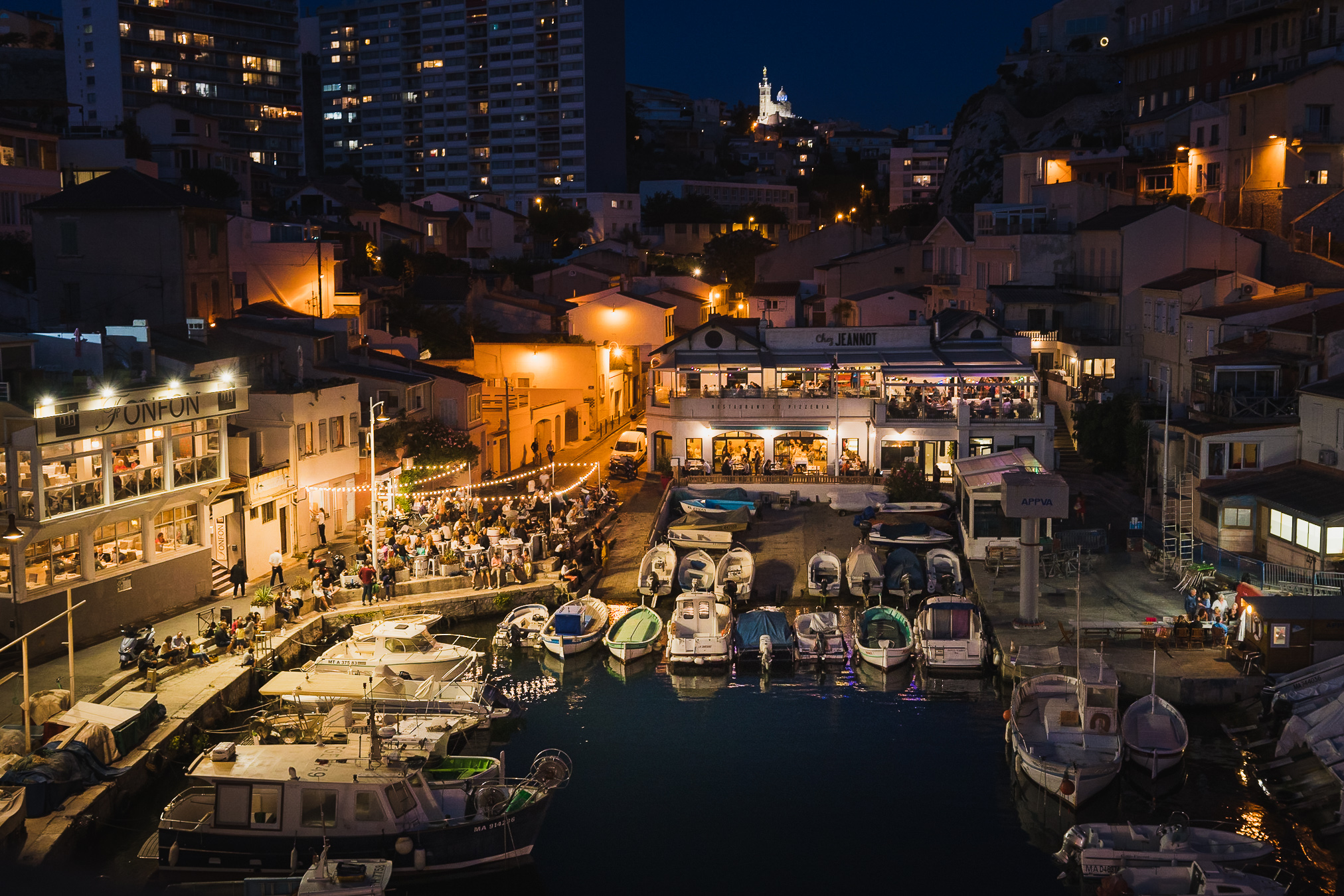
For dinner we went to a place next to the sea at Corniche Kennedy. There is quite some restaurants to pick from, but some tend to be very pricy. We went to Le petit Pavillon – nothing fancy, but views on the sea and good seafood without frills: oysters, grilled fish etc.
Day 3
Our third day we had breakfast in a nice arty airbnb at La Maison du Petit Canard in the Panier neighbourhood. The location is quite good, so this could be a good option to stay for your full weekend.
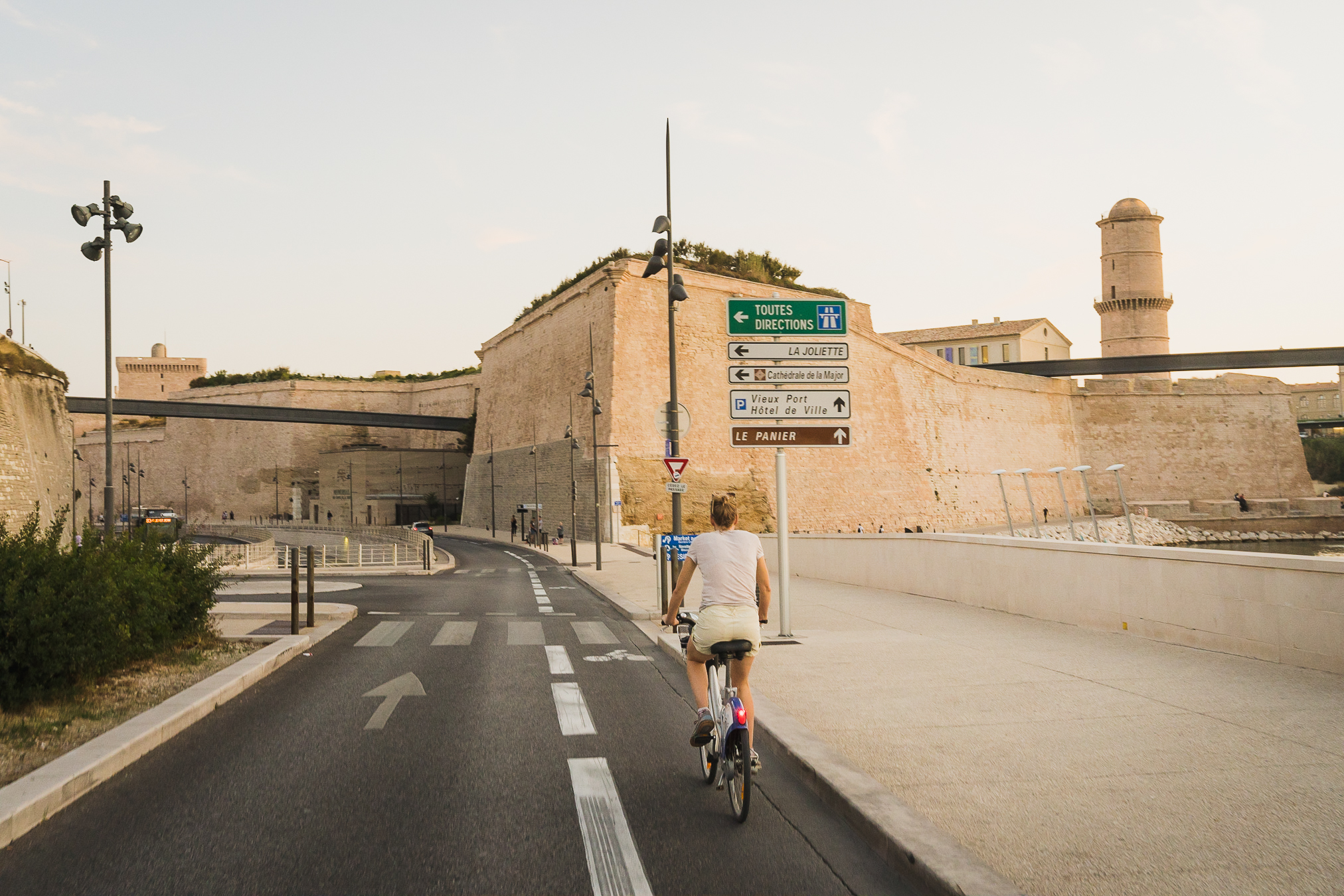
We strolled around the Panier neighbourhood, visited the Cathedral La Major and went to MuCEM for the complete rest of the day: the museum of European and Mediterranean civilisation offers on its own is already worth a trip to Marseille. It has a very diverse range of expositions with art, history and science, multiple restaurants and terraces to read a book, a fortress with gardens and a watchtower with views on the old harbour.
As in Paris, every first Sunday of the month entrance to the museums is free of charge. We visited multiple expositions, joined for part of a tour in the fortress and had a really good buffet lunch in the restaurant on the top floor.
After spending multiple days discovering Marseille we felt we could live there. So who knows in a couple of months or years you can come visit us here in Marseille!









































































 Carbon Conscious Travel